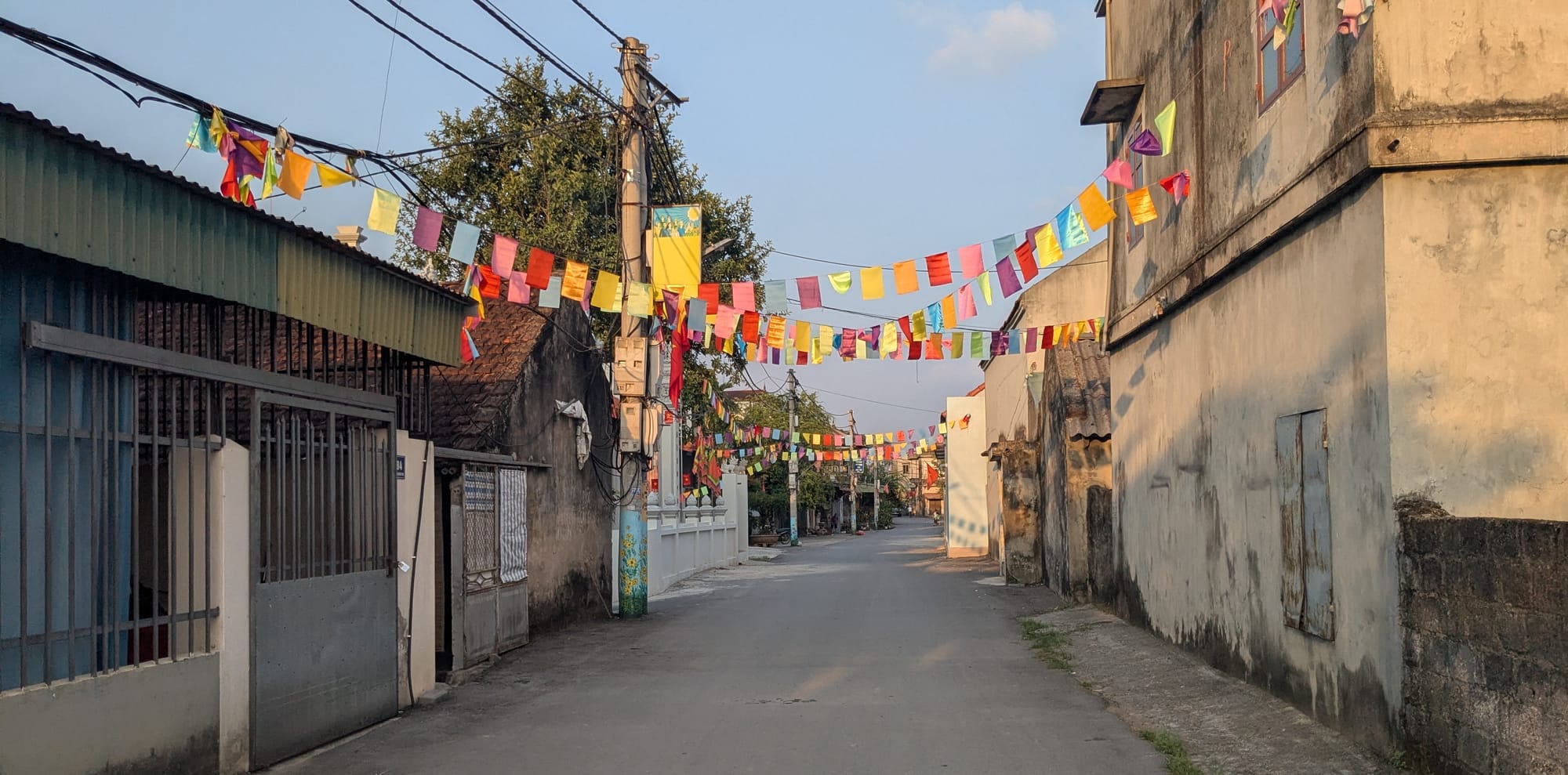
Viet Nam Diaries 2.3: Main Character

Saturday, October 3
I head into the city on the weekend and check in to the hotel that the Peace Corps has reserved for me. We are volunteering at a festival for international culture; my shift is in the morning.
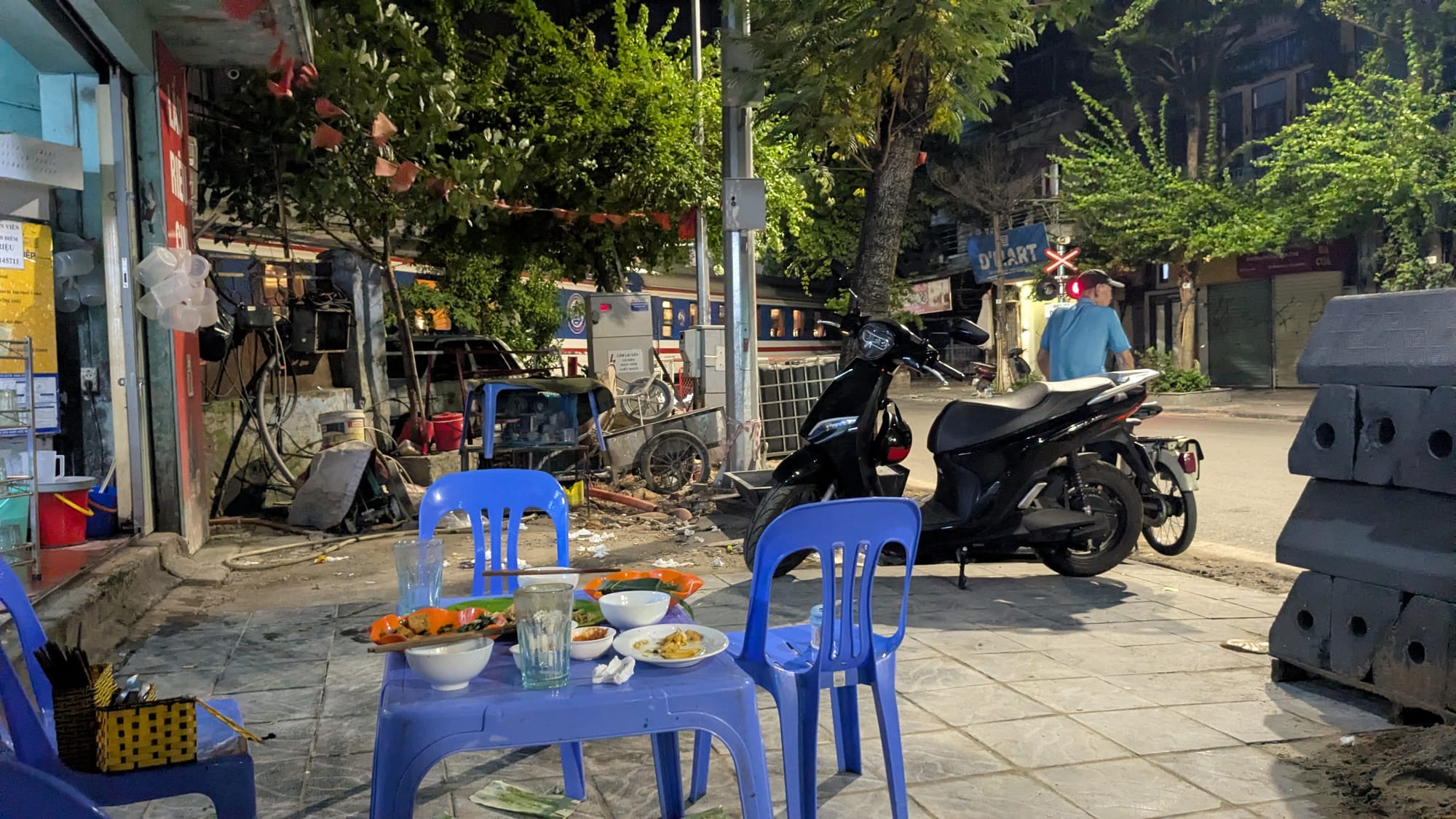
My friend Sean took a Saturday night shift, and when he gets off we decide to meet up to get some food and bia hơi (fresh beer). When I get to the spot he's found, there's already plenty of food on the low green plastic table on the sidewalk next to a railroad crossing. There's a heaping plate of spinach stir-fried with garlic, salt, and MSG for an umami punch.
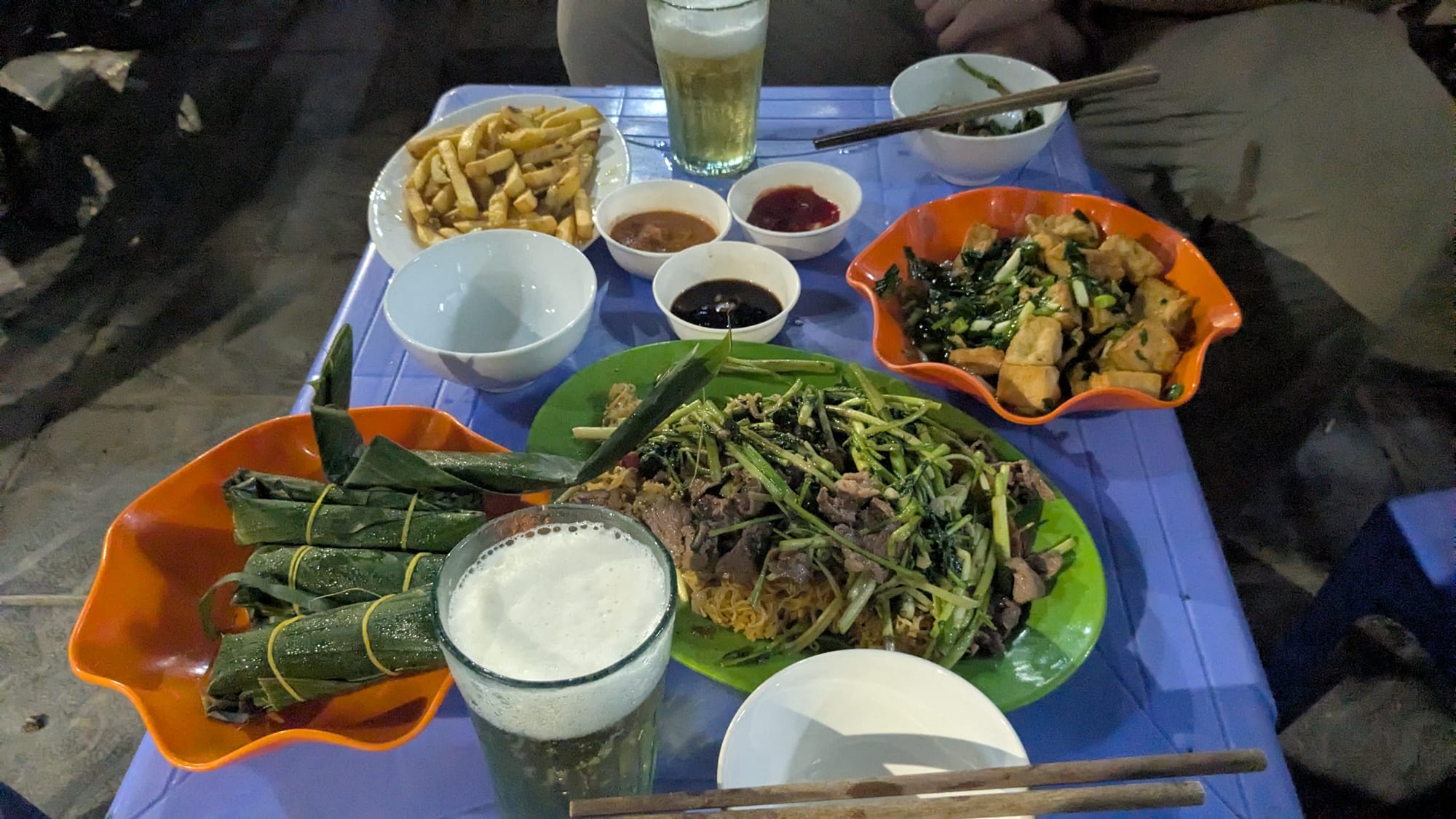
We cheers our little green glasses of beer - the country's signature beer glass was commissioned in 1976 and designed for low production cost, durability and utility (read more here) - and talk about how our last semester is going.
"Hold on, I have to get some of this," I say, reaching for a bundle of nem chua wrapped in green banana leaves. A favorite bia hơi snack, the sausage-like "sour rolls" are made by piping raw minced pork with chilis and sliced garlic into the banana leaves which are wrapped tightly. The meat is then left to ferment, giving it the sour flavor of lactic acid; the banana leaves, acid, garlic & chilis all keep dangerous bacteria at bay. It is a food preservation method from a time before refrigeration, and the flavor is addictive.
Sean offers a small dish of red Chin-su hot sauce, which is sweet and looks like ketchup.
"No thanks, I hate Chin-su. It's too sweet," I say, eating my nem plain and savoring both the flavor and texture of the meat and slices of raw garlic.
"Oh well, you have to try this at least," he replies, presenting another dish with what looks like red salsa. It's a homemade pepper sauce that's tangy and fiercely spicy. Liters of the stuff line the restaurant's shelves in repurposed soda bottles.
"Oh my god! Where has this been the last two years?..."
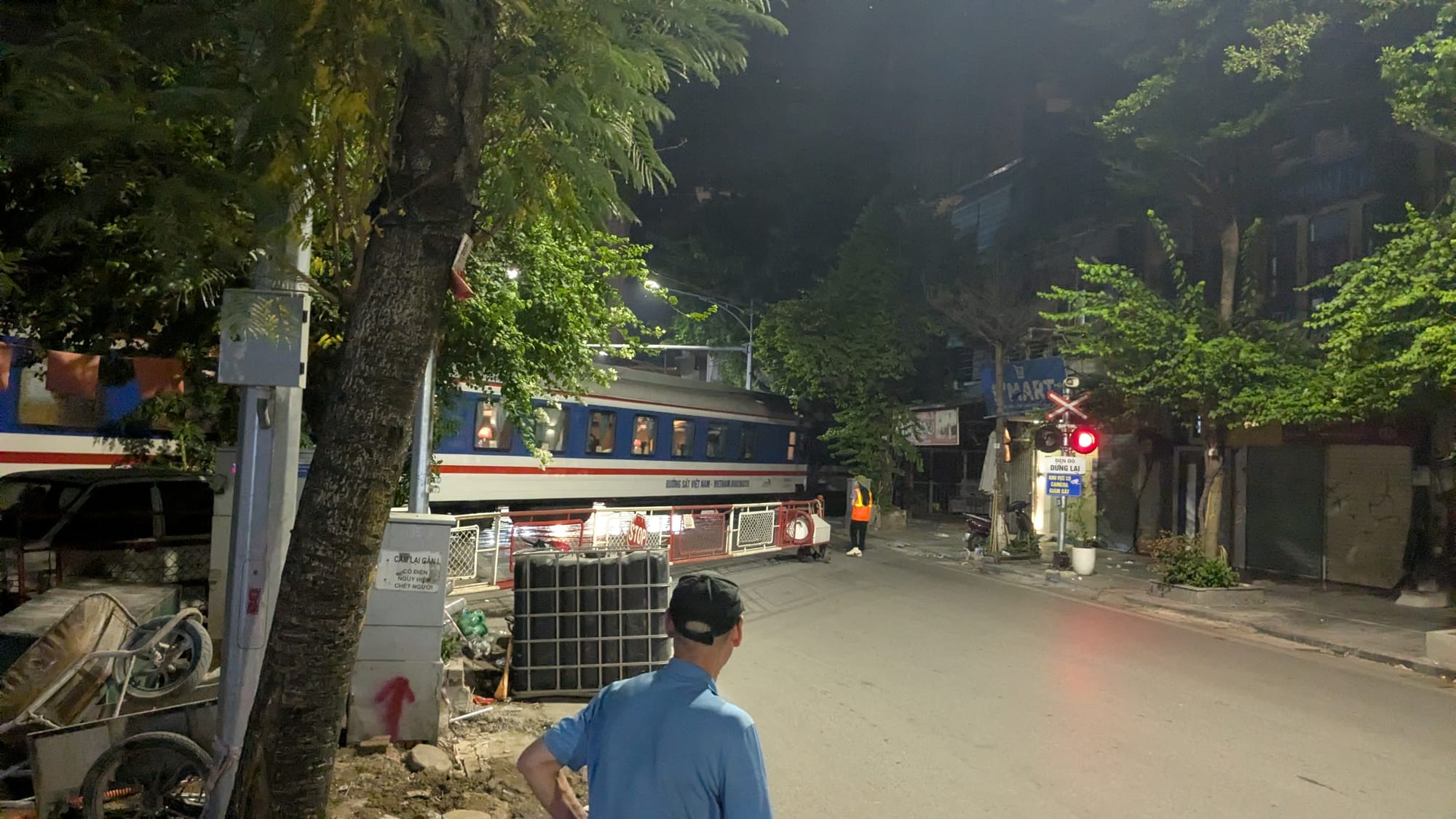
A train crossing bell goes off and a police officer walks into the street, manually moving a metal gate across the road. We are just around the corner from the notorious "train street" where coffee shops line an alleyway just big enough for all of Hà Nội's daily train traffic to squeeze through the city's 'old quarter'.
Comparing notes, Sean and I both have the same bittersweet feelings as we approach our final two months. We are ready to leave and excited to take on our next challenges - while Sean is ready to return home, I'm ready for a complete change of scenery and to make new friends and colleagues in another country.
But at the same time, it will be difficult to leave behind all of the lovely friends and colleagues we have made here in Viet Nam. And it's strange to be thinking about leaving now, as we finally feel "at home" to some extent. We finally know what we are doing in our foreign classrooms; we finally feel confident enough in our Vietnamese to travel around easily and talk to strangers without an app.
Sunday, October 4
In the morning, I take a taxi to one of the city's biggest historical landmarks, the Thăng Long Imperial Citadel. The wide expanse of lawn in front of the old fortress gate is now a mass of tents. Dozens of tents are being operated mostly by the countries' respective embassies. The USA booth is being co-presented by the American Center and Meta.
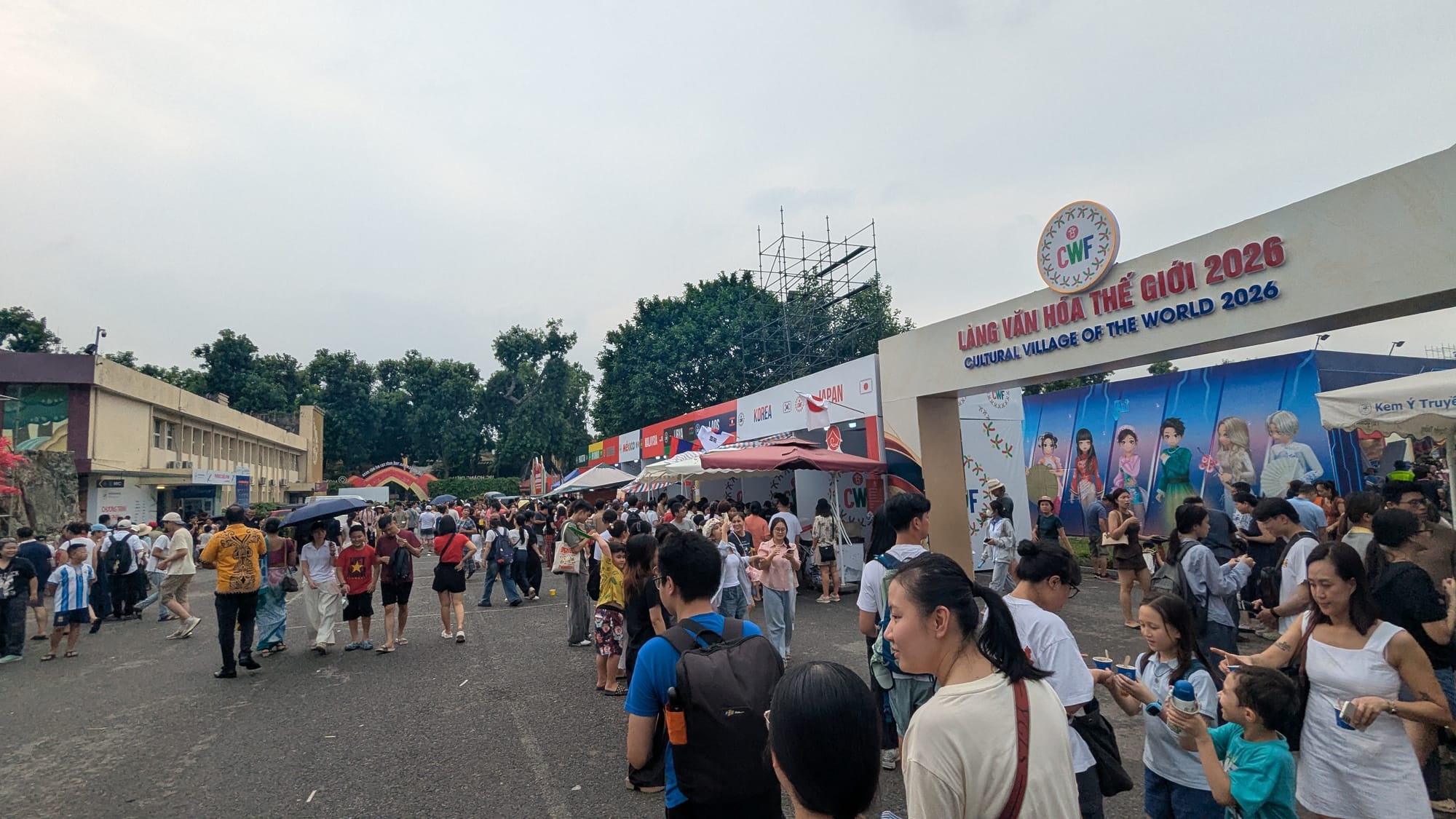
As I walk up, I'm delighted to see somebody I know.
"Em Keith ơi!"
Keith is from the cohort of volunteers that came after mine; he's been here for a year now. Although I address him affectionately as 'younger brother', he's only a few years younger than me so is the closest to my age of all the volunteers.
We catch up and discover that there's not a whole lot to do in the booth today. There are some Vietnamese college students running things pretty smoothly. On one side of the booth, Meta is letting people try out a demonstration of VR with Oculus headsets. "I think they get to see dinosaurs," Keith says.
On our side of the booth, there's a survey and a wheel to spin for prizes. A Fulbright Scholar is also volunteered at the booth who has been teaching English here for 2 months of a 10-month stint. "I think I'll let you go up there since your Vietnamese is better," she says.
Curious locals get a kick out of it when they hear me trying to speak to them in Vietnamese. A sudden downpour of rain starts a crush at the opening to our booth, but the spirit of the festival never sours.
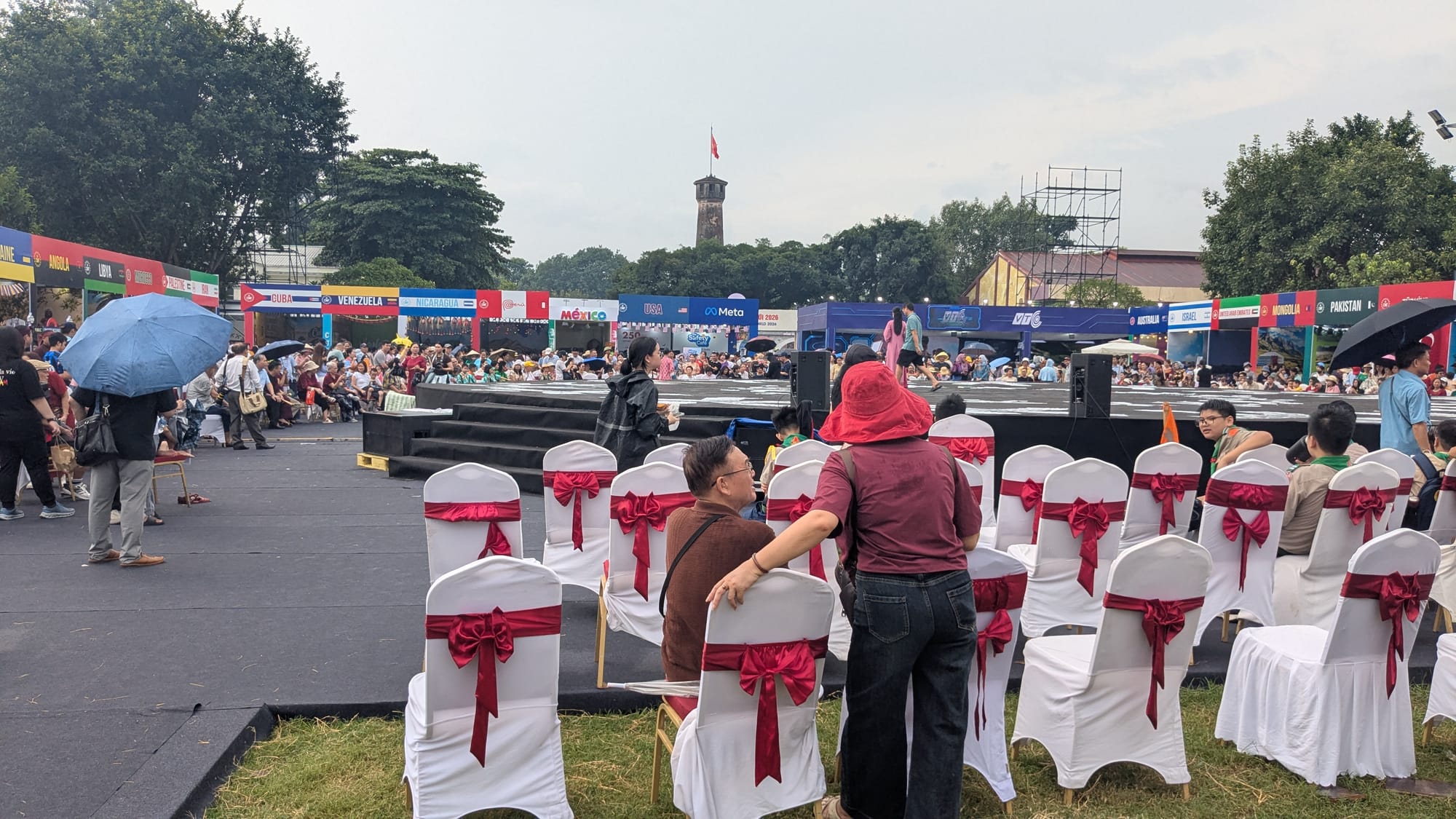
After a couple hours, I take a break from the booth when the rain has cleared up and look around at some of the festival's offerings. On a stage in the center, traditional music and dancing is being celebrated with a diverse array of acts from Latin America, Eastern Europe, and South Asia. Surrounding the stage is a perimeter of country booths.
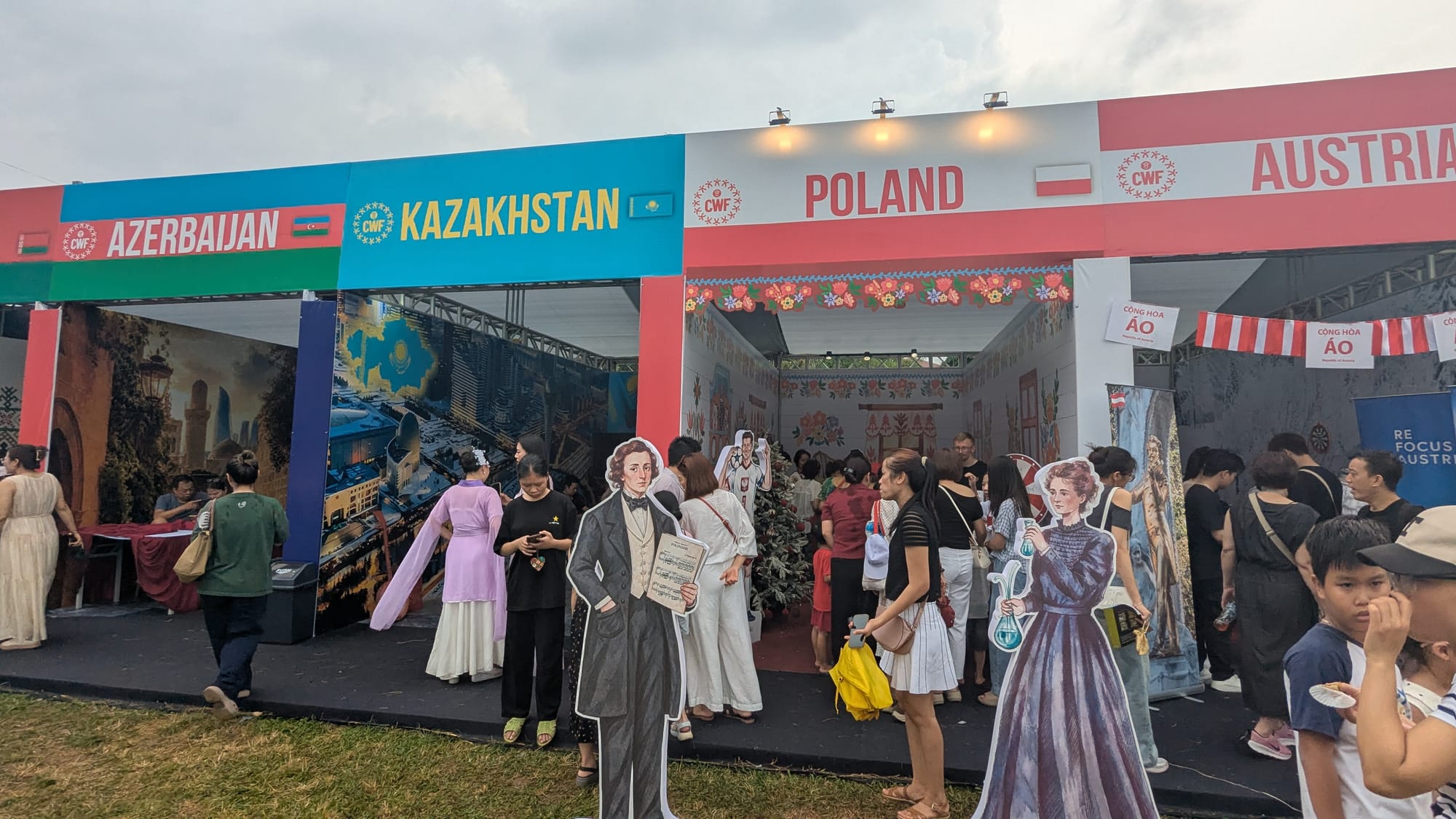
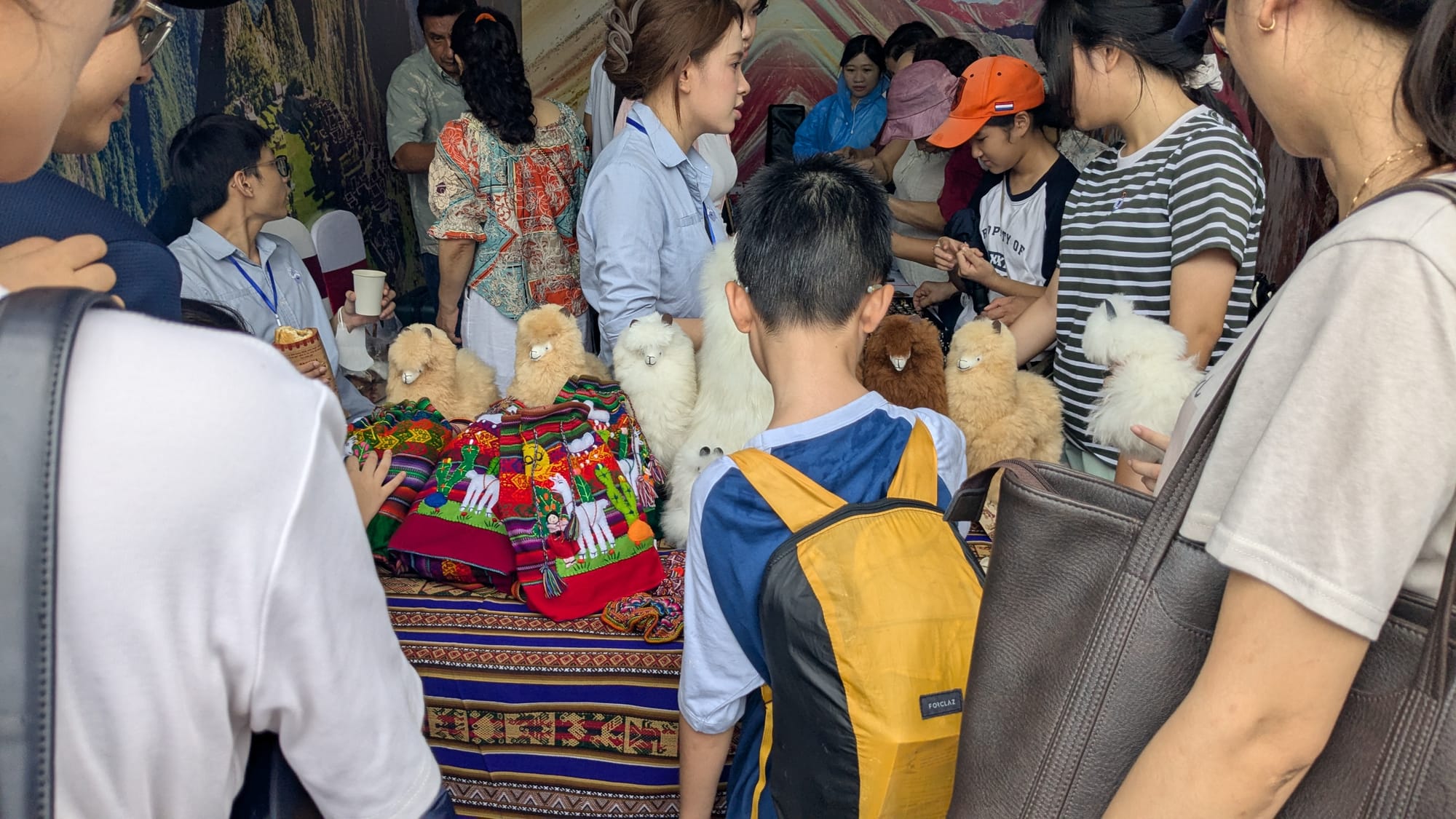
The Italy and Russia booths are attracting the biggest crowds, with full blown stores inside selling souvenir and packaged foods: imported cheese, olives, canned seafood and vodka. The Peru booth is also popular selling colorful handwoven crafts like purses and stuffed llamas. The Ukraine booth is nearby, while booths for Israel and Palestine face off directly across from each other.
Some booths have exhibits of art or photography. The China booth has several mascots walking around to take pictures with you: a giant panda, and the Monkey King from Journey to the West. A few booths are empty except for a lone caretaker looking after the space on a folding chair. I have to presume they had more things going on during the festival's previous days.
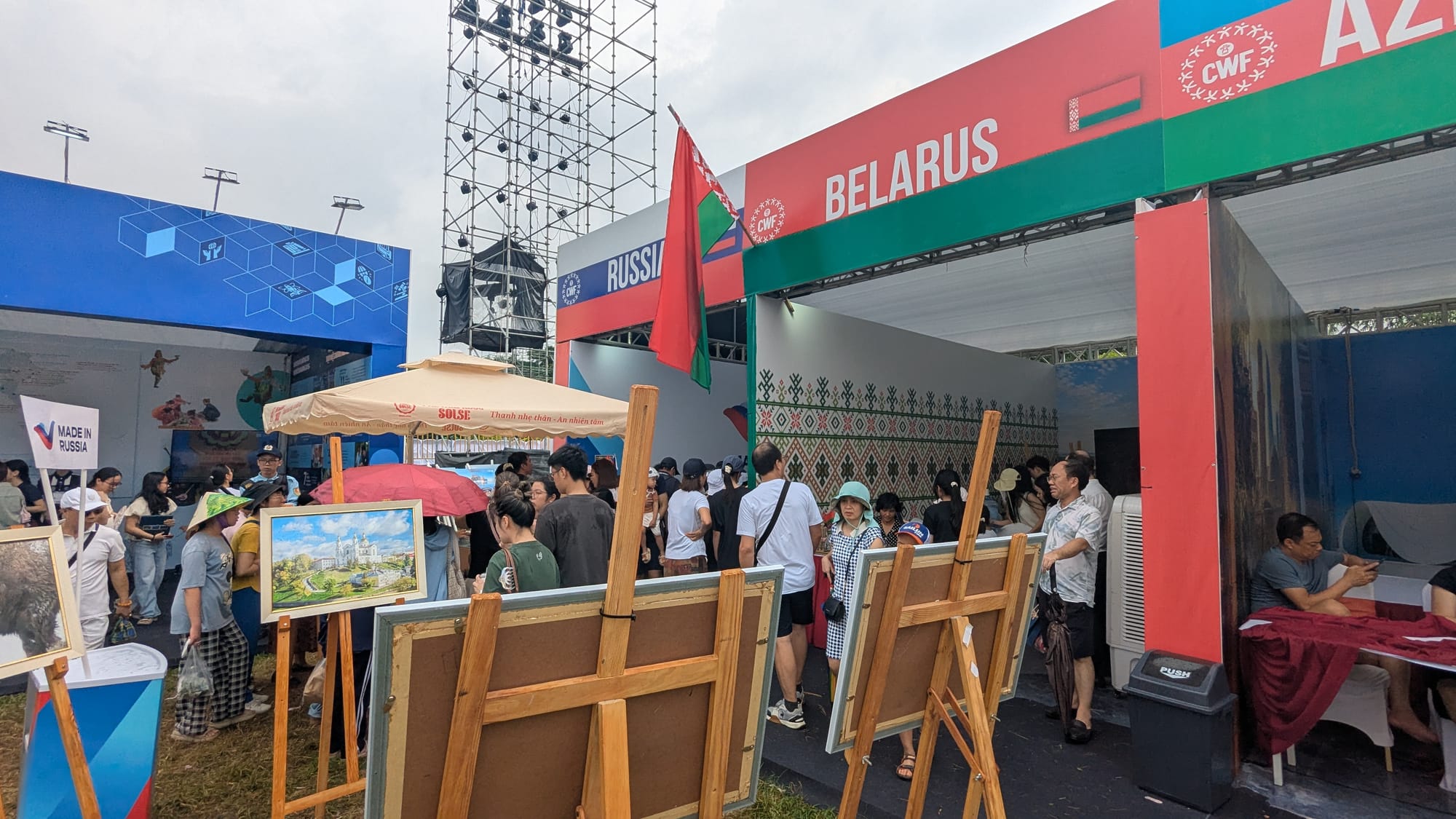
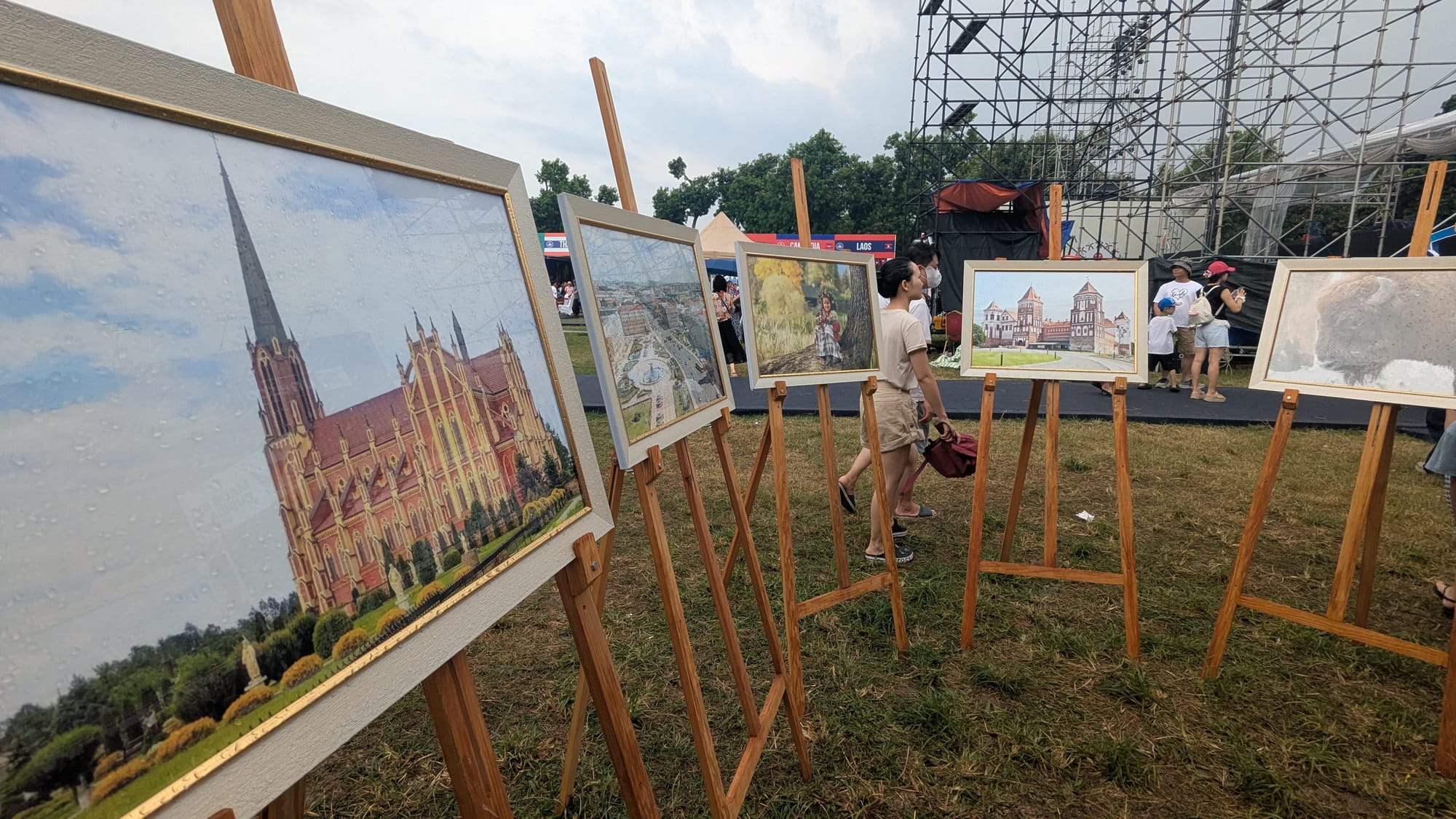
In another area there are separate booths for buying snacks and beverages from many of the same countries. After our shift, Keith and I retreat there with the Fulbrighter for refreshments. Some people are trying pitch black kvas from the Russian booth and making disgusted faces. I beeline to the Peru booth hoping for food. I settle for a Pisco Sour.
We spend some time comparing notes about our programs with her. She also teaches English in schools here, but farther away from the city. "I can't believe they don't let you guys ride motorbikes..."
Monday, October 5
Getting up at dawn, I'm surprised to leave my room and find the weather has cooled considerably. The onset of autumn weather gives me extra energy to cycle into the village to get something for breakfast.
I head to the market, taking a circuitous route to enjoy the trip and avoid the traffic and hordes of students on the main street. It's partly thanks to taking this longer route that I see something I haven't yet seen in my village. An older woman sits in front of her house on the pavement with a wide shallow basket covered with towels.
I know what this signifies and bring my bike to a sudden stop.
"Xôi à?" Sticky rice? I ask.
She says yes, and she and her neighbor have a good-natured laugh at my pronunciation when I ask her for some.
Taking a paper torn from a child's textbook with a bit of plastic film to line it, she scoops a serving of the white rice from the basket. The towels keep the rice warm and moist. Then come the toppings that make this a breakfast I will crave for the rest of my life: A sprinkling of crumbled yellow mung bean paste and a handful of meat floss - pork jerky shredded finely, almost like hair - is then pressed into the top of the scoop. Over that comes a couple of scoops of crispy fried shallots and a sprinkling of fish sauce for saltiness.
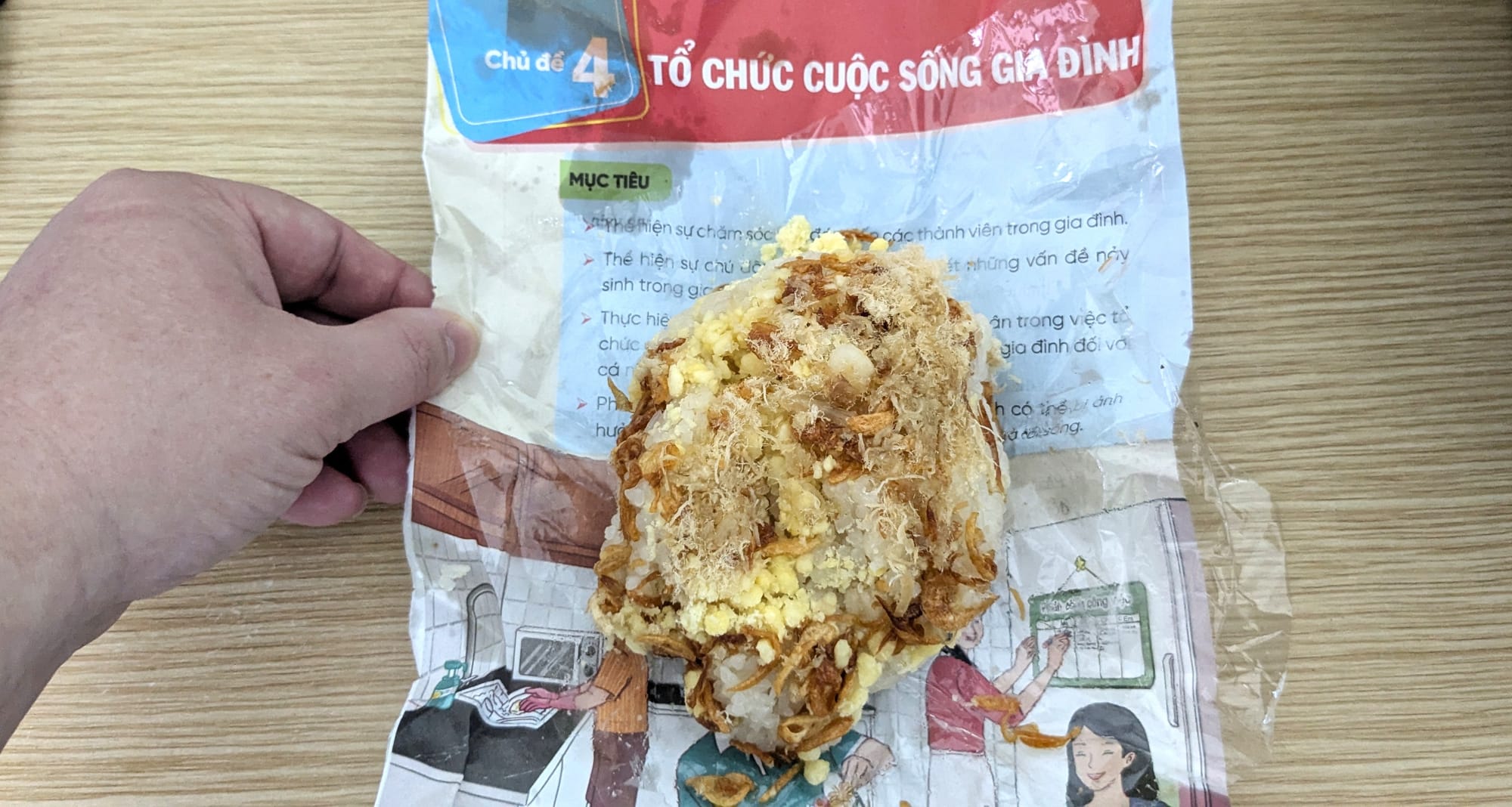
The scoop of rice doesn't look like much but it's incredibly dense and filling; this version is studded with kernels of white corn for extra body and texture. The rice itself is almost flavorless on its own but that's where the toppings come in. It's a cheap to-go breakfast that you can find all over Việt Nam, but the flavor is so good. And at 10,000 VNĐ it costs less than .50¢.
I hurry up and get back to the school, because the previous night I saw the guards painting new traffic stripes on the paving stones of the school courtyard. Having seen this happen last year, I know that this morning's flag ceremony will be followed by a traffic safety presentation.
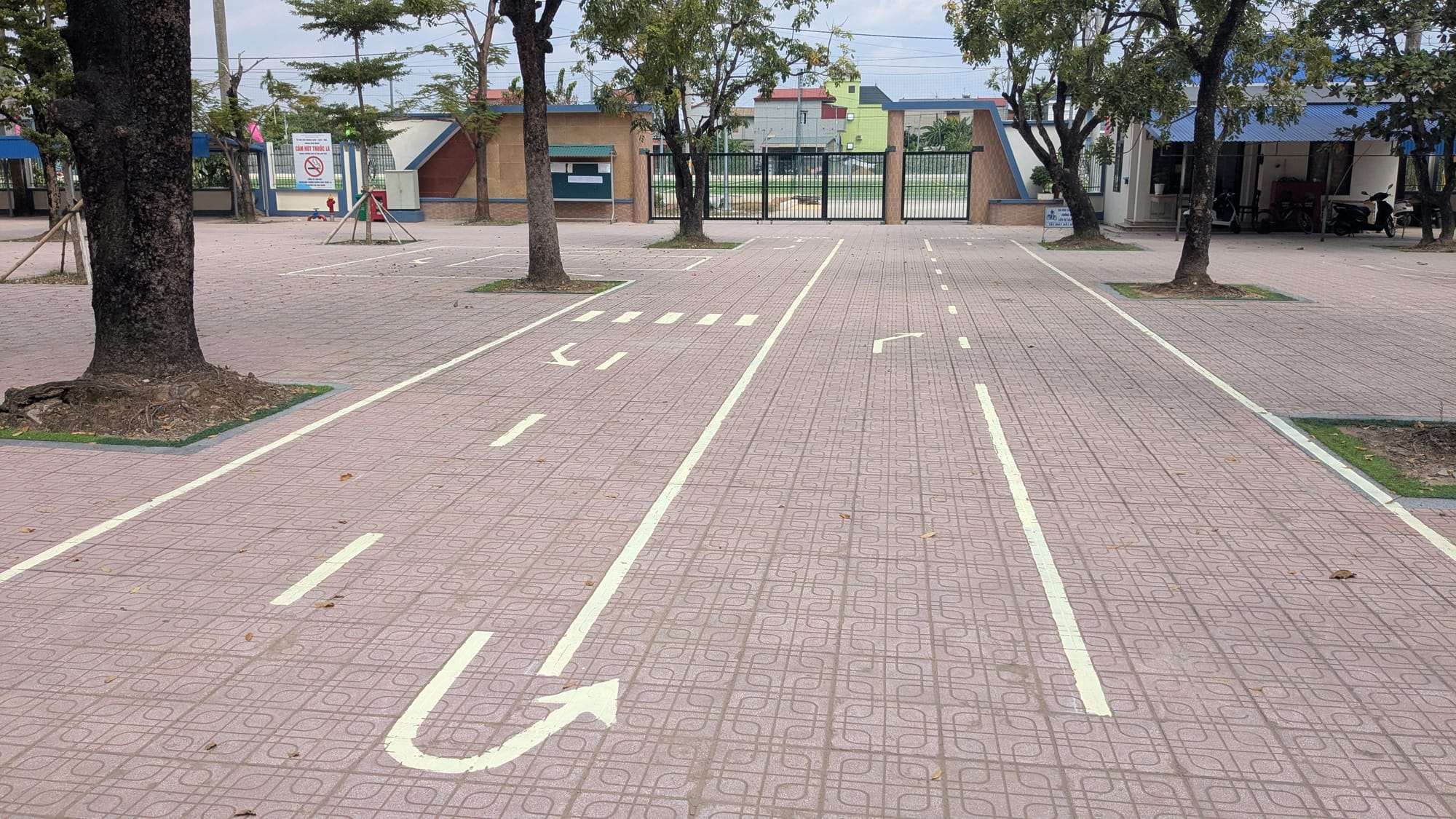
Several police officers have come to our school this year to demonstrate the course and talk about motorbike safety. Between the ages of 16-18, students are only allowed to drive low-powered (under 50cc) motorbikes. These motorbikes do not require a driver's license, so the police have annual safety demonstrations in the high schools. Most students have an elementary school and their lower secondary school close enough to walk or bicycle to school, or their parents have to pick them up. But there are fewer high schools so high school students sometimes have 10-20 kilometers to travel each morning.
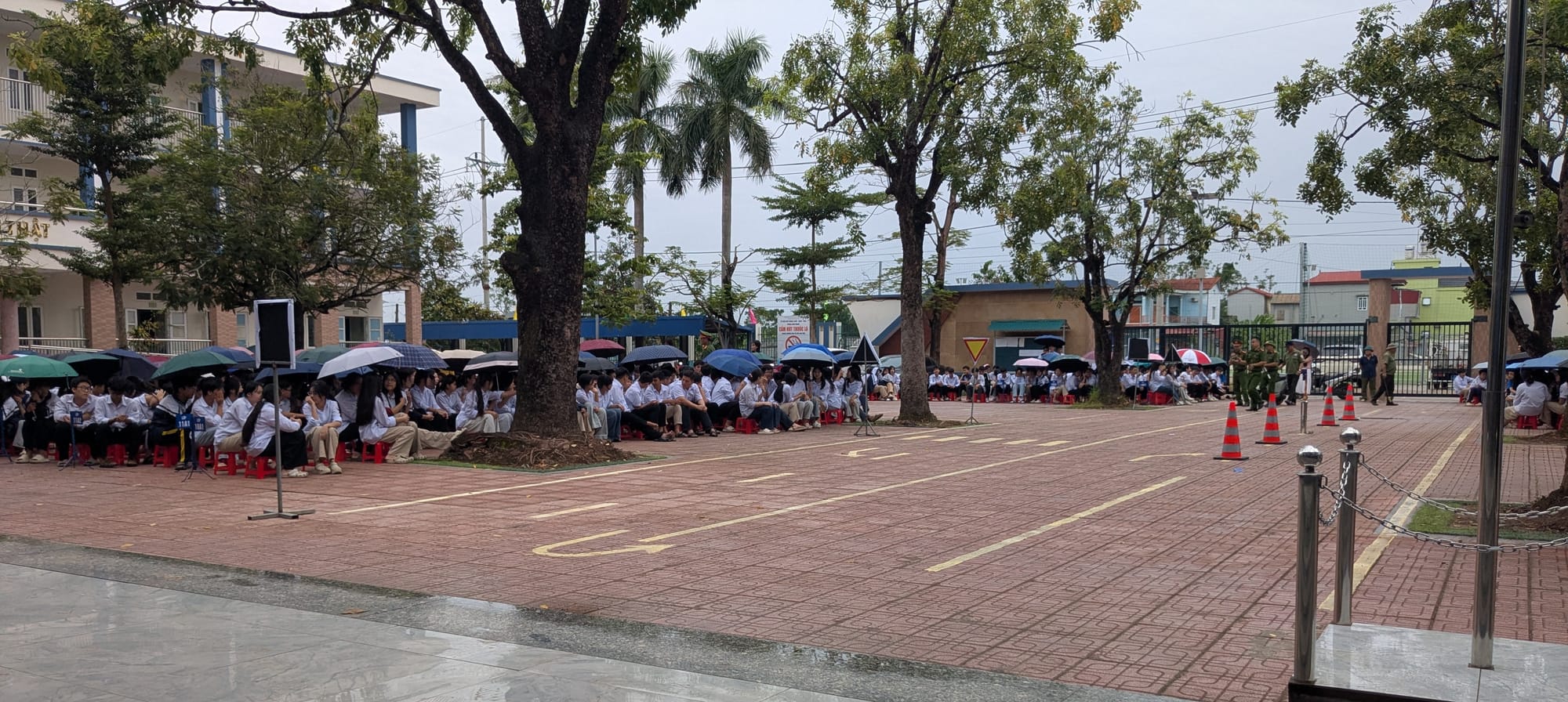
The students are reluctant to volunteer to try the obstacle course. There's one part where a U-turn needs to be taken so slowly that most students have to stop and put a foot down, while the rest of the school watches on ready to cheer or groan.
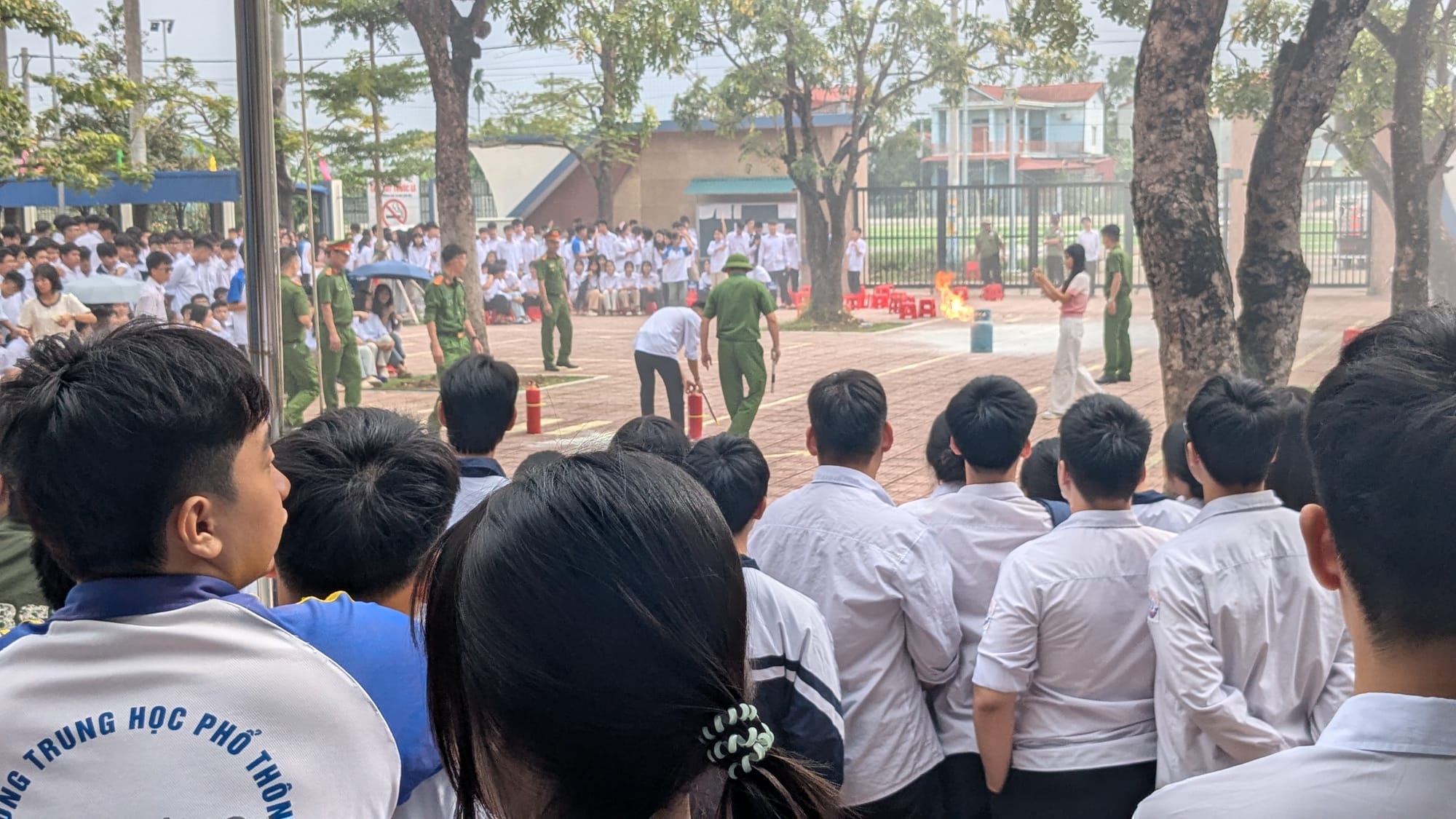
But this year, there is also a demonstration of how to use fire extinguishers! For this, the students unanimously have their hands in the air to volunteer. One police officer starts a fire from a 15kg orange canister of propane or butane gas. The students take turns learning the sweeping motion to use with a fire extinguisher and shooting it at the gas nozzle. Soon there's a big white splotch in the center of the courtyard.
The demonstration ends abruptly when it's time for classes to resume, and while the students put up their stools, I shake hands with the police and they ask to take a group picture with me and the principals.
Tuesday, October 6
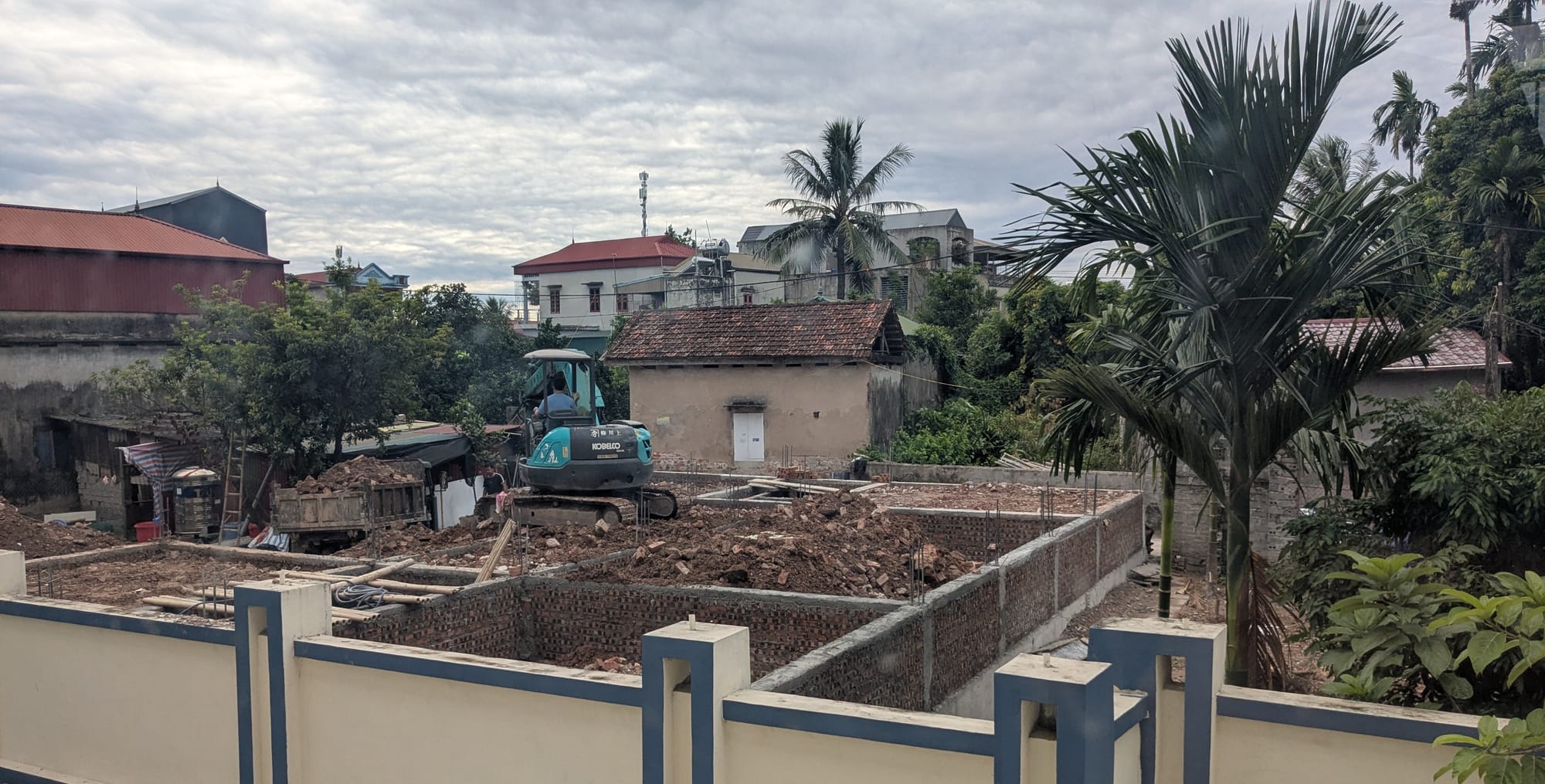
I'm trying to rest after classes and lunch, but suddenly there is quite a bit of jackhammering, so I get up to find somewhere more quiet. There is a new house being built directly behind the school near my room. It will probably be finished in only a few weeks; the progress is visible every day.
I put my chair and table out in front of my room. After studying for a little while, the librarian Ms. T invites me to the other Ms. T's office to eat quả bưởi. The sweet, oversized citrus fruit is from the school's pomelo tree.
Ms. T the Accountant has her readers on and is entering data into her computer diligently behind stacks of documents and barely acknowledges us as Ms. T the Librarian peels the pomelo. Soon piles of peel and pith and big pomelo seeds are stacked stickily all over the corner of her desk and on the floor, and I wonder if she wanted this intrusion.
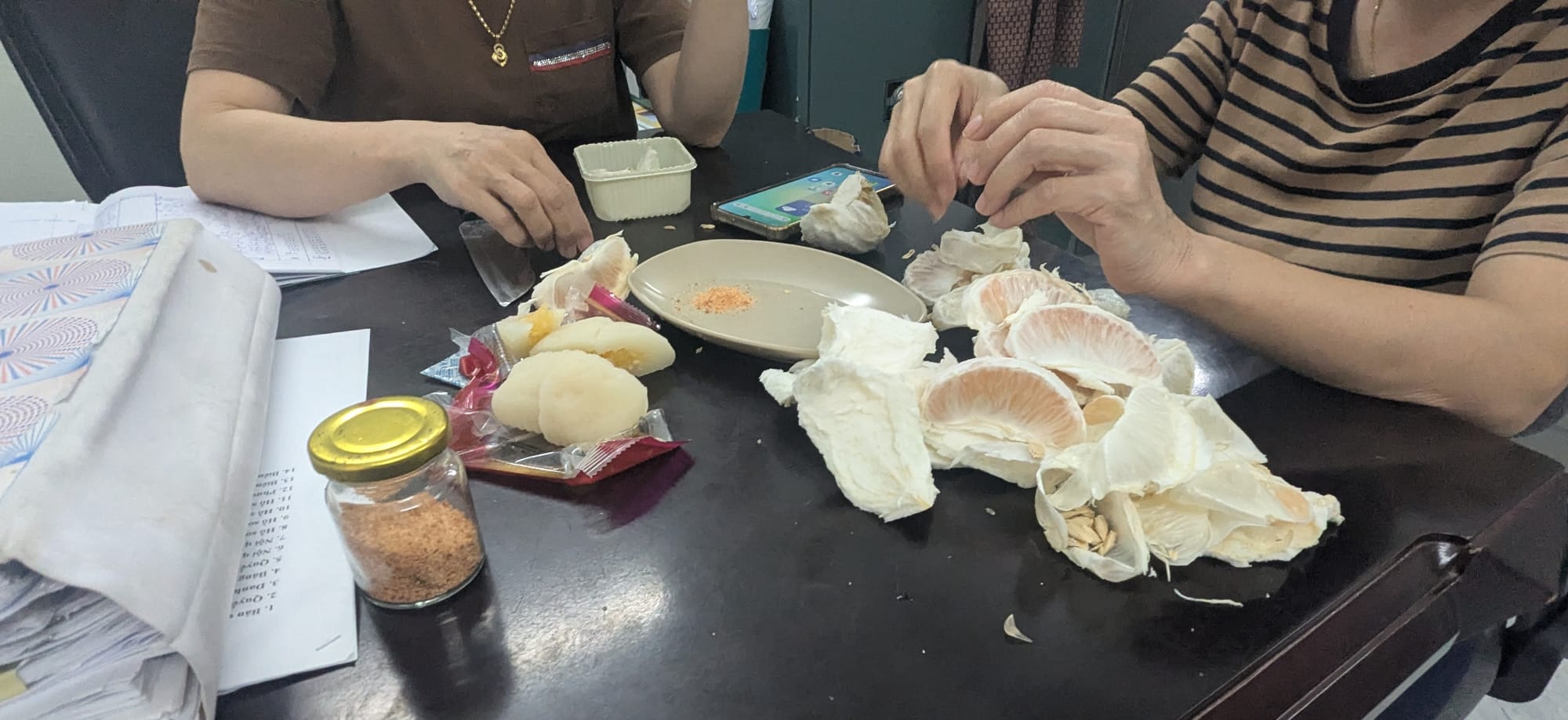
But then she stops and joins us in eating. She asks me something and the librarian translates, but I recognize one of the words 'chia tay'. Literally, it means to divide hands or unclasp them. To split up. The same word is used for relationships or professional relationships.
When exactly am I leaving? Where am I going next? How long will I be home in the U.S.?
I tell them I will keep in touch and give them a call every now and then.
Wednesday, October 7
When I get to my first class in the morning, Ms. D tells me she needs to attend a meeting. So, I'm left winging it again, trying to explain English when sometimes I don't have the Vietnamese I need for certain words. The unit is about "Smart Cities". These students cannot have a basic conversation, but are expected to learn 'public transport', 'sustainable energy', 'smart sensors', and 'eco-friendly'. I put them in groups and tell them to draw a city using all of the vocabulary. This lets me go around the room and ask them questions about it: "Where is the public transport?"
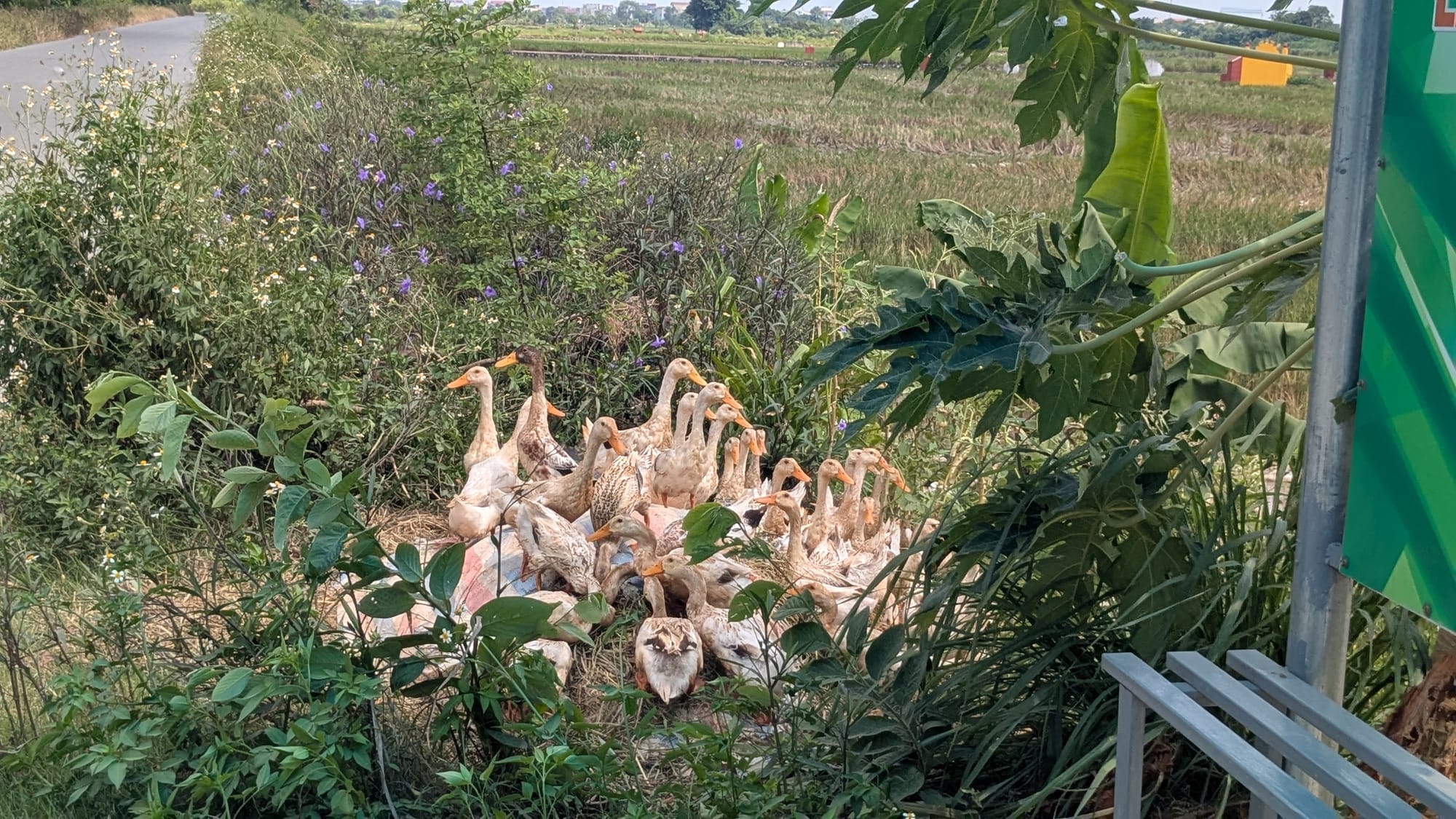
When Ms. D returns at the end of two periods, she explains her students were being disciplined. The parents of the students had to attend too.
"What did they do? Smoking?" I ask.
"How did you know that?"
"It seems like the main discipline problem at the school."
She is very worried about her responsibility for this class. It is her second year as a teacher here, and her first time being in charge of a class.
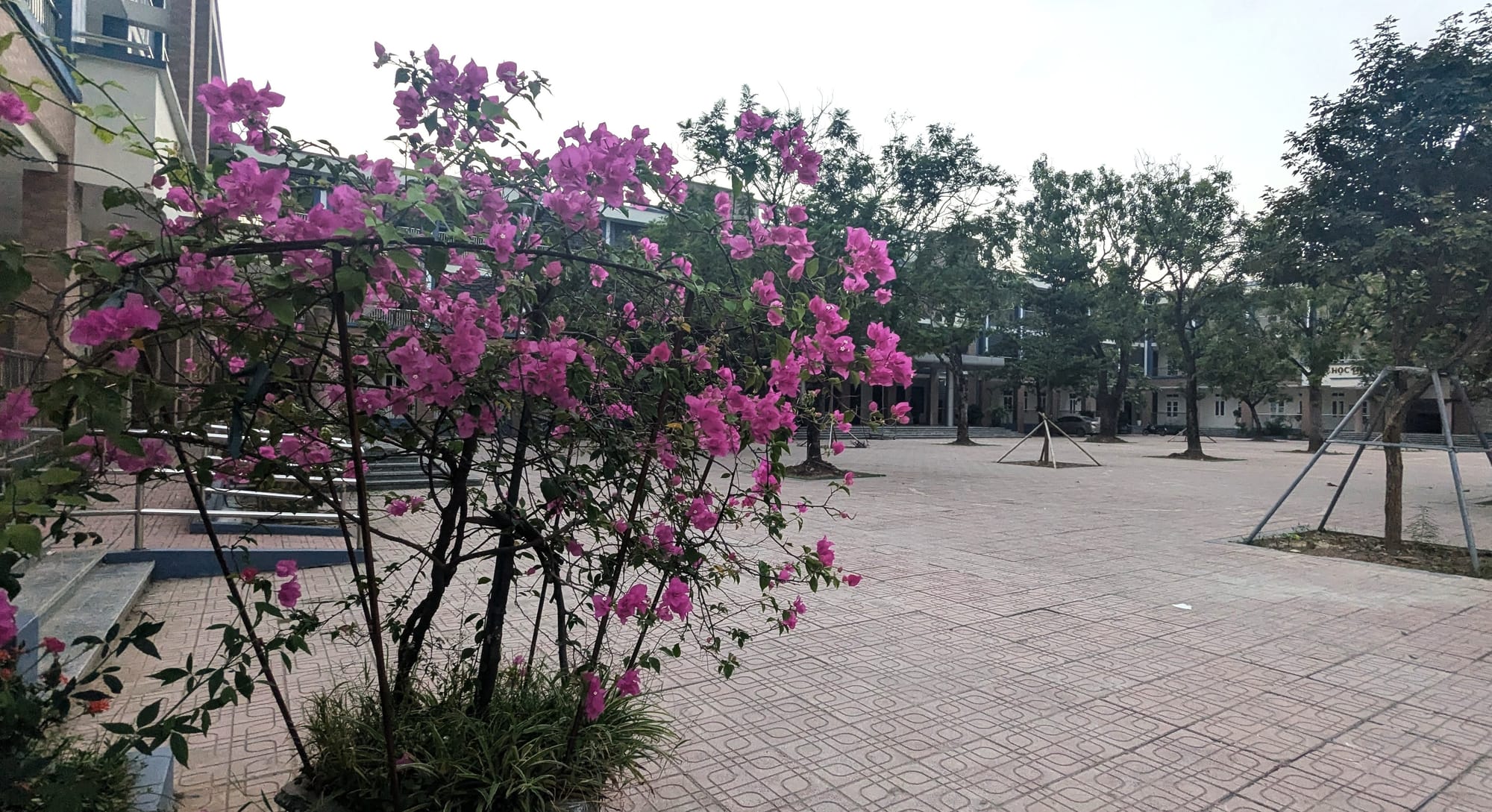
After classes, I start a load of laundry and wait for the last classes to get out before cooking lunch, in case my students want to come in and practice English before lunch.
But midway through the cycle, the washer suddenly stops and gives an alarm. There is a code and flashing red light on the front. I check the water in my sink. No water.
Without anything for lunch, I bicycle into town. I fear I'll have to travel a little ways but then I see that the doors are open on a restaurant that had been closed. It used to be a chicken phở shop, but it closed after I started going regularly. It reopened with signage that it serves duck. There are no customers, only the new owners eating their own lunch. I park and ask if they have food. They have beef phở.
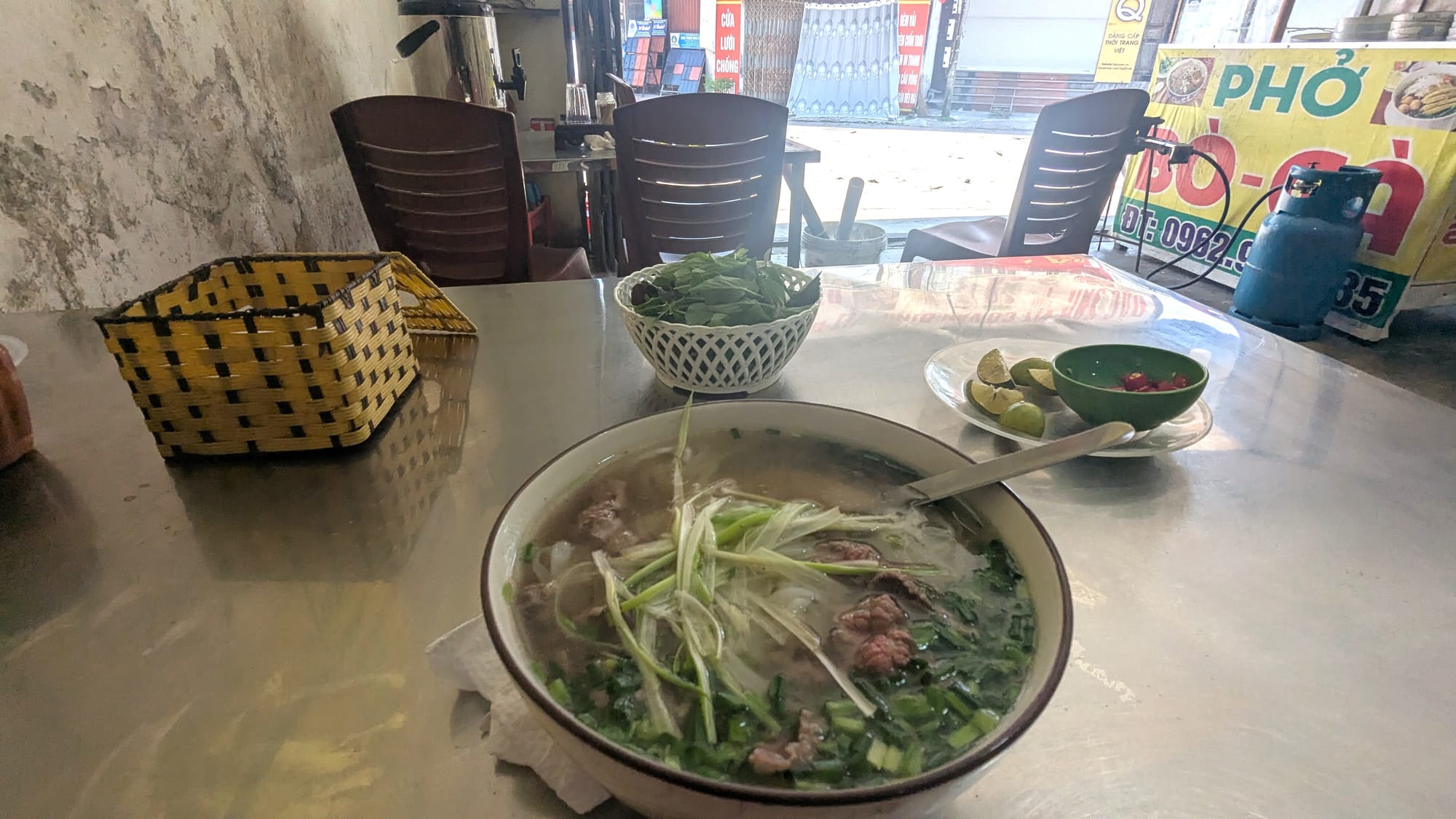
When the owner brings the bowl over with a basket full of basil, he asks me what "center" I teach at.
"I teach at the high school."
"You know ****, the guard?"
"Yes, he's my friend."
I think he tells me he's related to him, but I haven't studied Vietnamese words for distant relatives in a while and I can't quite make out if he's a cousin, or in-law, or cousin in-law.
Thursday, October 8
Most girls in a Vietnamese classroom are the very definition of demure. They sit quietly, keep their heads down; most try not to be seen or called on if at all possible.
But in almost every classroom there is one girl who is the Main Character.
She is fearless. She is unfiltered. She says what she's thinking. She raises her hand constantly and can't believe it when you don't call on her.
Some are really good students. The best students.
Some are the opposite.
One such girl walks casually into class five minutes late.
"Em xin cô vào lớp?" May I enter the class, teacher?
Ms. L - the strictest of teachers - becomes angry. "No! No! In English!"
One of her shoulders drops under the sudden unfair burden. She looks at me with jaded eyes.
I try to help her remember. "Em nói: 'May I...?'"
She tries again in Vietnamese, like we won't notice.
"No! No!" Ms. L repeats.
A nearby student pipes up to help her: "May I go out!"
I try not to laugh. "No, not 'May I go out'... 'May I...?'"
"Come in!"
Finally, in a soft monotone voice, she acquiesces: "May. I. Come. In."
We let her go to her seat in the back of the room, and Ms. L pauses for a long moment like she's thinking. She turns to me:
"I think today you will control my students."
"Oh?" I'm totally lost by this turn of phrase. "What do you mean?"
"In the back row. Two girls. You can control them for me."
I'm fairly certain I cannot, but I go to the back of the class and do what I think she wants which is to keep the students on task and call on them to answer the questions.
Friday, October 9
After dinner, some of the village women congregate in the unlit football stadium next to the school. Their children kick balls around or horseplay, while they walk laps barefoot on the soft artificial turf. An after-dinner walk aids good digestion.
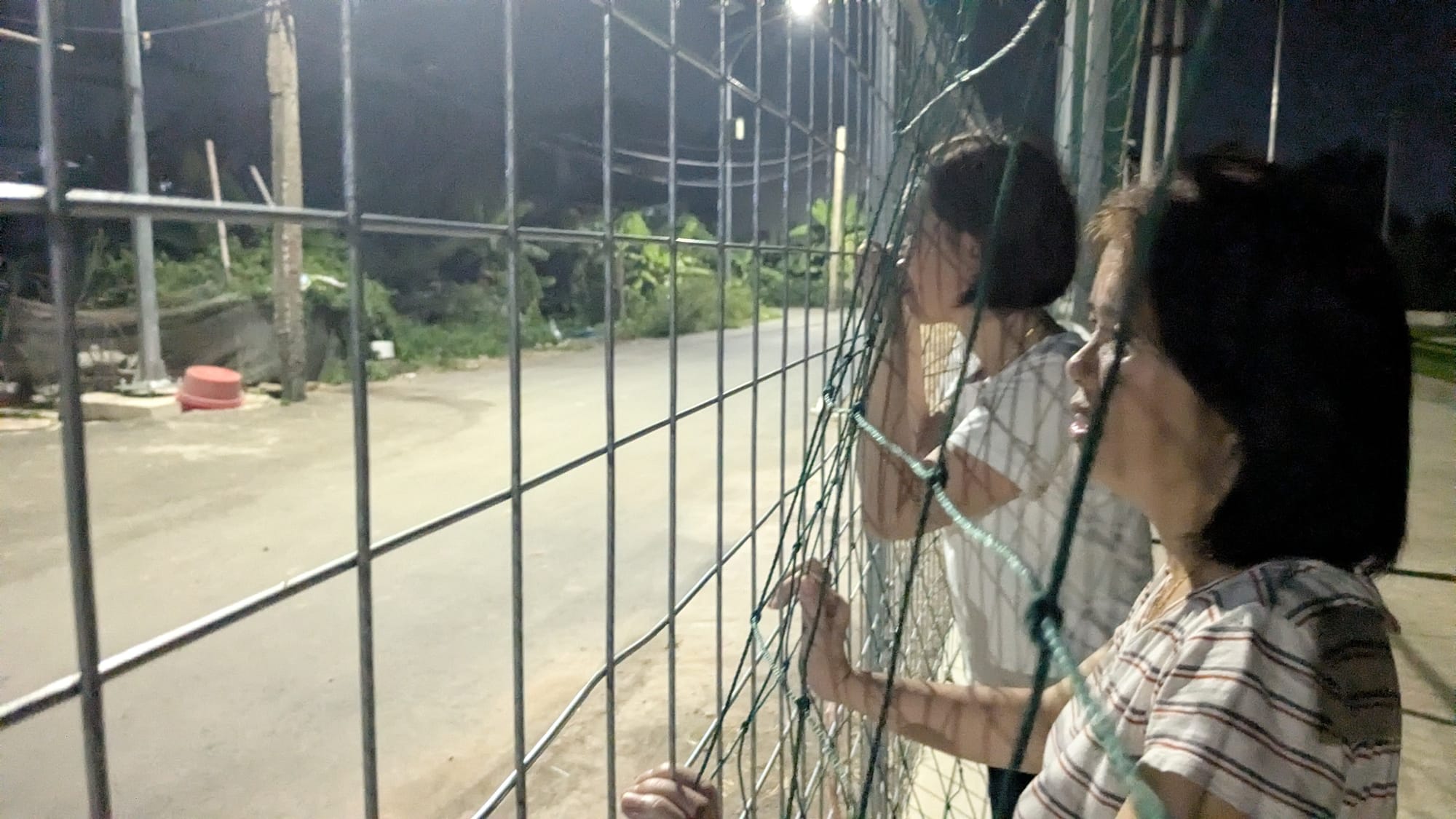
I walk for a while alone with my headphones. Then I see one of the school's staff members and I walk over to her. Her youngest kid greets me with a high five and a "Chú Cuh-ris!" (Uncle Chris). He is more at home on his bicycle, and he rides back and forth on the pavement sometimes striking perilous poses riding sidesaddle or squatting with both feet on the seat.
When I first moved into the school, I was surprised when the 10-year-old boy came and stared into my room one day, his face pressed against the mosquito netting.
"Hello!" I said, and he just kept staring.
Soon his mother comes running down the hall looking for him, shouting his nickname: "Tôm!" Tôm means shrimp.
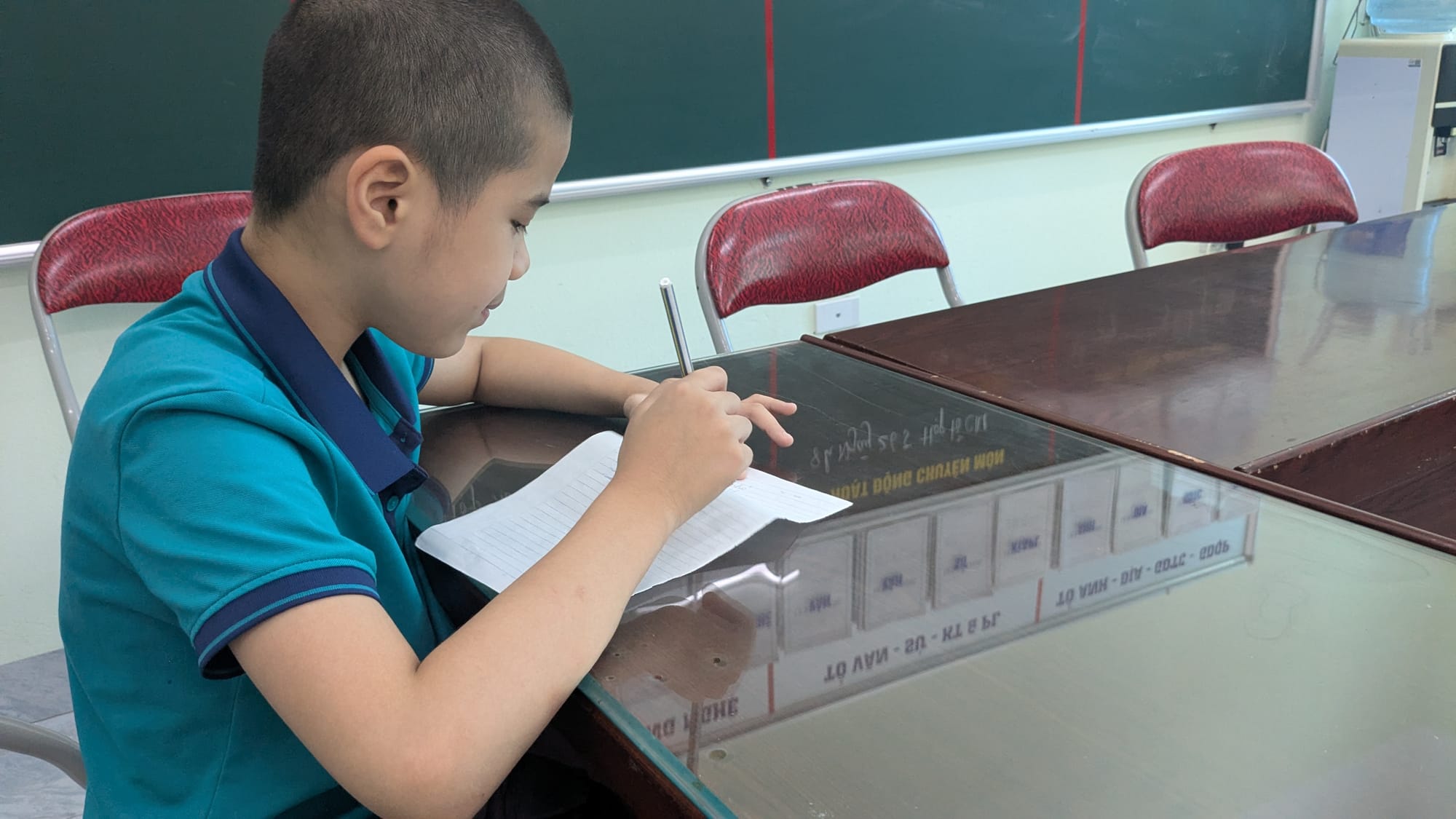
It became a regular occurrence where he would come into my room and look around but never say anything. I eventually learned that he has a learning disability, but undiagnosed. The family can't afford to take him to a city where a doctor might be able to offer advice. The elementary school turned him away; there's no support for special education outside the cities. He follows his mom to work and has to entertain himself in her office. Until he finds a moment to escape and wander around.
Eventually he learned to say my name, and "High five!" in both languages. He laughs sometimes at the pronunciation of English words, but that seems to have been the impetus for him vocalizing more. His mother later confided to me that he almost never spoke a year ago. Now they are teaching him Vietnamese pronouns and how to greet the staff at the school.
Today, she tells me he's learned a new word. It takes her a minute to goad him into repeating what he said earlier. "I like...? I like what?"
"I like.... BA-NA-NA."
His mother doubles over in laughter.
"Wow!" I say, with laughter and excitement. "I like banana, too!!"
And we high five again.