Việt Nam Diaries, Pt. 4: Playing the Lottery
Week 57: January 2026
Saturday
A little before 8:00am I get a text from the tour guide that he is in front of my guest house. I have arranged to join a day-trip from Sài Gòn to the Mekong Delta, a fairly standard tourist trip. I had considered building my own overnight trip to Cần Thơ or Bến Tre - cities on the delta - but didn't have the time or money to plan it properly. I was hesitant to go on such a touristy trip - I could have easily spent my last day doing something else in Sài Gòn - but decided that it was a must-see part of the South, and that the pictures I would bring back from it would be the most useful for my classes.
The bus holds about two dozen people, and the tour guide makes a point of saying Hello to each of us in our native languages: Spanish, French, even Gaelic. There is a couple from Romania and he asks them how to say it in their language. The tour will be conducted in English, which has caused some disappointment for two sisters from France who were under the impression they would have a French speaking guide.
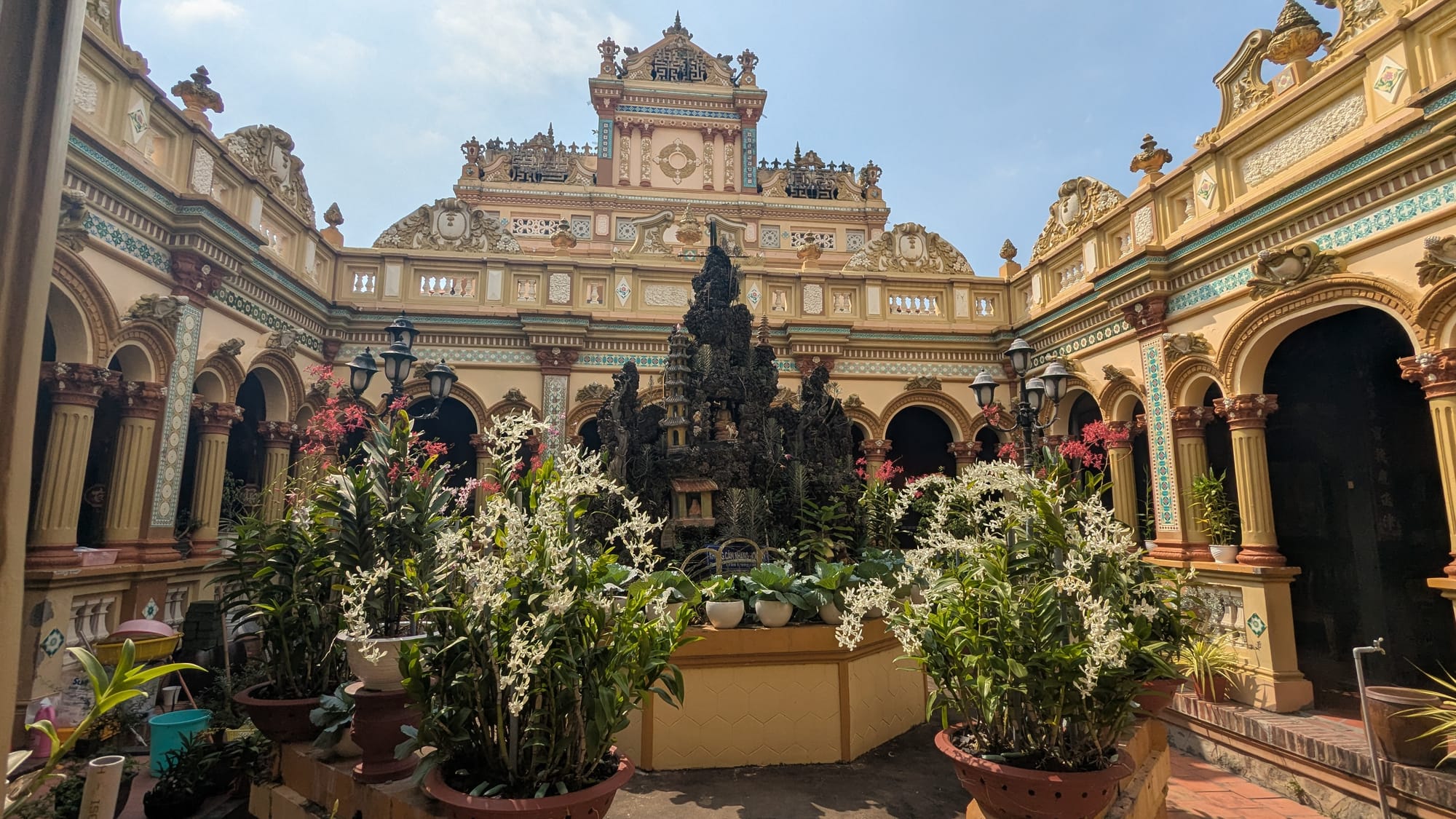
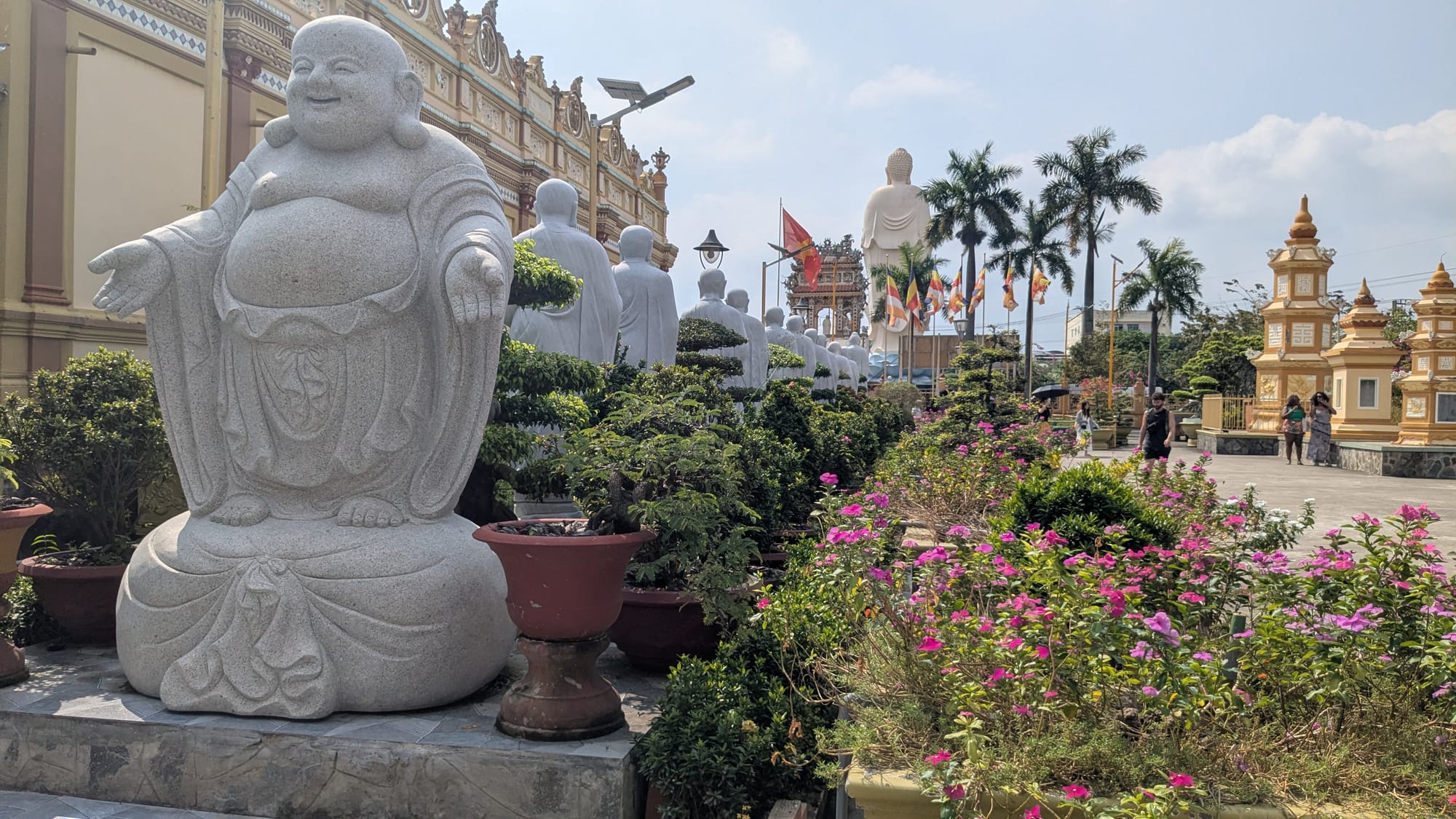
After a two-hour bus ride, we first stop at a Buddhist pagoda in Mỹ Tho: Vĩnh Tràng Pagoda. The central temple dates from the late 19th century and includes French Colonial architectural elements.
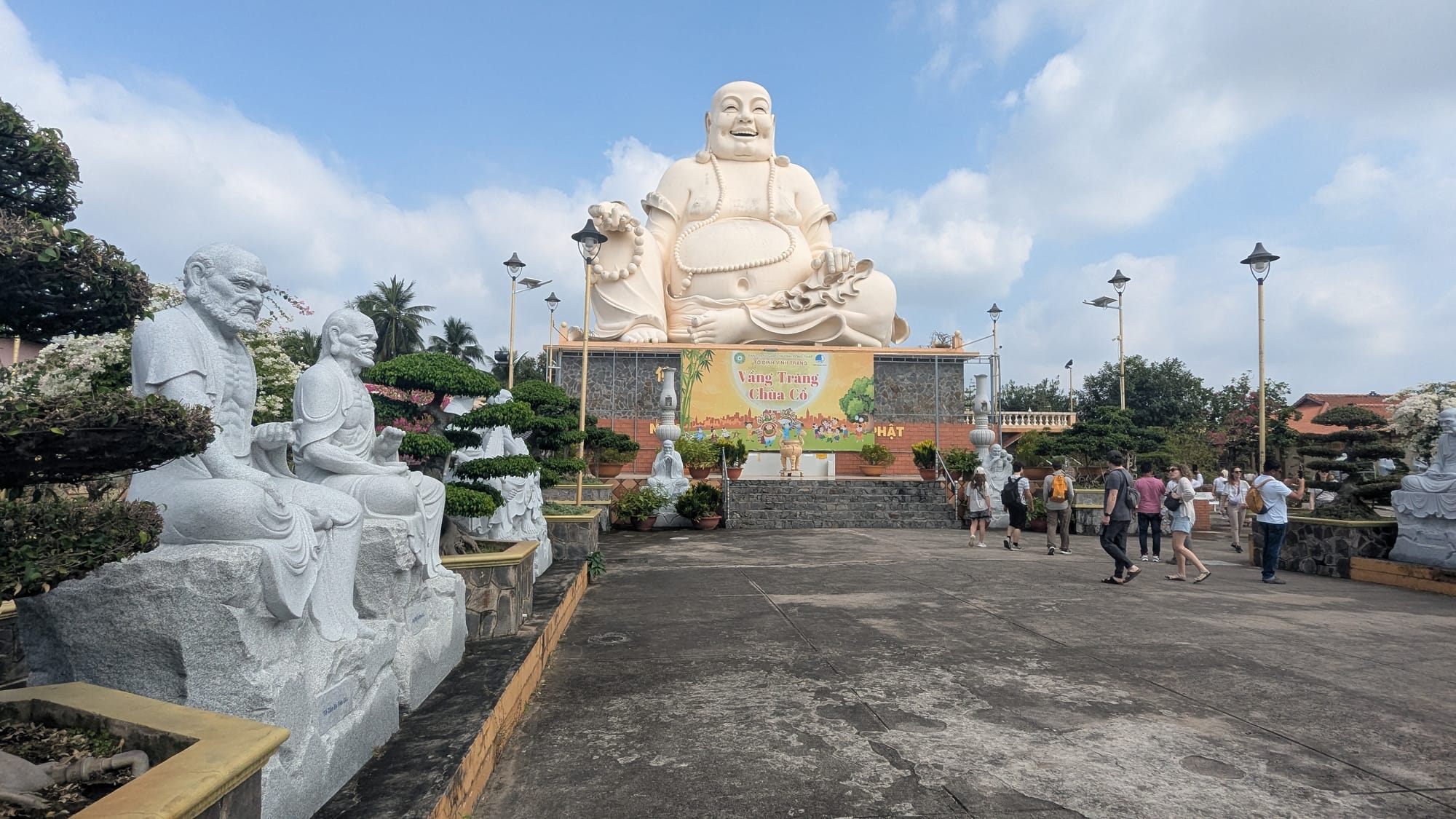
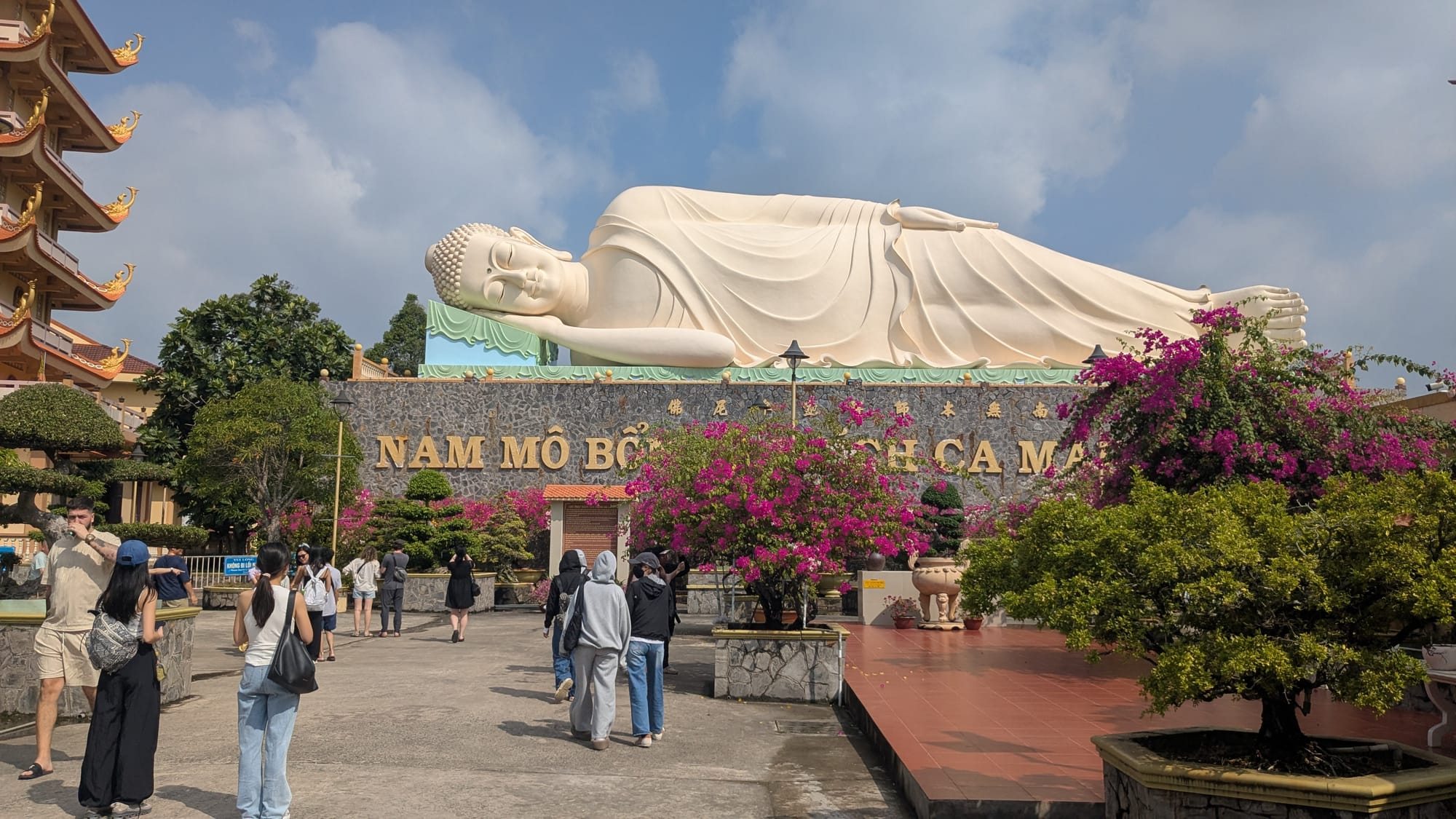
Over the decades the pagoda has accumulated over 60 Buddha statues of many different sizes, including large-scale gleaming white statues of the Reclining Buddha (Siddhartha Gautama entering nirvana), Amitabha Buddha (the supreme buddha in the Mahayana sect of Buddhism), the Lady Buddha, and the Laughing Buddha (the Maitreya Buddha who will come in the future).
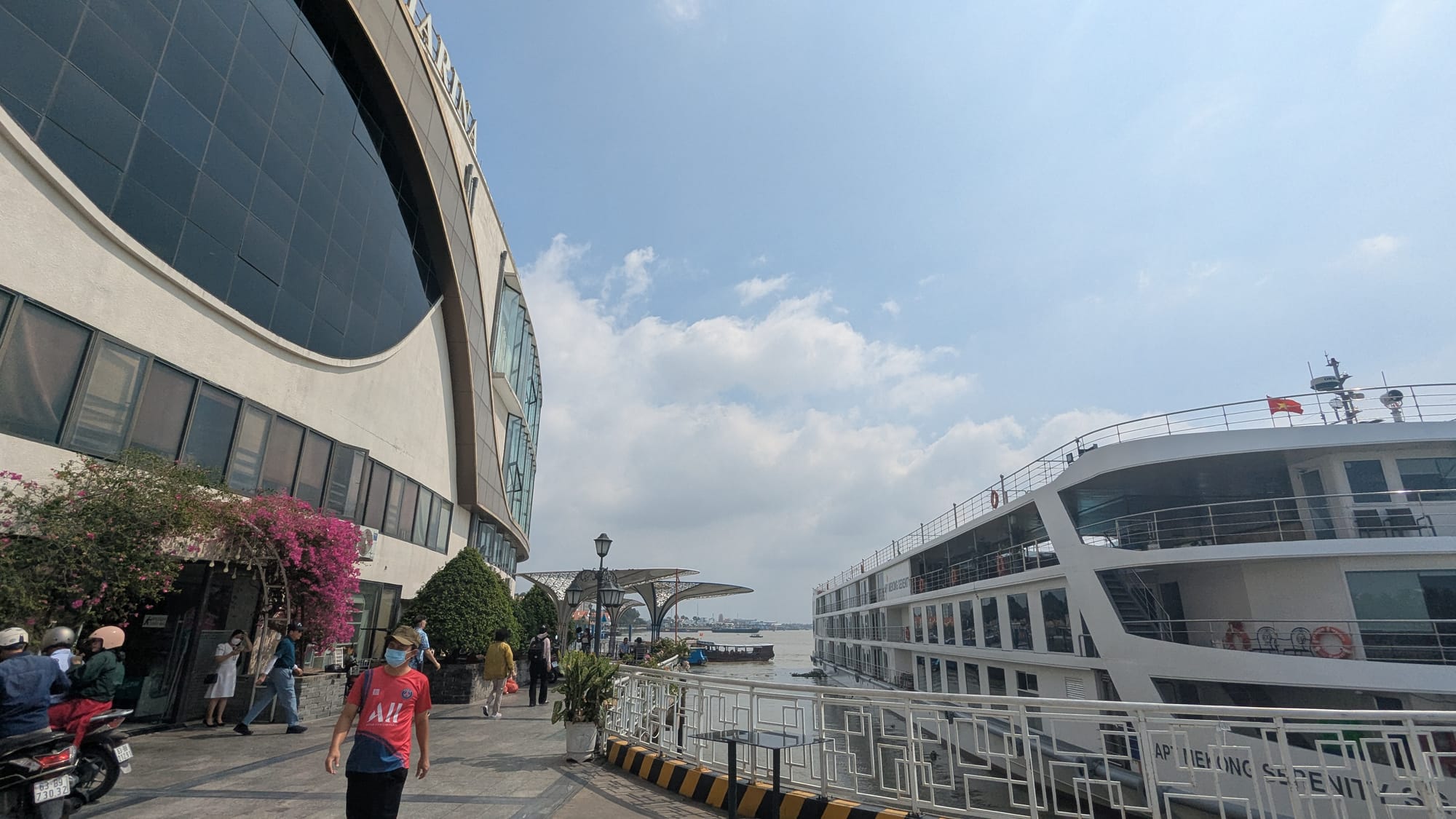
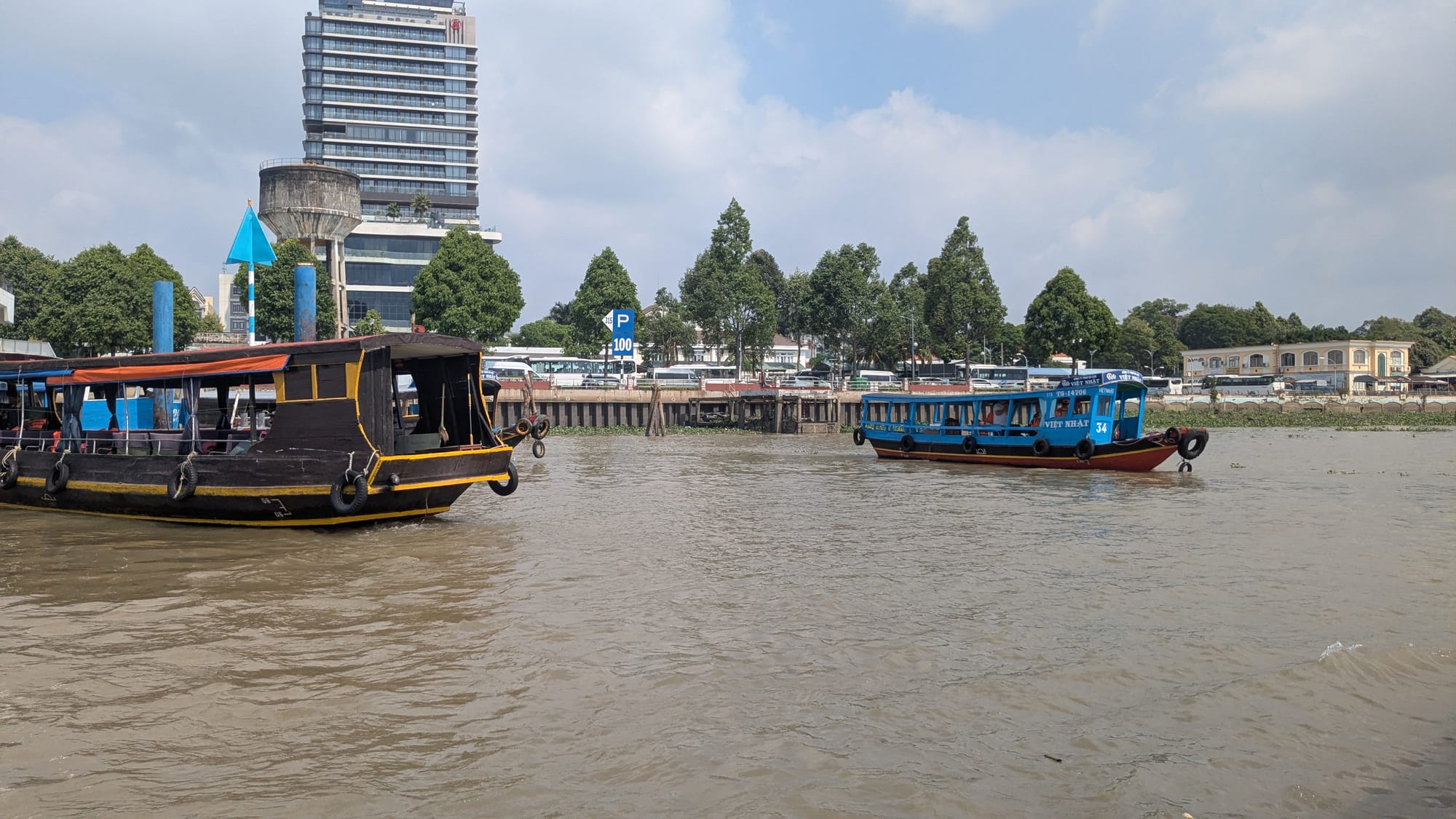
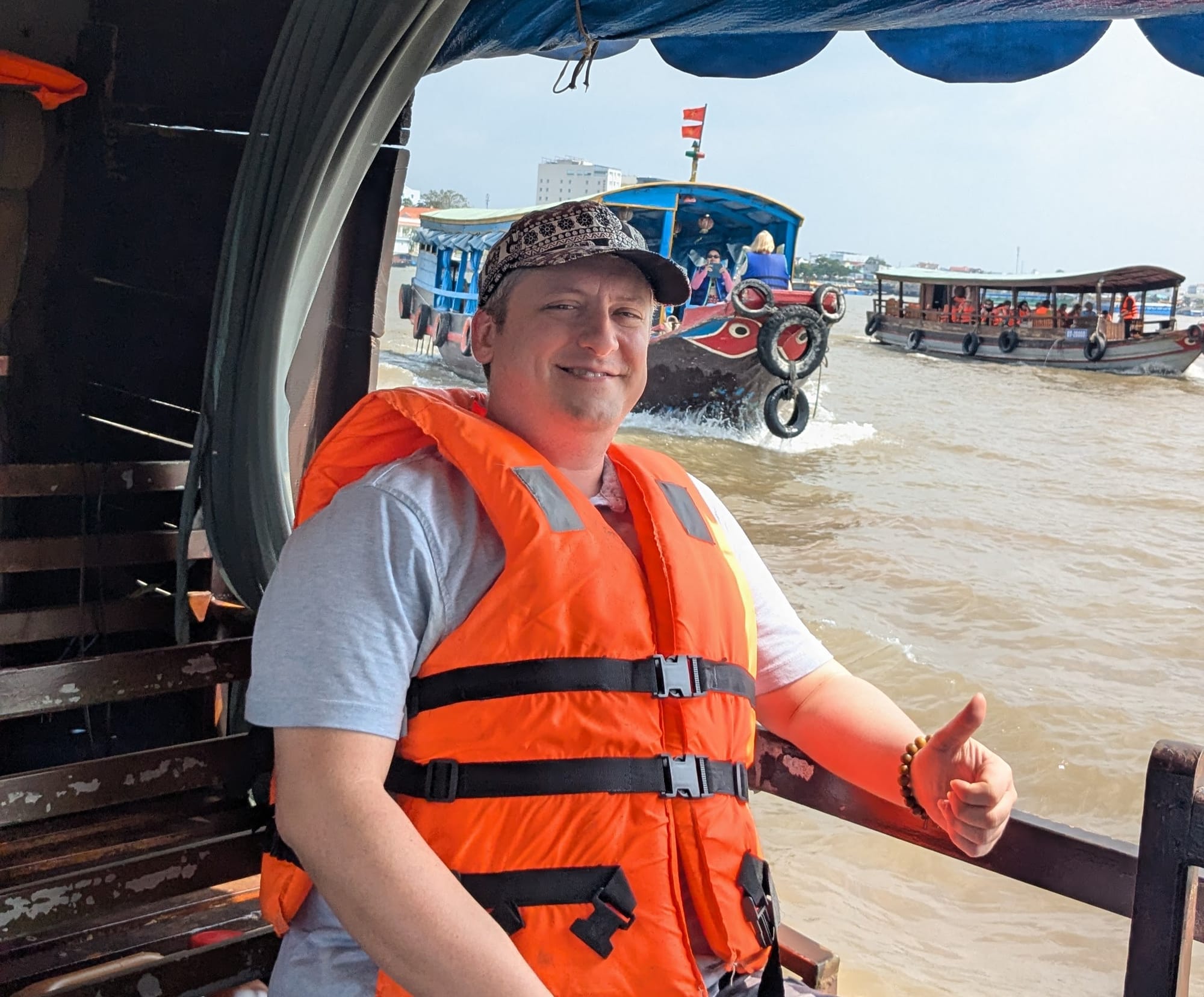
Next, we headed to the marina and finally set off across the Mekong River. The tour guide reminds everyone that the Mekong River is famous for carrying a high amount of silt through its Delta every year, so the water is not brown and murky because of pollution.
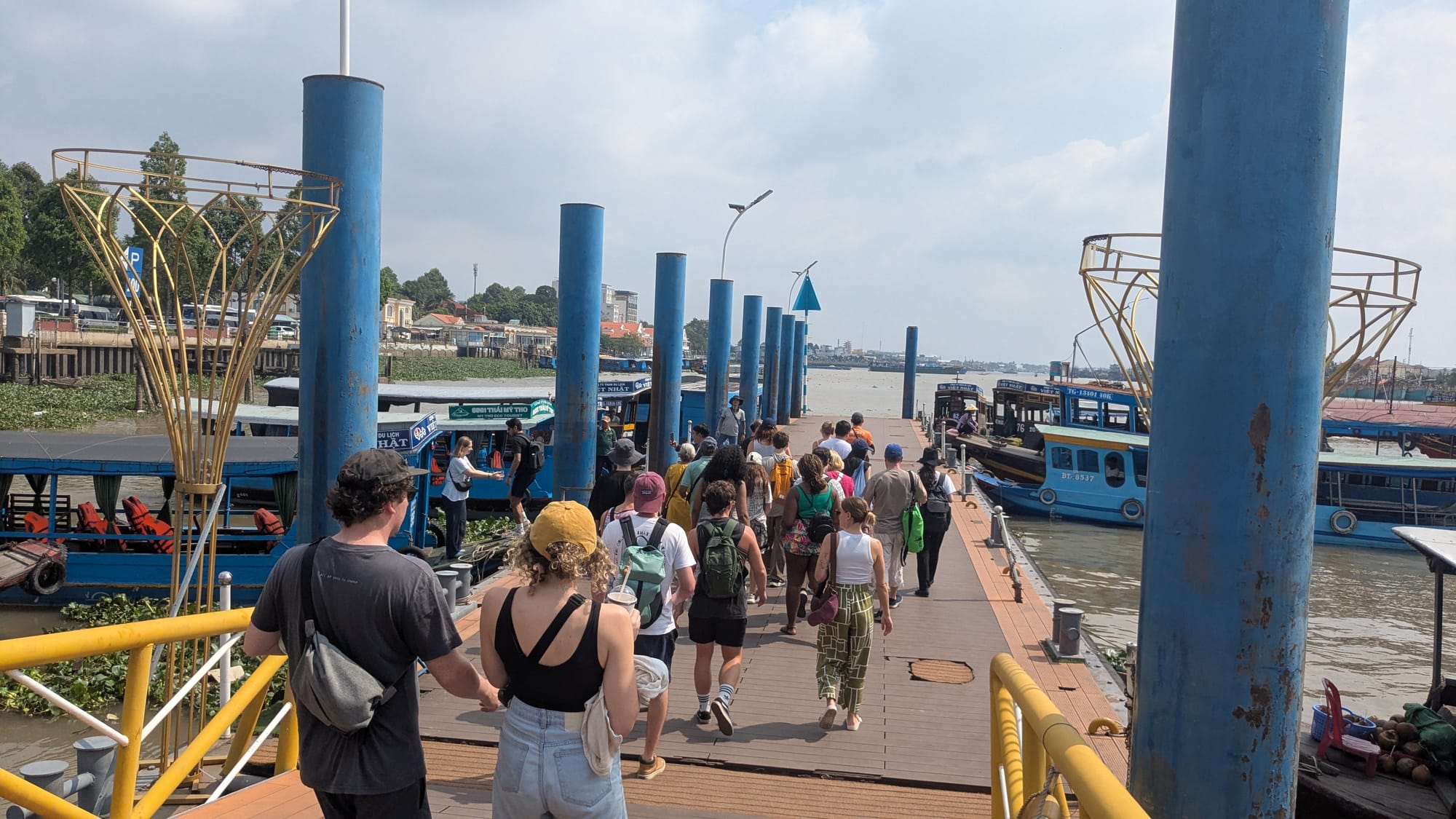
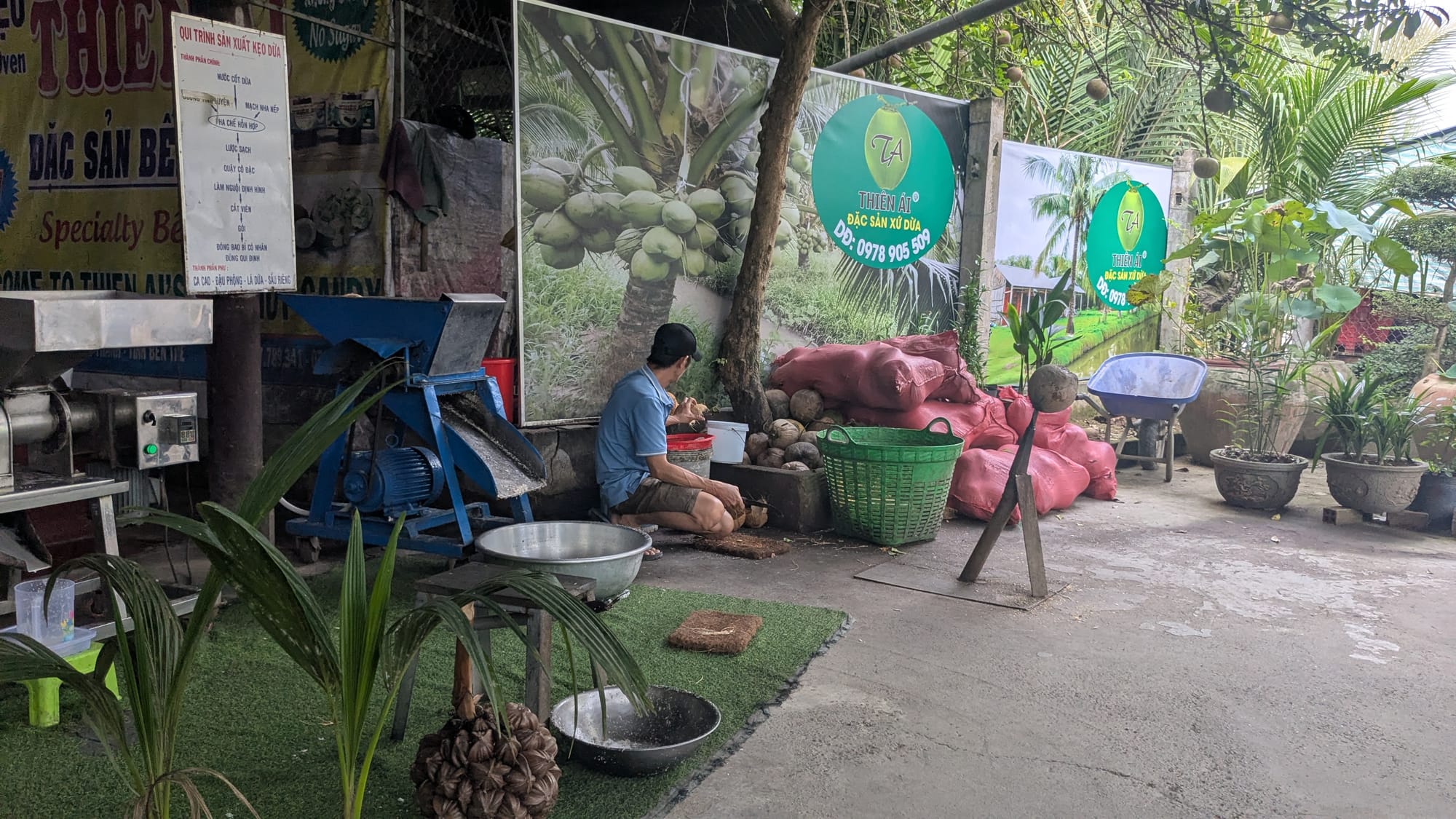
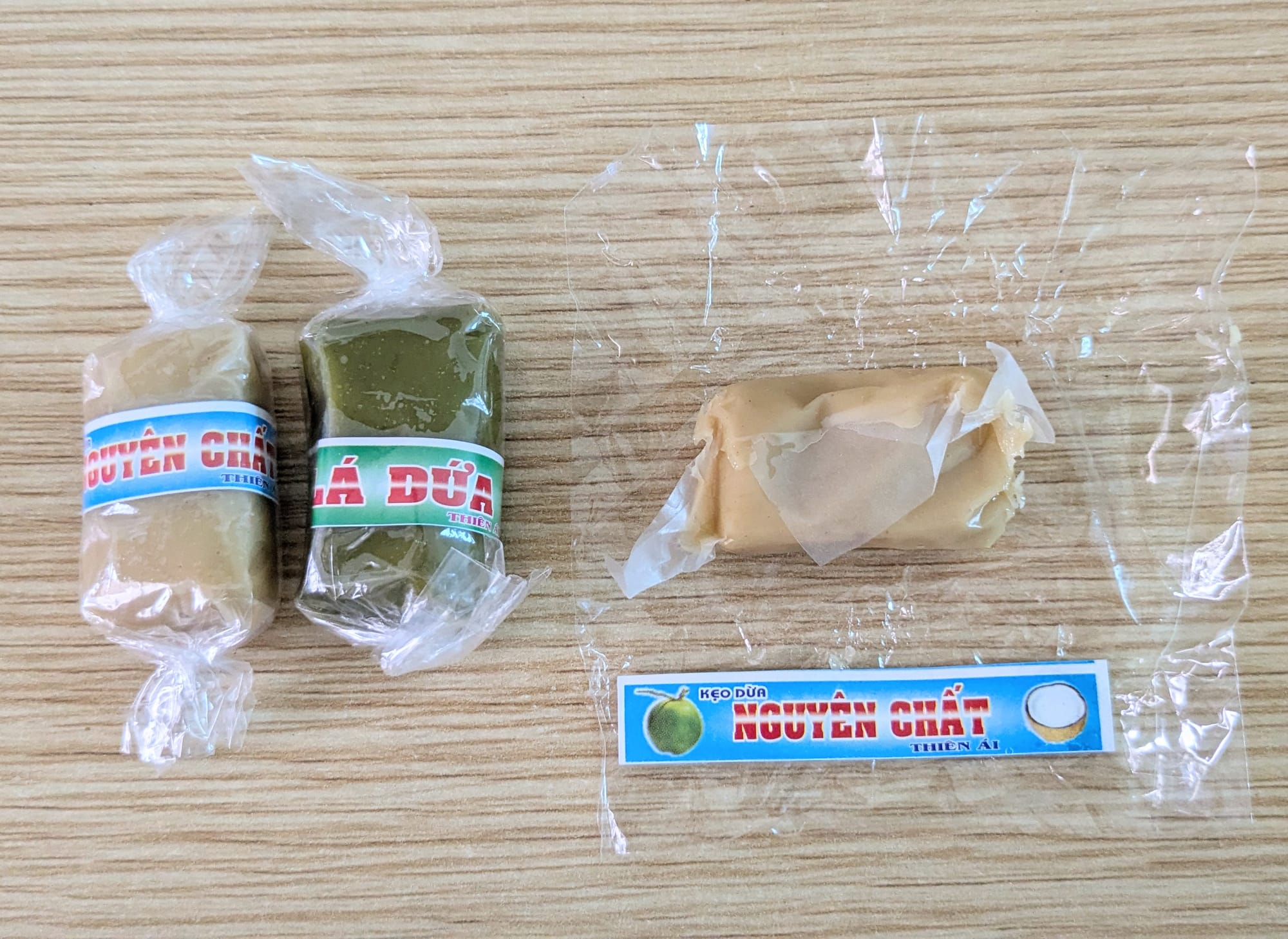
We docked on a large island on the northeastern edge of the delta, the island that includes the town of Ben Tre. Our first stop is one of the island's famous coconut candy factories. The small family-run business gives a step-by-step account of the manufacturing process. They have a use for every part of the coconut, and no sugar is added to the candies.
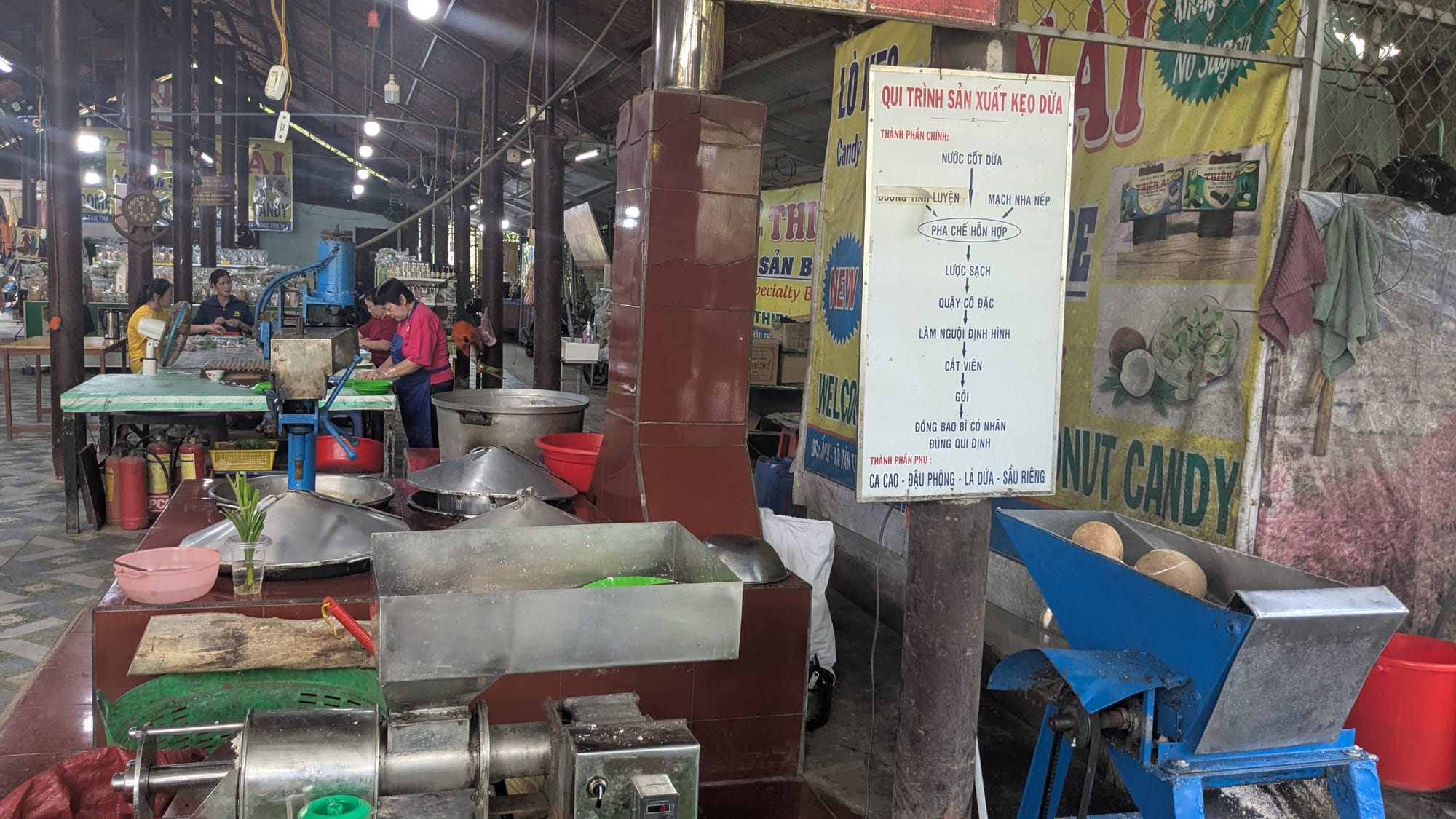
As we proceed through the workshop, three women sit at a long table with rows of cooling sheets of processed coconut. They are wrapping the chopped pieces of candy by hand: first, with a paper-thin, edible square of rice paper, because the candy is so sticky it will fuse to any wrapping. Then, they wrap it in plastic tightly, followed by a small paper label, followed by a second plastic wrapping.
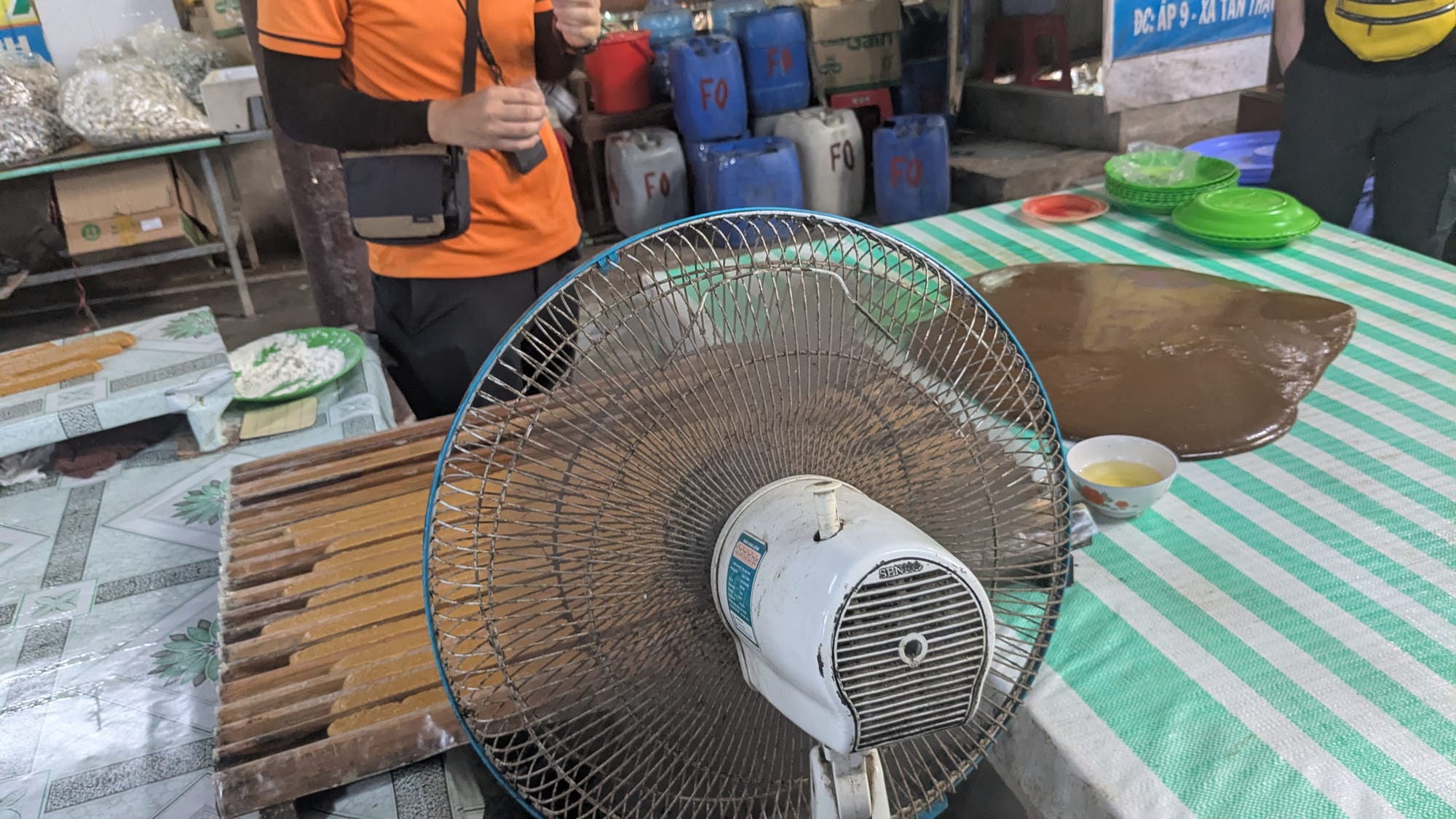
You eat the candy with the inner rice paper wrapping, which dissolves quickly and is flavorless. The candy is not overly sweet, having only the natural sugars in the coconut. Even more delicious are the candies infused with different flavors. I use all of my souvenir money to buy two big bags of candies: one of the plain flavor, and one with pandan flavoring. The fragrance of pandan leaves is commonly used in desserts in the South, rare in the North, but it's a favorite flavor of mine.
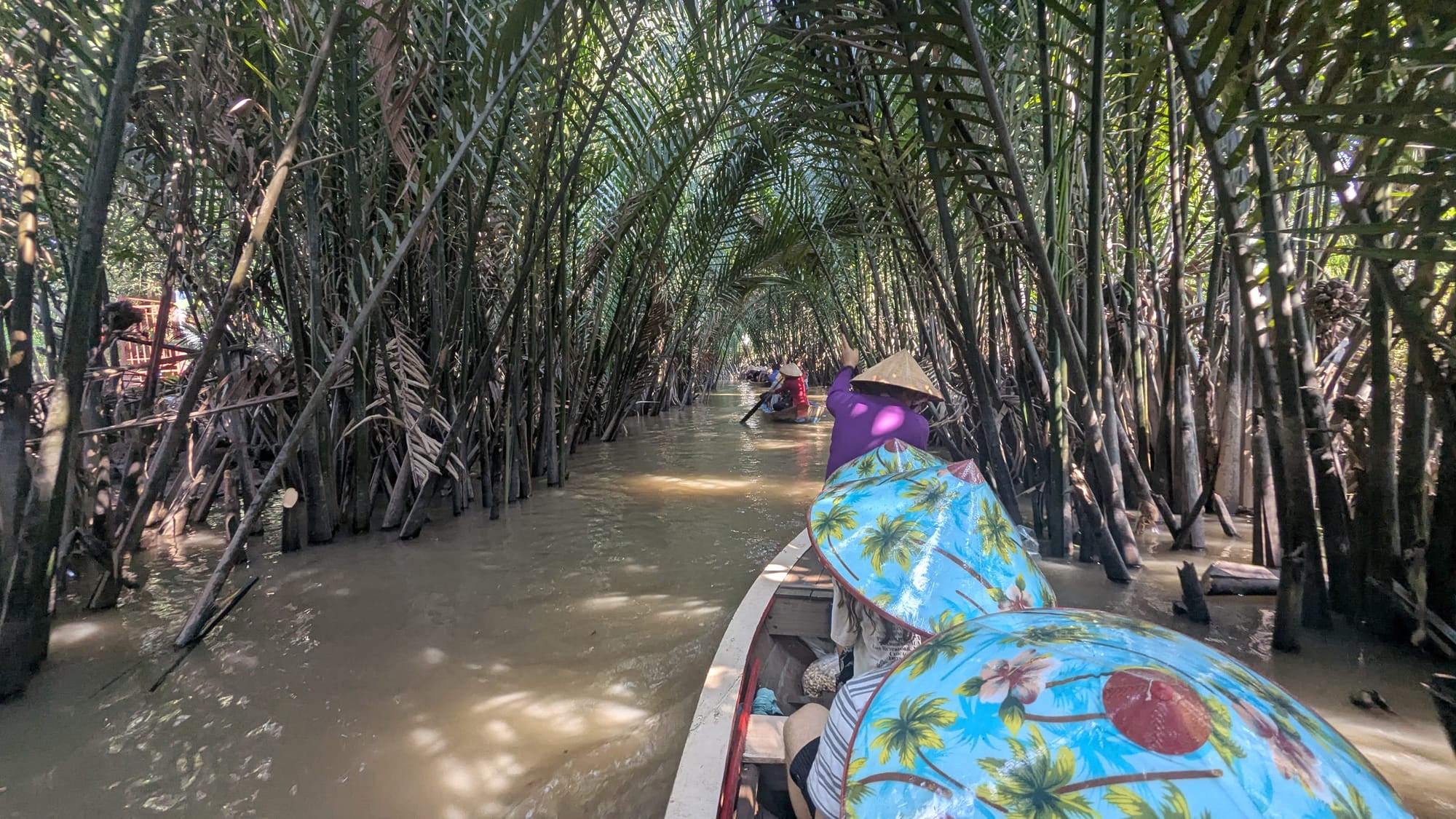
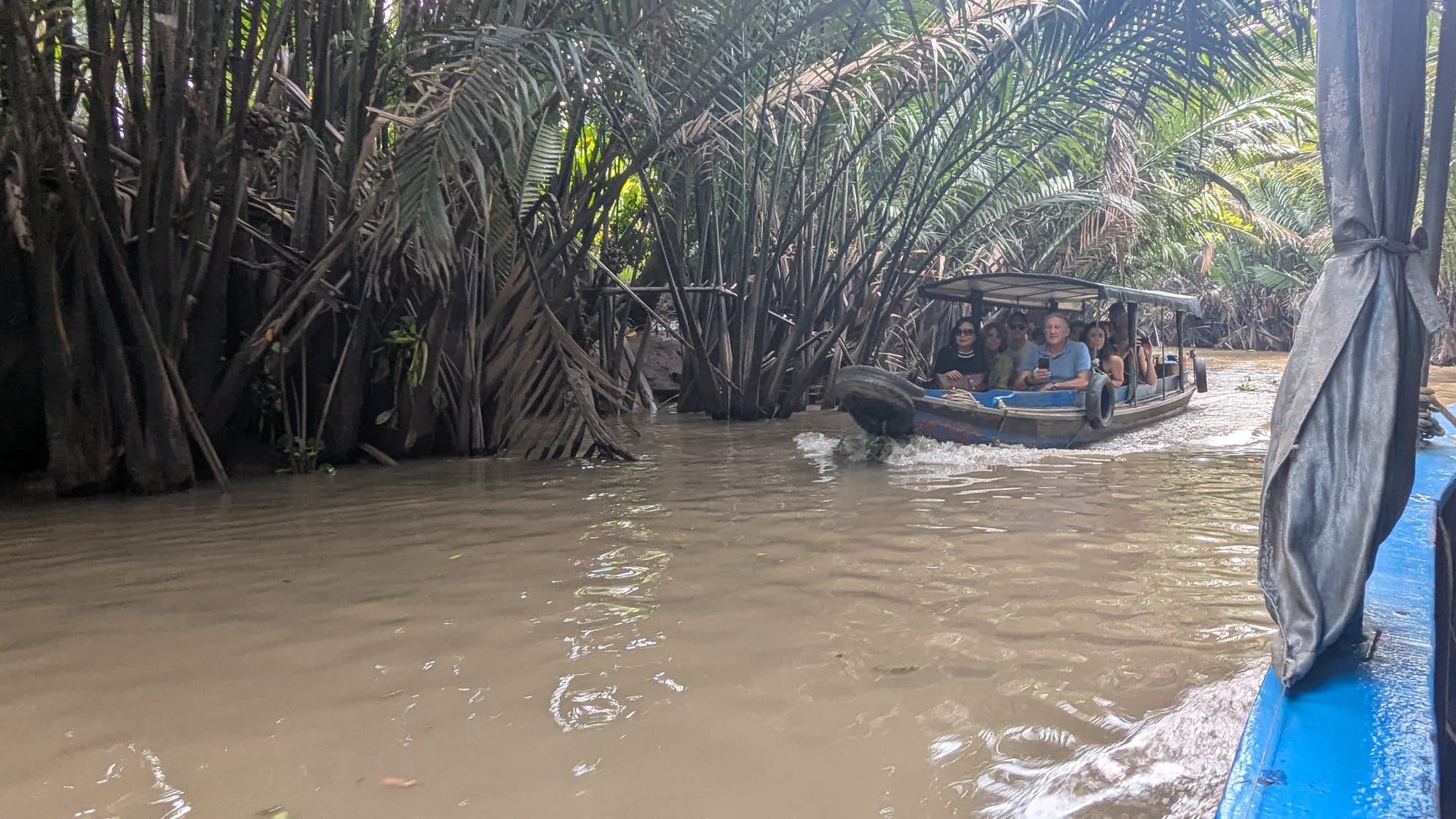
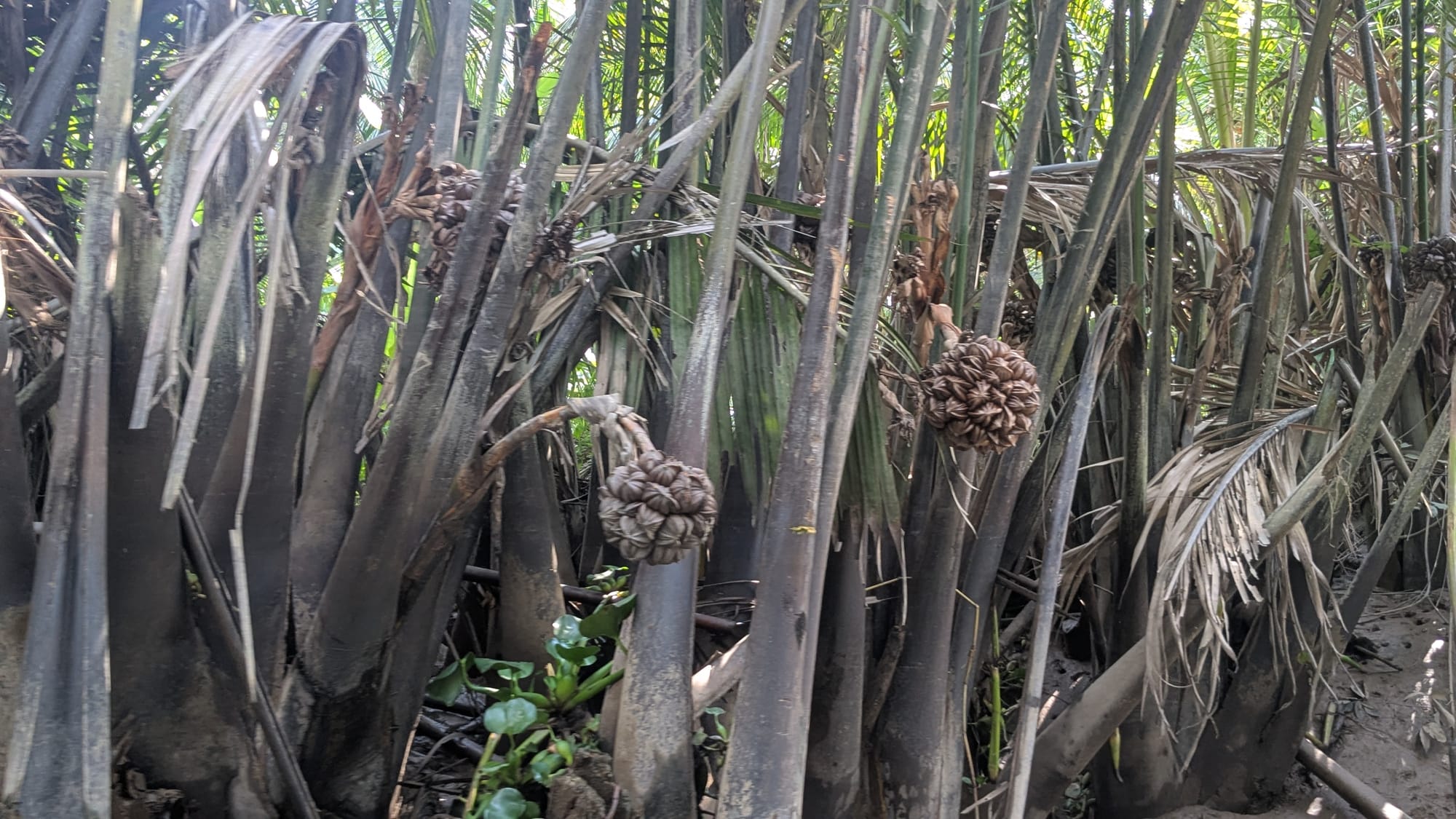
Next, the tour proceeds in a smaller boat through the canals of the Delta. The canal is incredibly well-shaded by giant palm fronds growing straight from the base of the plants at the water. I ask the tour guide what plants these are. In English, they are called the nipa palm, but in Vietnamese they are called the water coconut. The fruit of the water coconut looks like a fractalized coconut (a "biblically-accurate" coconut), or a medieval weapon, and he tells me the flesh is often eaten as a snack.
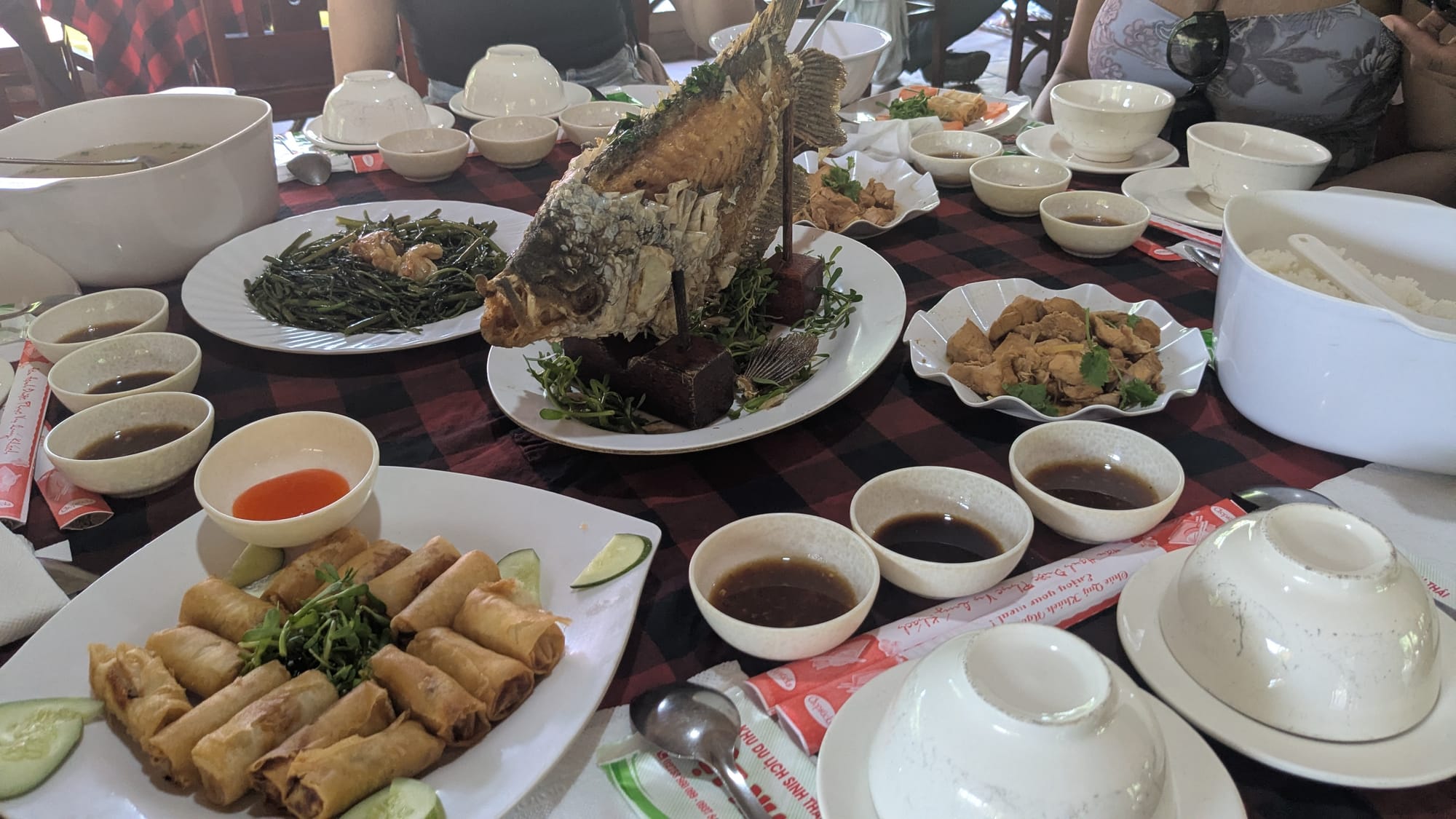
We have lunch family-style, the tour group split up across three big tables. A giant fried river fish is displayed on the table, which is then taken away to be carved. As several of us order cans of cold beer, I offer to teach them the Vietnamese way of toasting (1-2-3-Cheers!) careful to change the pronunciation to Southern style ("Yo!" instead of "Zo!" at the end).
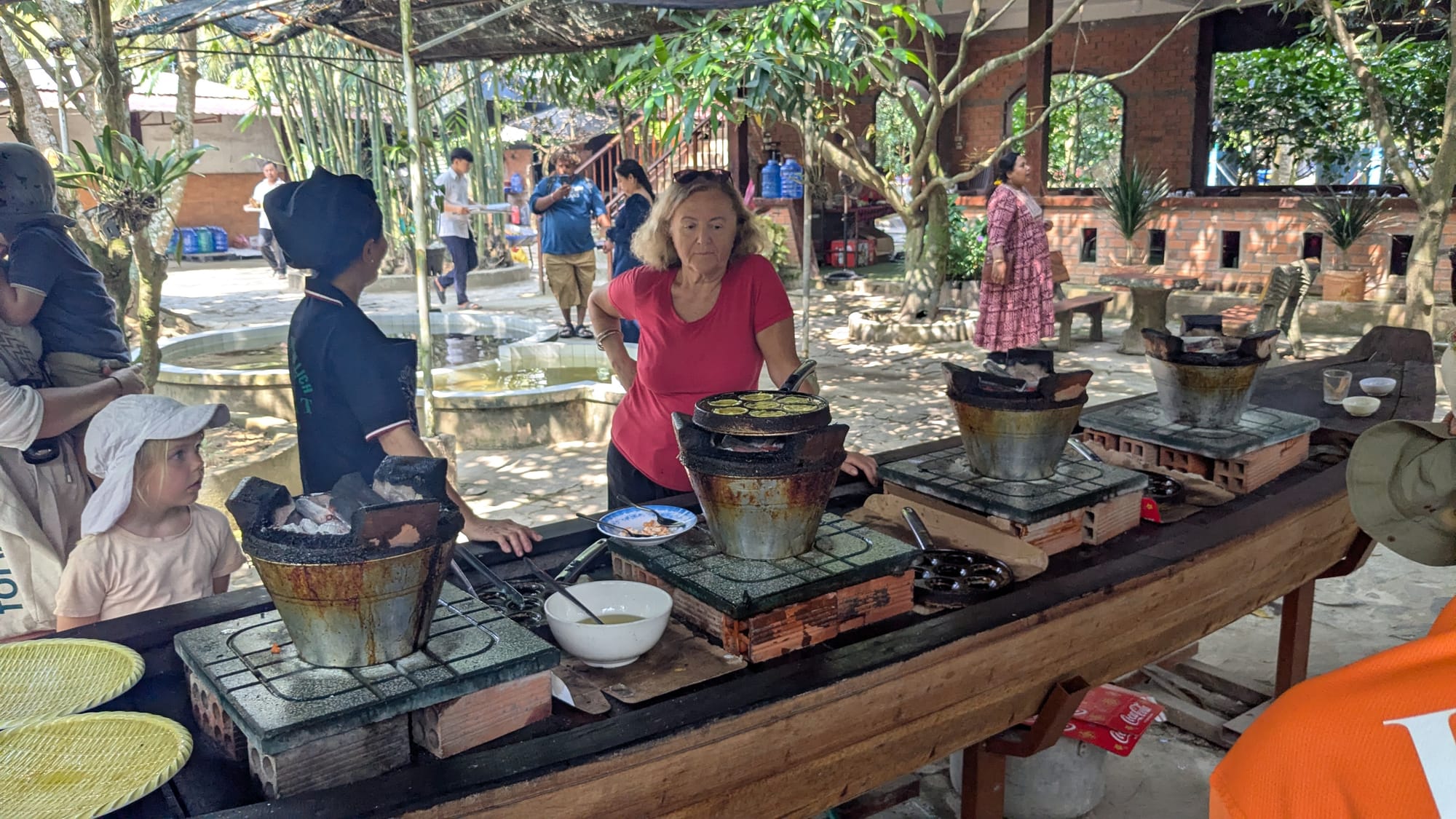
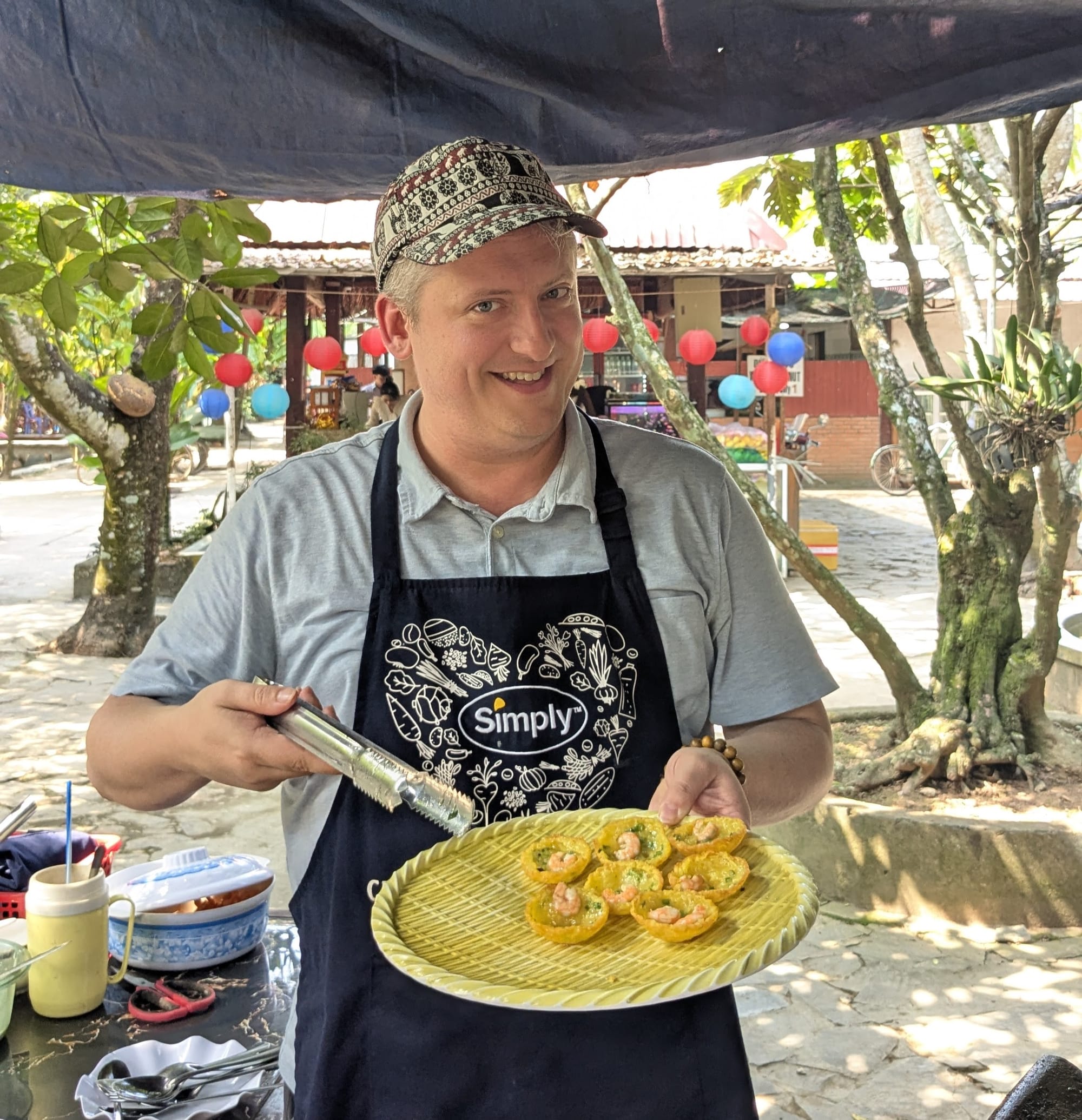
After lunch, the tour has several options for activities including the option to bicycle around for a little while, but the tour guide barely admits that option strongly suggesting we do other activities; seems like he's had people get lost on the bicycles. Anyway, I'm interested in the "cooking class" anyway, where an auntie who doesn't speak English guides you to frying little bánh khọt - turmeric-colored pancakes like mini bánh xèo with green onions and shrimp in the center. The edges curl up a little bit, and it's finished with a splash of sweet-salty fish sauce mixture.
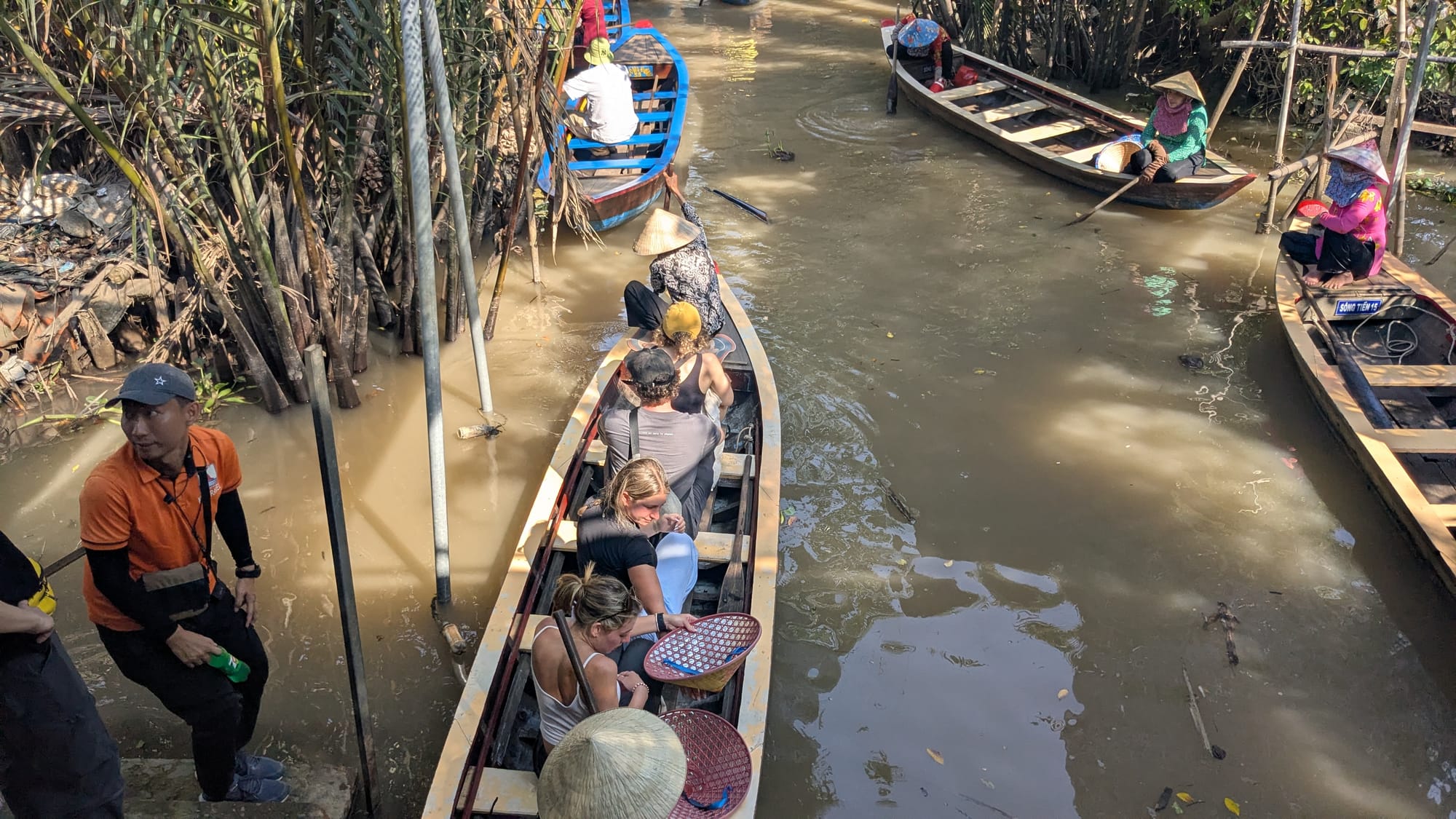
We take an even smaller boat through narrower canals, and I wind up sitting in front of the man at the rudder. I speak to him in Vietnamese and then try to converse with him a little despite the Southern accent making it a little harder for me to understand. Eventually, the conversation turns to the usual: I'm not married, so I should marry a Vietnamese girl.
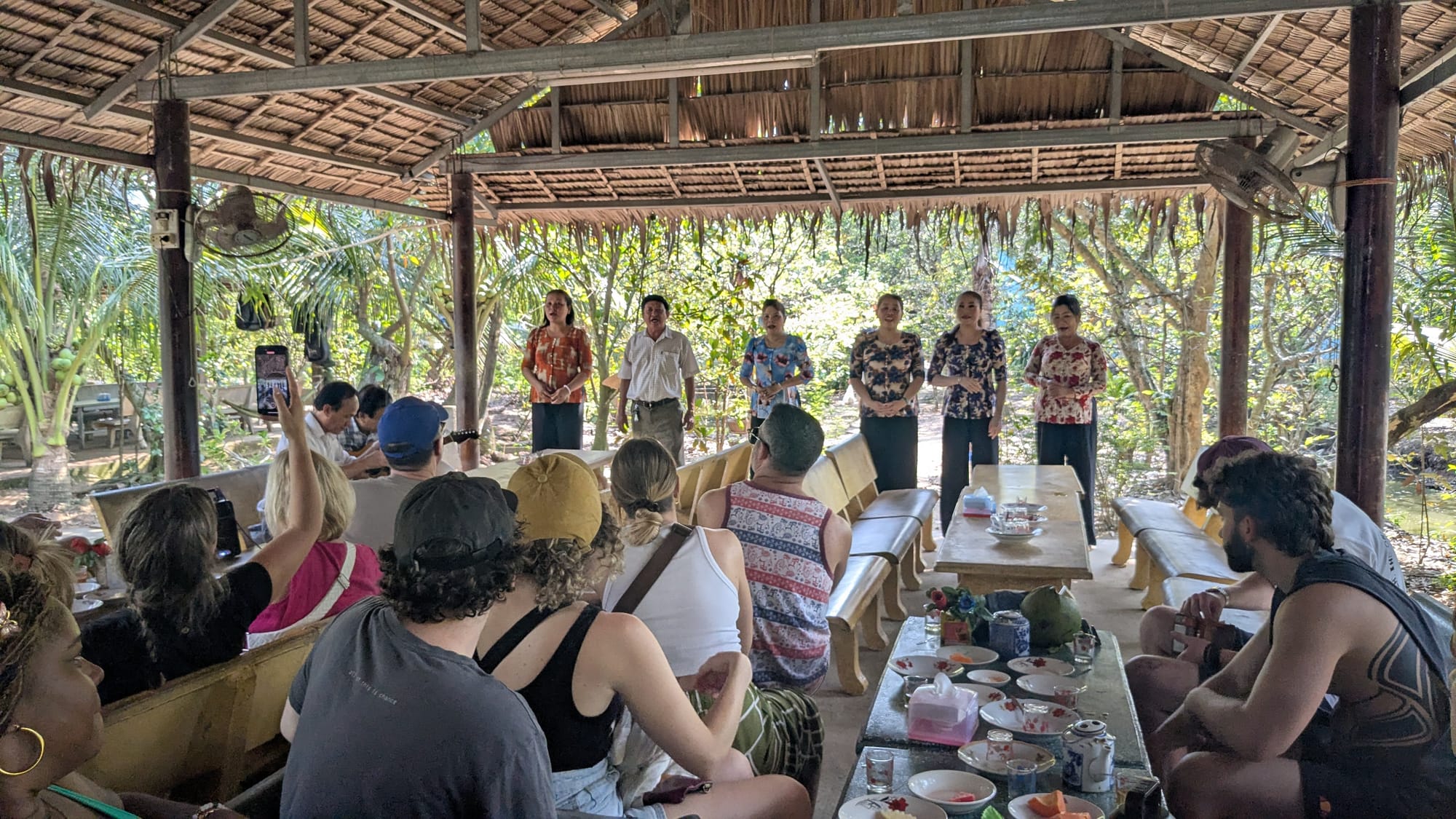
At the next stop, we are fed a sampling of local fruit while a troupe of đờn ca tài tử singers perform a few songs for us; it's lovely. They also sing "If You're Happy and You Know It" to try to connect with westerners. This type of traditional singing is part of the cultural heritage of the Mekong Delta that this style of tourism is aimed at preserving and is de rigueur in the textbooks I teach from.
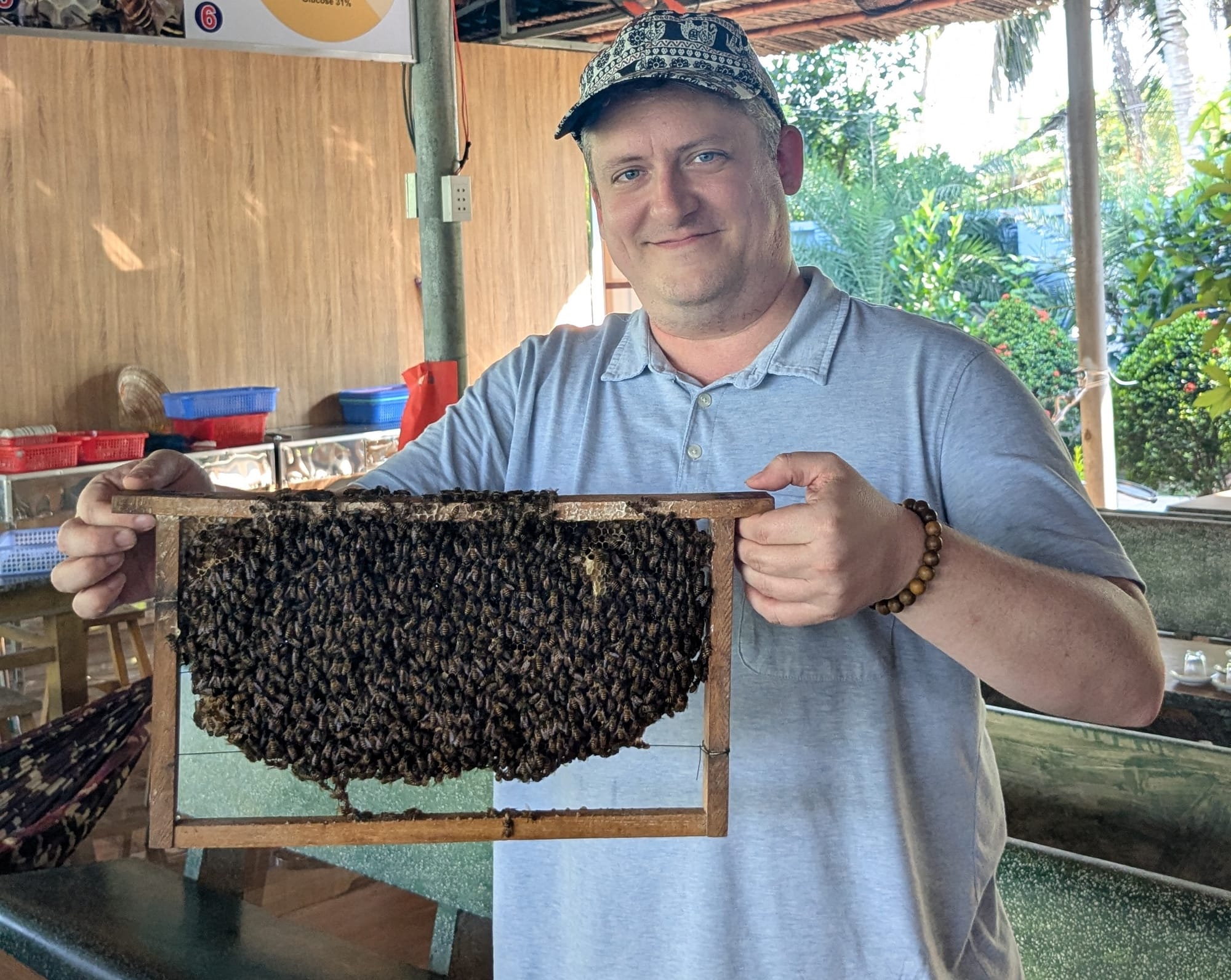
Finally, we are late and rushed through the final tour stop, a honey farm, where we sample tea made with royal jelly and pollen, which was incredibly fragrant with a complex floral aroma.
After returning back to Sài Gòn, I tried to connect with my group one last time, but their plans are very loose and they are in a different part of the city. I wander out to look for some place not too crowded to eat, but the smell of grilled meat beckons me to a narrow alleyway. People are packed around tables inside the alley. It's a cơm tấm spot. I order a plate and wonder where to sit, but fortunately one seat opens up before my food arrives. It's the best cơm tấm I've had all week and I will miss it deeply. You can find it in Hà Nội, but it's usually not this flavorful or fresh off-the-grill smoky.
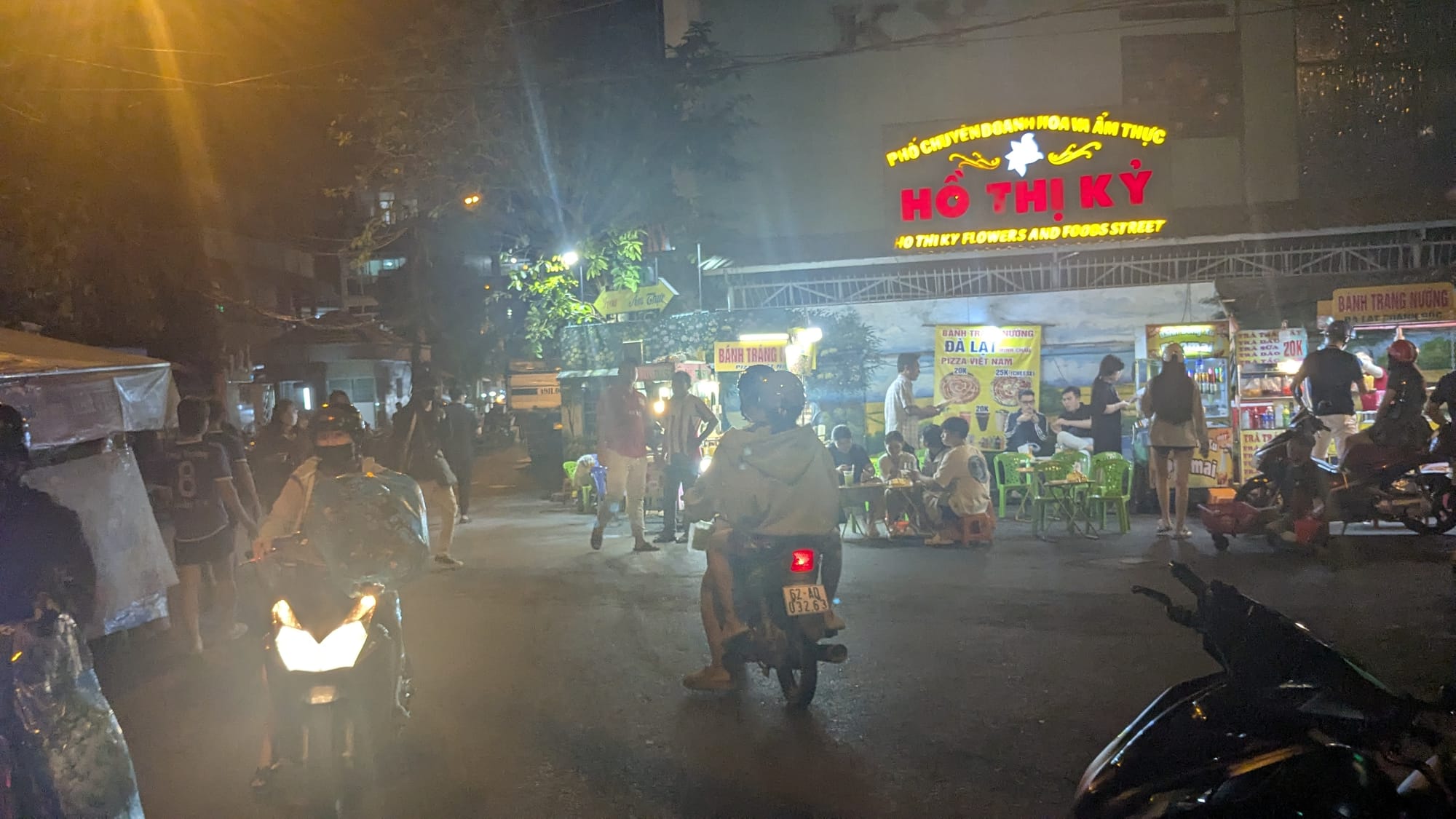
I venture out to a flower market that is closing for the day, but has a street food alley behind it. I'm amazed at the variety of the foods there; there are lobsters and abalone and all manner of seafood ready to be grilled to order. There are candy stands, and boba stands, and snacks made famous in Korea or Taiwan. A Japanese taiyaki stand is pressing the stuffed waffles on-a-stick into various shapes including penises.
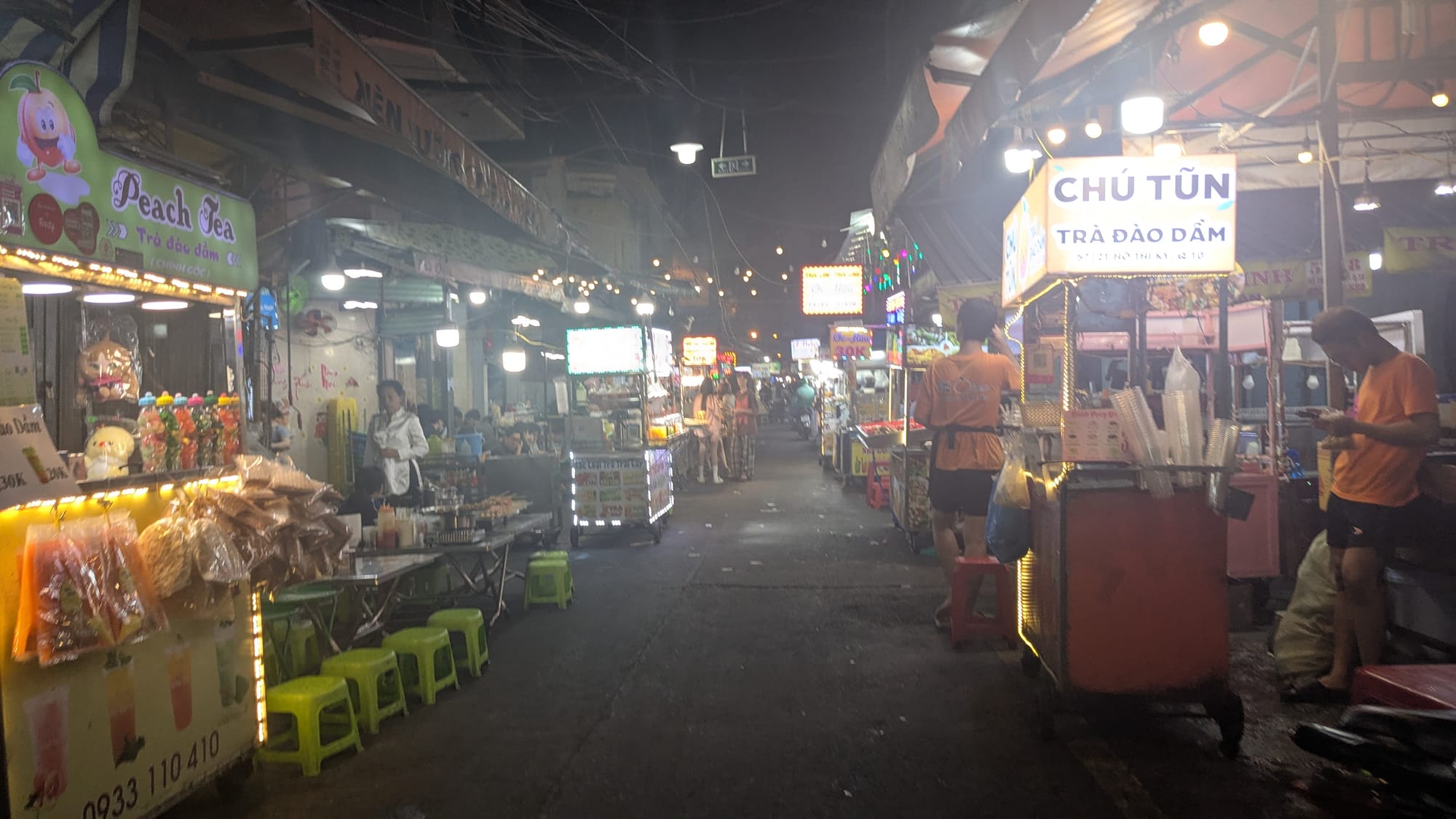
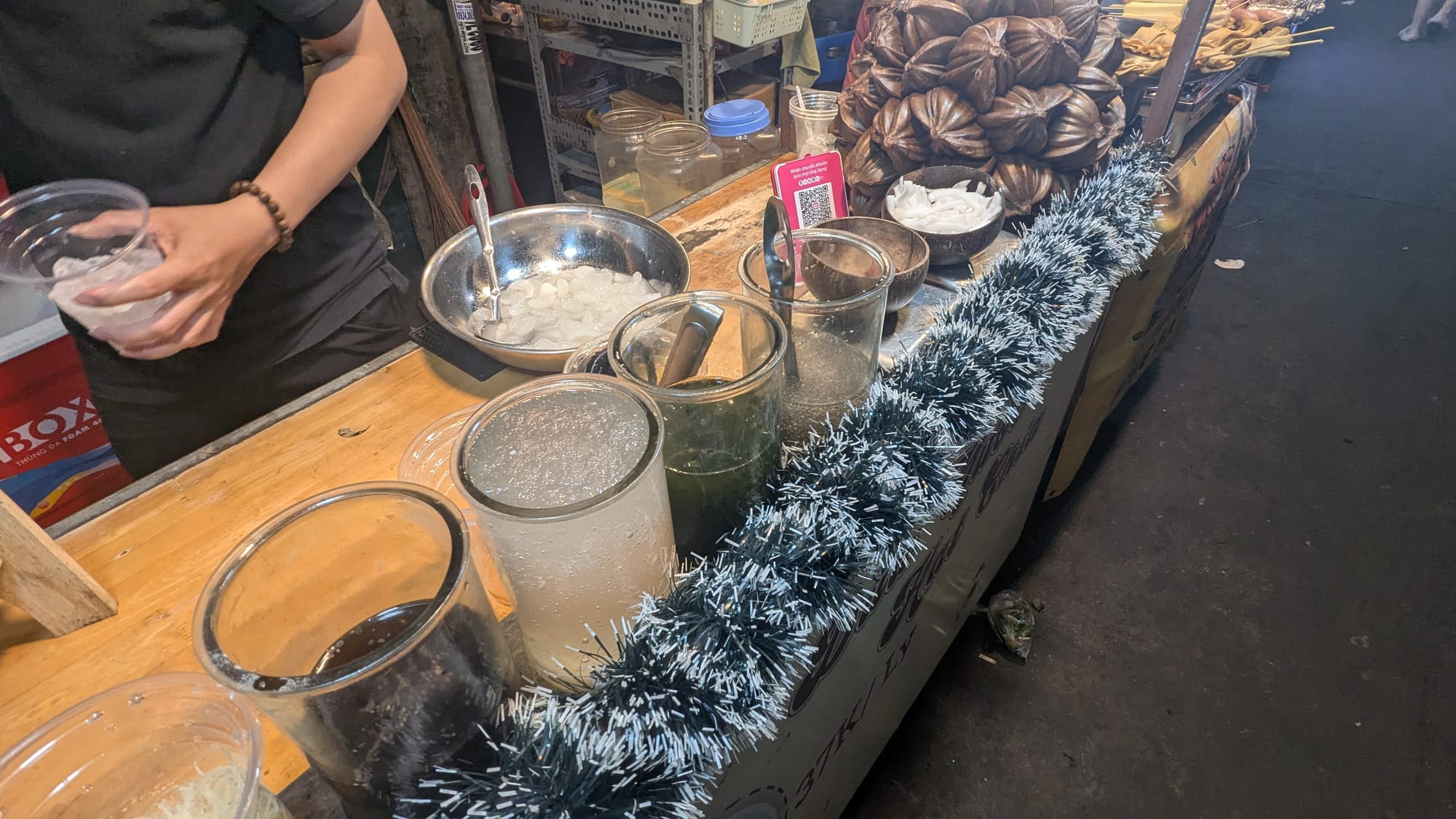
But I spot a young man with a giant "water coconut" on display at a cart with no customers, and so I stop and strike up a conversation. I tell him I've never tried it before, and ask for "full topping". The chopped gelatinous fruit flesh is put in a big cup over ice with toasted coconut, other fruits and jellies, mung beans and coconut milk, very similar to the dessert soup chè. Only a few of the components are sweet, so after mixing it is just sweet enough. The water coconut has the juicy texture of lychee but no flavor of its own (it is mostly water). But the concoction as a whole is both refreshing - from being cold and water-rich - and ultra-filling from all of the fruit fiber.
I am attracting more stares than normal, indicating this is not a popular tourist spot. There are homes in between a lot of these food stalls, and families are gathered around tables drinking and carousing for Saturday night. One woman has gathered a small crowd with her wine-inspired karaoke singing.
After strolling through the whole market, I pass the water coconut cart again. The young man still doesn't have any other customers. But I give him a thumbs up and tell him "Ngon quá!" (Very tasty!) and it puts a big smile on his face.
Monday
I communicate to my teachers that I have a short slide show about the Mekong Delta that I can present to classes if they want it as a warm-up. My vice principal is supportive (at least in the group chat) and instructs the teachers to make time for my presentation.
I only end up sharing the stories with about three classes, but it works really well with the 11th graders, who are currently learning about cultural heritage. The textbooks try to use an even number of examples between North, South and Central Việt Nam, and the examples of Mekong Delta culture from my tour are almost verbatim a part of the textbook.
The longest break in between classes is 10 minutes, and it takes place after 2nd period at about 9:00am. Students rush to one of the walls of the schoolyard, passing cash through the iron bars to the wife of the security guard, who's selling bánh mì (less than a dollar) and bags of chips.
I take this moment to bring my gift to the teachers to the break room. An assortment of the coconut candies. There are big smiles all around, and I'm surprised when they look at it and say the name of the village where I got it.
"Bến Tre! Bến Tre!"
But I shouldn't be so amazed, as Vietnamese always bring back the "specialties" of different regions when they travel, and every place leans into one "specialty" for "brand recognition". Even if you don't travel, at any given grocery store you're likely to find Ba Vì yogurt, Hải Phòng paté, Ninh Bình cơm cháy (puffed rice crackers), or Mộc Châu bánh sữa (milk candy).
Thursday
A very cold morning, 50 degrees Fahrenheit, and humid. Brisk. Going down the hall to shower in the morning, which I usually do in my shorts, is a little bit rough.
First period, 10th grade class can't pay attention. They're restless. And just as soon as class ends, two students whip out a small portable chess board and start trying to play a match in the five minutes between class periods.
In the teacher's room, we all drink tea as usual. Mr. H, one of the gym teachers looks like he's struggling to keep warm. He looks at me and points to my two layers. And then he points to himself, and says he's wearing four layers! The layers here are very thin though, even the jackets could barely be classifed as windbreakers.
I teach another 10th grade class with Ms. L, and for once the co-teaching goes exceptionally well. I feel like she's finally starting to trust me, especially with pronunciation exercises. I stop to teach them that "kindergarten" is actually from German and translate "child garden" for them in Vietnamese. They have a similar phrase "vườn trẻ" which I think they came from the French during the colonial era.
When one girl in the back successfully translates "gender equality" into Vietnamese, Ms. L suddenly asks her "Do your parents treat boys and girls differently?" The girl quickly says "Yes." Ms. L laughs and says "I need to talk to her parents."
I take the opportunity to ask the class, "How do parents treat boys and girls differently in Việt Nam?" Some students offer some things in Vietnamese I can't quite understand, but Ms. L explains that since boys often (well, traditionally) live with their parents after they get married, while daughters go to live with her husband's parents, they sometimes are treated differently at home. Traditionally, the girls would be expected to do more chores in order to learn to do them well.
Ms. L makes it clear that she treated her children equally.
(They are both boys.)
Friday
After classes I try to schedule a taxi using an app to go to the nearest town. When I get the call from the driver (I assume), I can't understand him. I tell him I speak a little but can't understand and tell him where I want to go. After the call is over, he cancels the trip. I try to schedule another, but this time they don't accept the trip at all. It's dispiriting.
Coming back from Sài Gòn I had to rush back to site and didn't make it to an ATM. I'm stuck in town with almost no cash. Today was payday.
I scrape together enough for the bus fare, and this time I ride it for about 45 minutes north, passing the small convenience store-sized Winmart that I sometimes go to buy refrigerated chicken meat. After 45 minutes, I come to the closest towns that have ATMs, and also a Lanchi Mart.
The Lanchi Mart is as big as an American grocery store (or rather, as big as they used to be before K-Marts and Walmart Supercenters turned every new grocery store into a superstore). It's even laid out a bit like a Walmart with bread and produce on the right, dry goods in the middle, and appliances and clothing on the left.
In the front of the store, there's even a KFC. Yes, really! Whenever I come here - which has only been three times in the year I've been here - I often think, maybe I should get KFC as a little treat. See what's the same and what's different.
And then I think, "nah". I'm good.
I'm in the back of the store looking through an assortment of spices with Google Translate, trying to find some things I'm missing to better approximate Mexican cuisine in my kitchen, when all of a sudden I hear running feet from clear across at the other end of the store. Three teenaged girls are running towards me.
Out of breath, their best English speaker interviews me: "What's your name?", "Where are you from?" I tell them what I do and where I live. We get to the end of their English small talk capacity very quickly, and then they're just like "Okay Bye!" I'm relieved they didn't ask for selfies. I was going to feel awkward, especially with several security guards wandering the aisles.
I stock up on coffee, both instant - for that first cup in the morning - and ground coffee for my filter, which I am finally getting the hang of and using in the afternoons.
After checking out, a security guard carefully checks the contents of my bags to my receipt. I have even bought some new things for my kitchen, so my total was about a million VNĐ. Then, he points to a tear off at the bottom of my receipt, and mimes for me what he expects me to do next. He gives me a pen and points to a big glass box with a slot in it. I'm supposed to write my name and put this paper into the box where other customers have been doing the same.
I'm totally confused, but after I put my name on it, and see that it wants my address, I pull out my phone to Google Translate it. It's a sweepstakes. Since I bought over a certain amount, I get an entry into a drawing for some grand prize. I don't know what. But I chuckled and put the school's address on it and entered the lottery.
Saturday
I go to the market. All the pork vendors shout at me when they see me coming. I look for the one that seems to have not sold as much and also look for the cleanest butchering. Sometimes the cuts of meat on display are completely unrecognizable hunks of miscellaneous flesh. On this occasion, I accidently end up buying double what I normally buy, but I decide to stick with it.
Then I go to a new vendor with crates of eggs. I try to buy a dozen but he talks me into buying two dozen for a slightly better price. I get two dozen for the equivalent of $1.25 USD (brag). I carefully place the eggs in the bottom of my empty rucksack, carefully cradled on my back for the ride home.
I grab my bike and slip the parking attendant a 2,000 VNĐ note for watching it. But as I walk my bike out into the busy square, a man comes up to me loudly and stops me pointing to my wallet. At first I think it's about the parking, which I've already paid for. But soon it becomes clear that he's drunk, and he's saying something about drinking wine. I tell him I don't have any money. Which is the truth, I spent more than I planned to this morning and used up everything I had.
Finally, another man I don't know comes over and berates him and gives him a few thousand to leave. I ask this man to confirm what I guessed, he wanted drinking money. I have never encountered a beggar in Việt Nam to date. Usually, instead of begging people will try to resell something cheap to you.
I tell this second man I'm a volunteer and don't have much money, but I can understand why people usually think I have a lot of money. Because a little bit of American money does go a long way here.