This Week: Searching for Stories in Far-Away Lands
3,000 Years of Longing delivers a visual extravaganza worthy of a modern update on One Thousand and One Nights, but unfortunately feels fairly shallow.
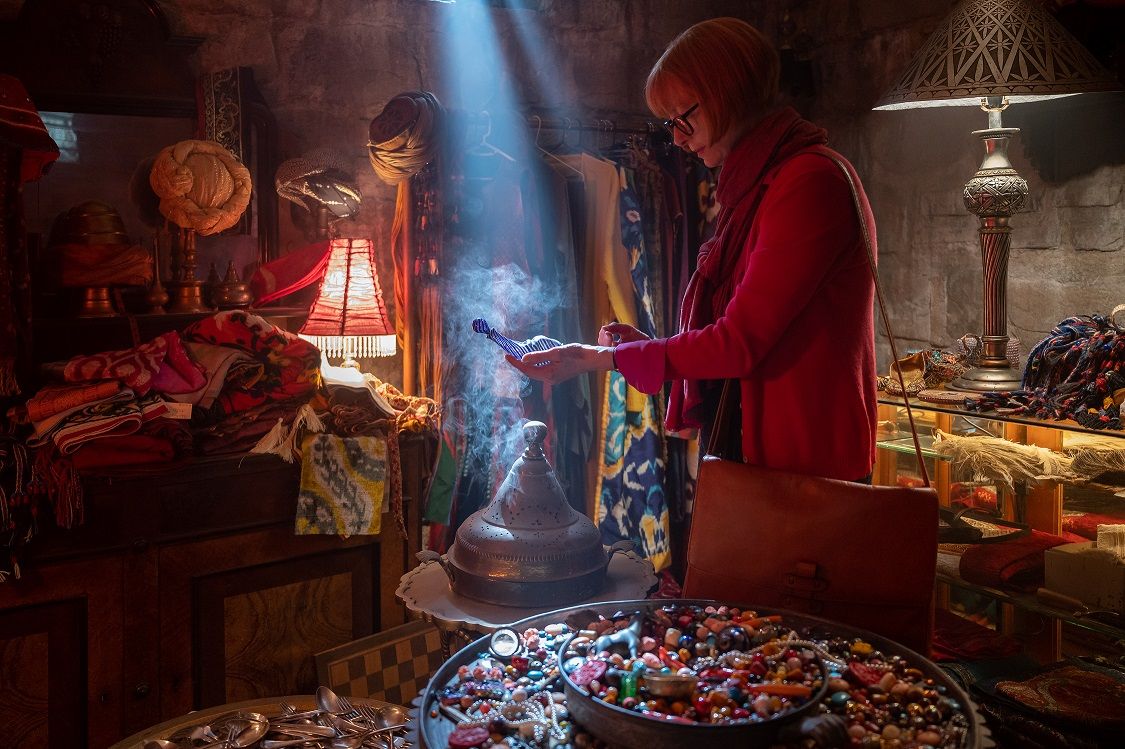
3,000 Years of Longing
Australia/USA, 2022, d. George Miller, In theaters now
George Miller is one of our finest cinematic storytellers, with an exciting and uncomplicated visual style which has served tales as diverse as Babe, The Witches of Eastwick, and the Mad Max series. 3,000 Years of Longing delivers a visual extravaganza worthy of a modern update on One Thousand and One Nights, but unfortunately feels fairly shallow.
There's a lot to love here. The chemistry between Tilda Swinton's stoic academic and the giant smoldering djinn of Idris Elba is fantastic. The bulk of the movie is spent in Tilda's hotel room as she learns his backstory through a series of elaborately production-designed flashbacks. An early gag about "the one thing all women desire," would seem to be ripe for further discussion in a movie about a genie's wishes, but it's soon forgotten. Later when Tilda makes her first wish, the movie pays lip service to the power she holds over him, but ultimately glosses over it and makes it all part of the happy ending. (See Kristy Puchko's review for a detailed take on why Tilda is really the villain.)
This movie sticks to the "Once Upon a Time" fairy tale set-up, and in the end that's what prevents it from becoming truly great. Since it never interrogates Tilda's narratology ideals, or create true conflict between its two protagonists, it becomes little more than an archaic pastiche.
This includes its outdated orientalism. Tilda's character excitedly travels to the most - to her - exotic places to study the stories of other cultures and explain them in only the way that she can as an academic. There is a Eurocentric point-of-view to this that is perhaps inevitable to the source material (the story "The Djinn in the Nightingale's Eye" by A.S. Byatt), but again the movie never interrogates this. So, ultimately this story about storytelling doesn't illuminate the subject.
Inu-Oh
Japan, 2021, d. Masaaki Yuasa, In limited release now
Inu-Oh is also about the power of storytelling, albeit more specifically the power of songs to tell stories, move people, and provide immortality to their songwriters.
Masaaki Yuasa is already a well-established voice in Japanese animation, but one of idiosyncrasy and experimentalism. Inu-Oh is not as commercially appealing as his previous feature Ride Your Wave, but it is sure to be a cult hit, as it mixes all the things he does best in a story about a curse, a demonic mask, and Noh theatre.
The story takes place "600 years ago" in feudal Japan and sets this up in a prolonged and dizzying prologue through the many psychedelic styles of animation Yuasa often utilizes. Eventually our story coalesces around a blind biwa player, and a deformed trickster with one incredibly long arm, who seems to change shape whenever he completes a new song.
They become rock stars, and the movie depicts this with '70s glam rock reminiscent of Queen or David Bowie. This is the fulcrum on which you will either love or hate this movie, which ultimately has more of a vibe than a full character arc; it climaxes in a series of rock opera performances which would be truly something to behold if they were real. But here, the freedom of animation falls short of the inspiration Yuasa is trying to convey.
Inu-Oh is much more awe-inspiring in the first half when it portrays Japanese history in time-lapse, feudal life in stunning detail, or the "point-of-view" of the blind biwa player in swirling, impressionistic watercolors.