Living in Việt Nam, Pt. 8 - Just Do Your Best
April 2025
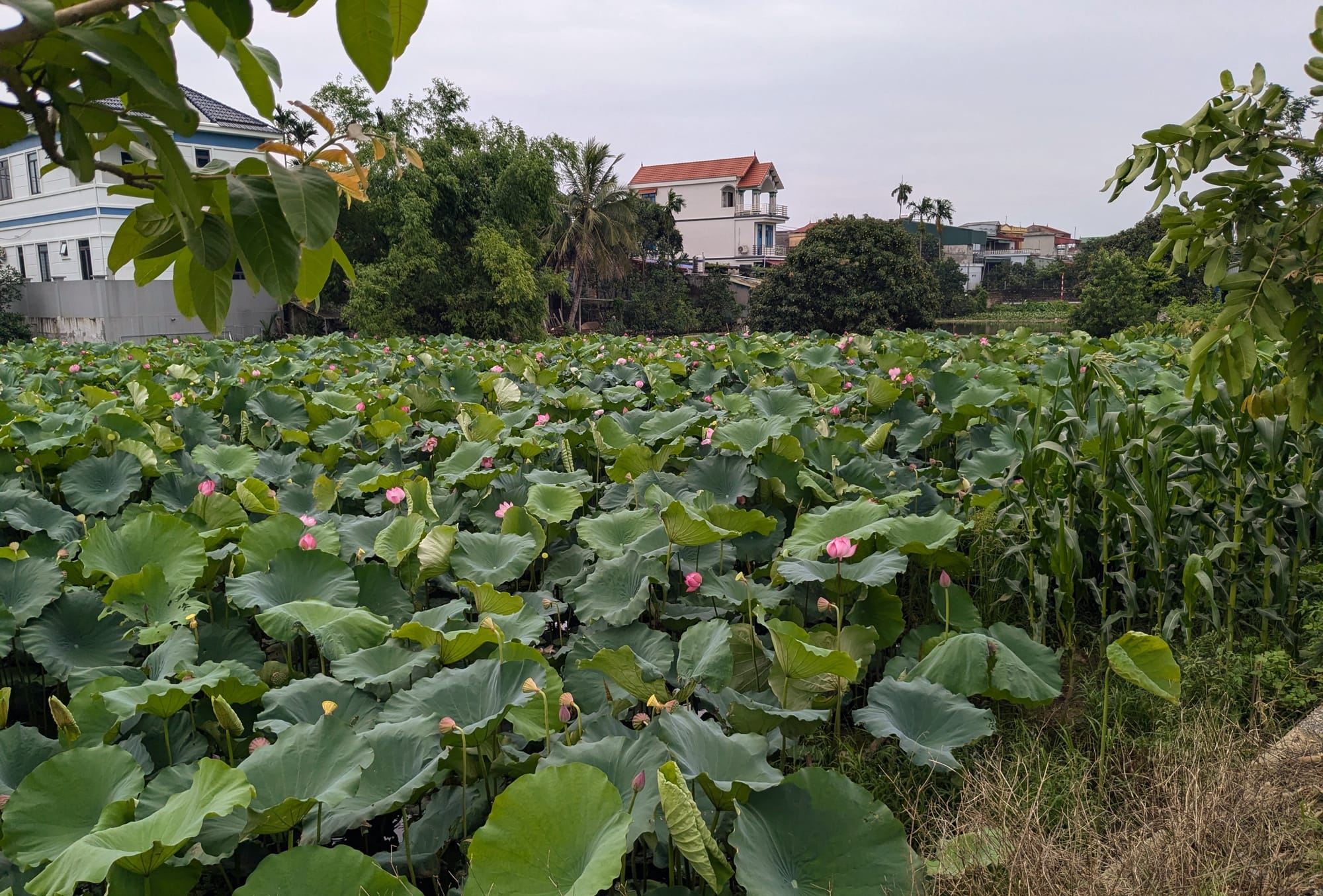
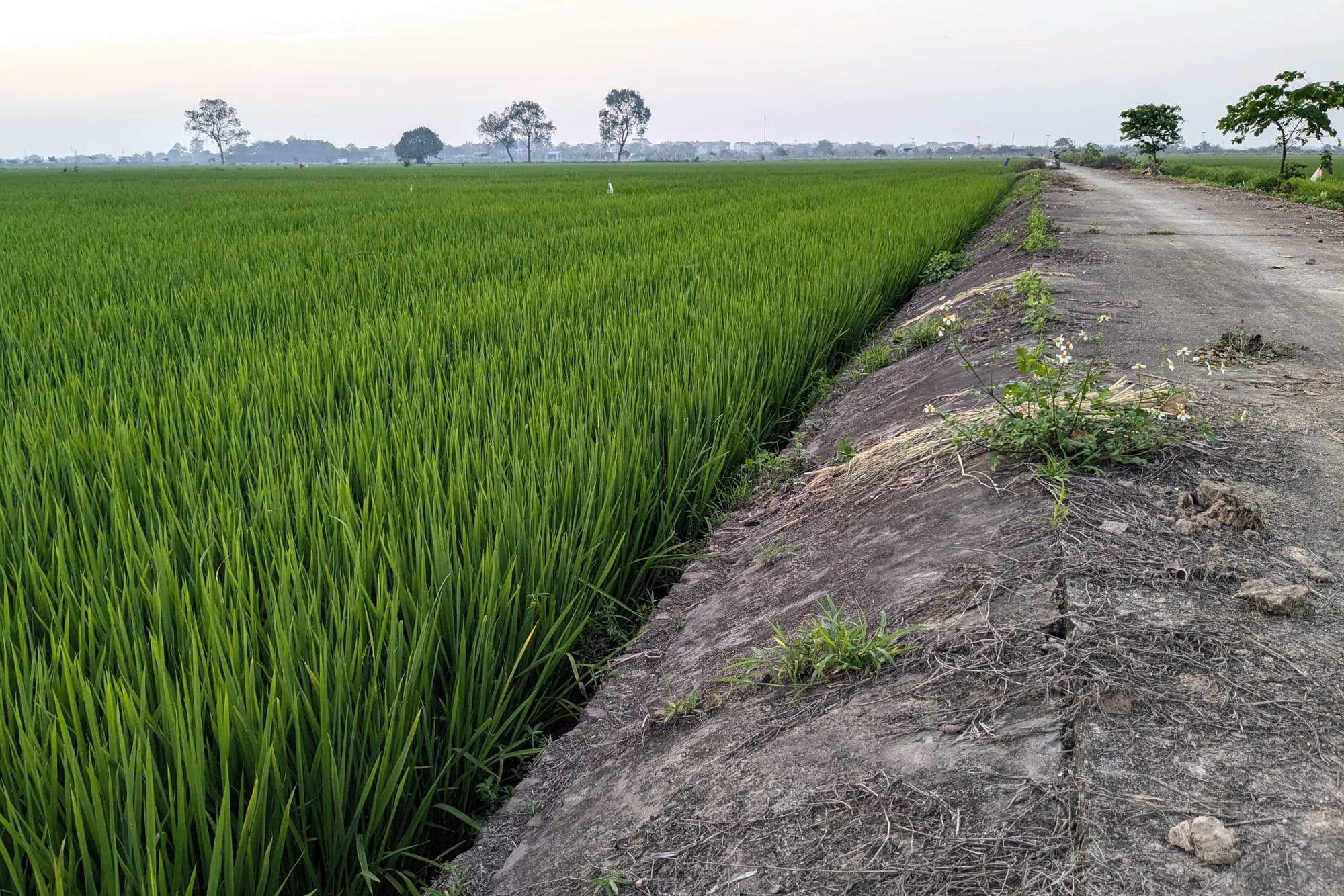
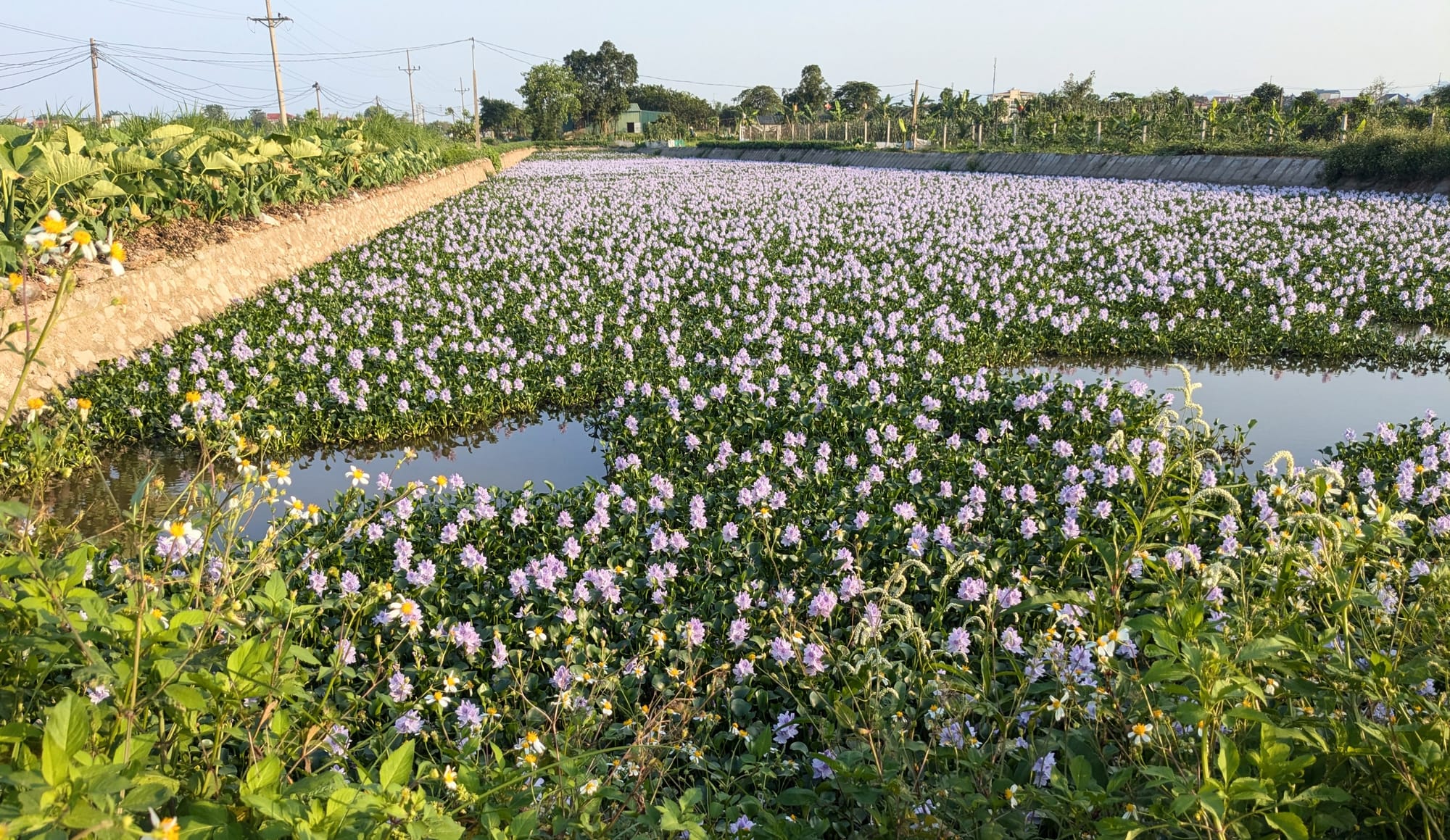
I don't think there is a deeper green in the universe than the green of fully grown rice in a paddy field.
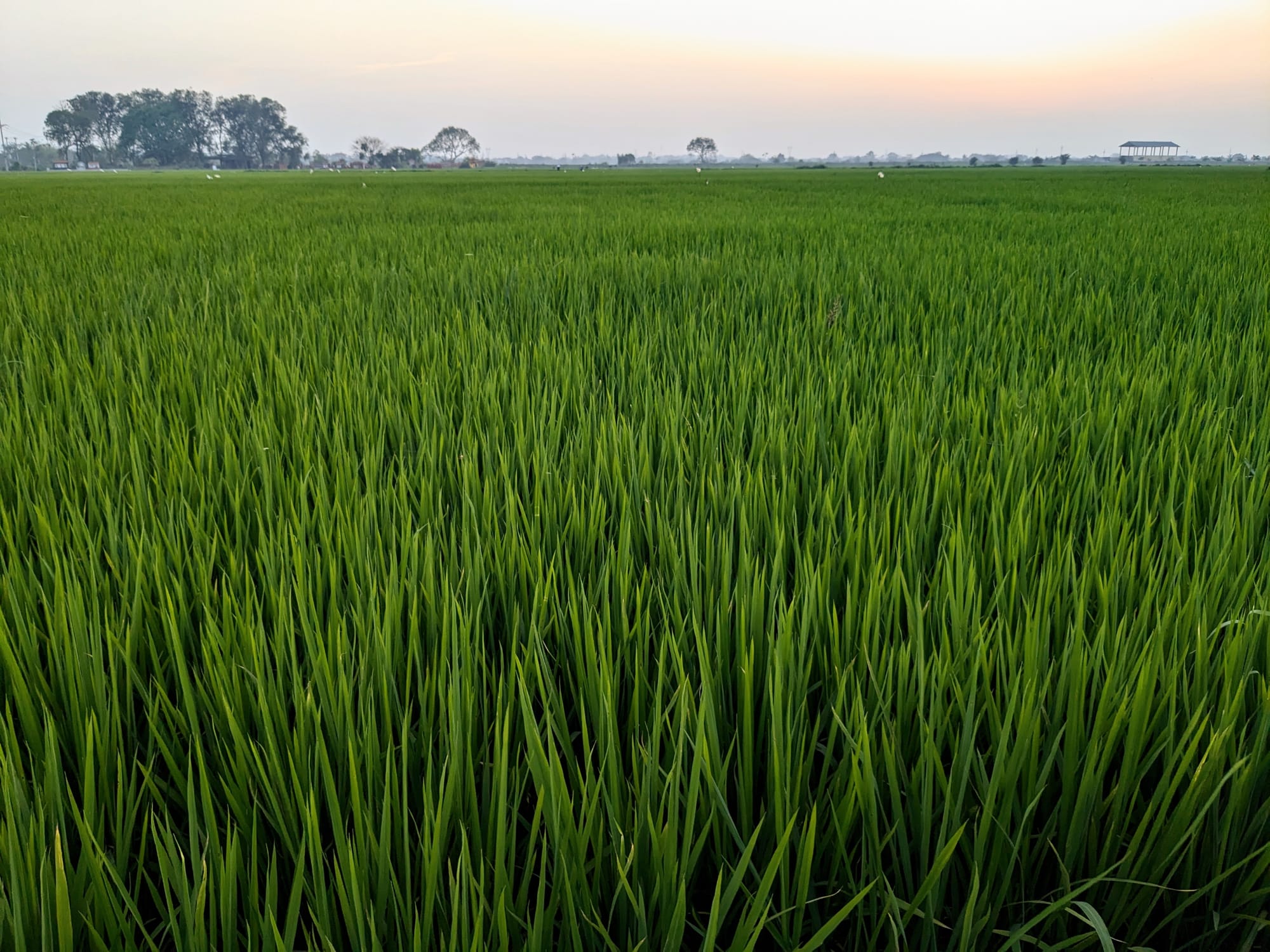
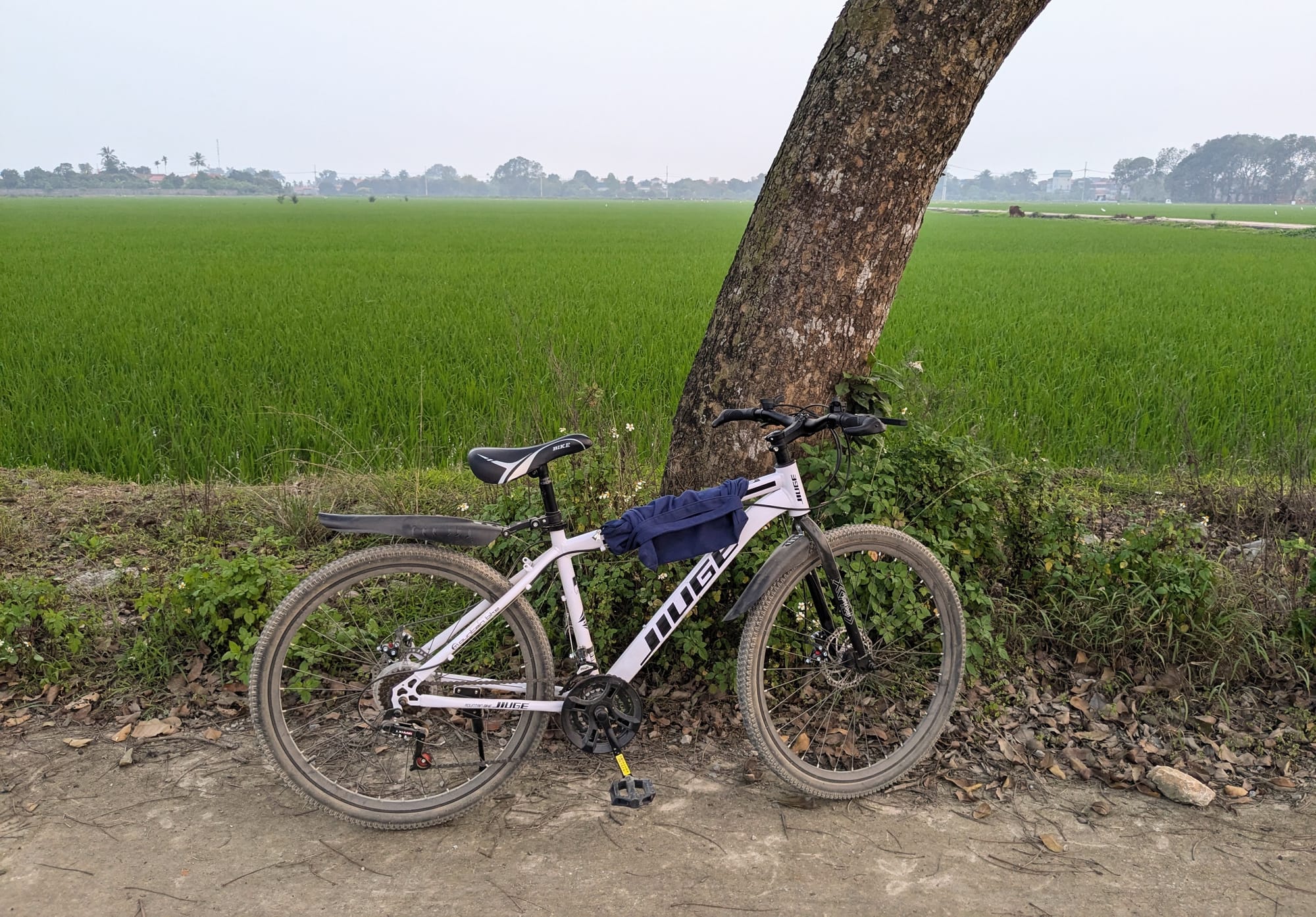
Most afternoons, when the school empties out, I take off on my bicycle to the narrow roads paved with white cement that criss-cross the fields. It is rush hour and the main roads are full of people returning home on motorbike, and big dump trucks hauling away construction rubble. But the fields have little traffic.
I put one earbud in my right ear to listen to music, keeping the left ear open to hear the honk of a motorbike or truck coming up behind me and letting me know that they are passing. I crank up the volume on "Dancing in the Street" by Martha Reeves and feel the wind through my shaggy hair as I fly through the fields admiring their beauty.
My troubles melt away in these moments, wicked away with my sweat in the evening breeze. And I think, this is such a cool place for me to be right now.
Fine.
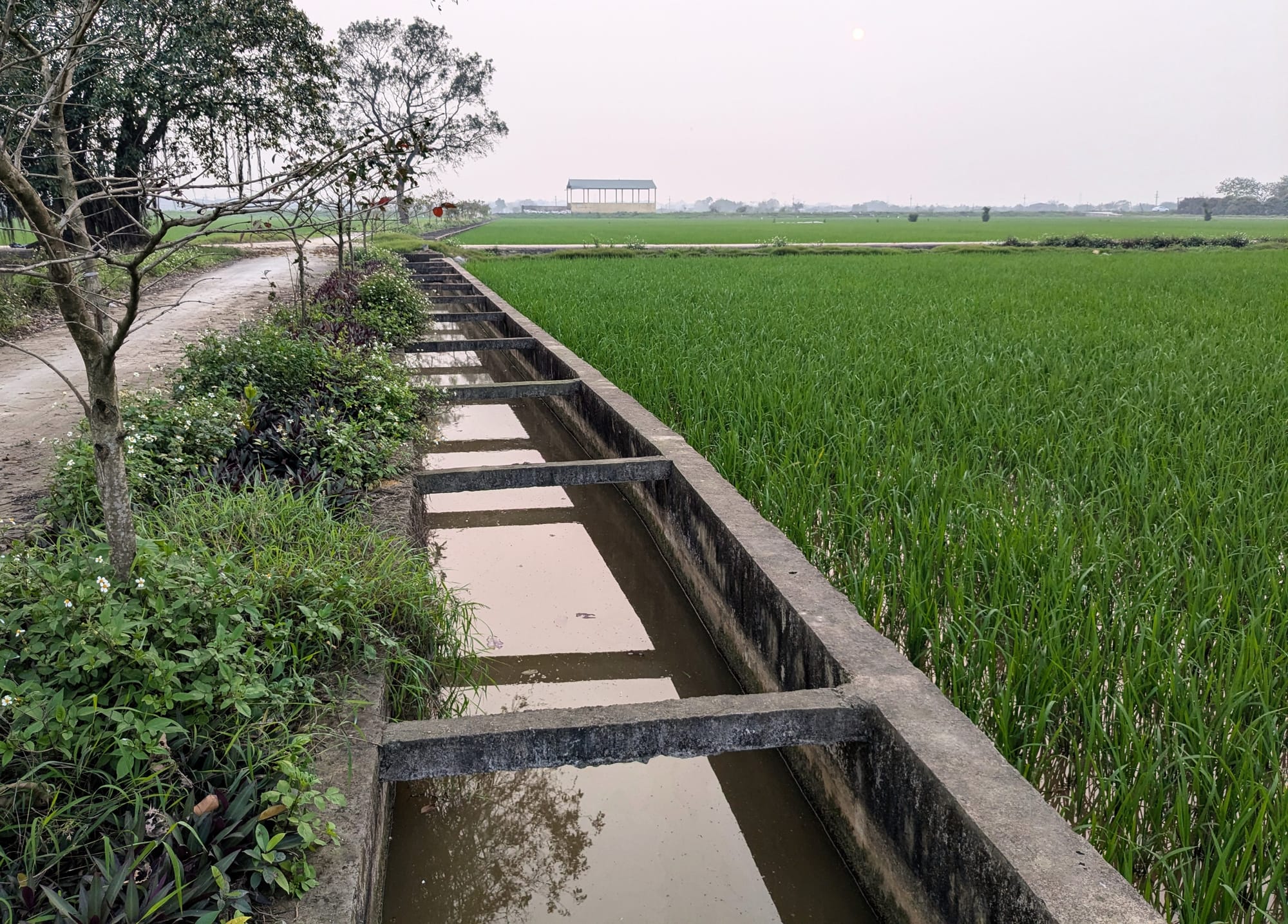
There is a clever system of drainage and irrigation running through the fields as the rice requires continual submersion. The roads are built up three feet off the ground, frequently crossing sluice gates. For the first few weeks, the rice grows a noticeable amount every day; I am shocked at how quickly it is up to the height of the roads.
As the sun sets, the farmers are out working again. They are burning small piles of trash at the side of the road or flinging scoops of white powdered fertilizer into the wind to settle over the rice or picking vegetables. At the side of the road every inch of useable earth is planted, so I ride past narrow rows of green onions, spinach, cabbage, sweet potatoes, or even a single row of corn. When it was rice planting season, the farmers worked together in rows in knee-deep water to plant the fields. It seems that every farmer in the area is over the age of 50 or 60.
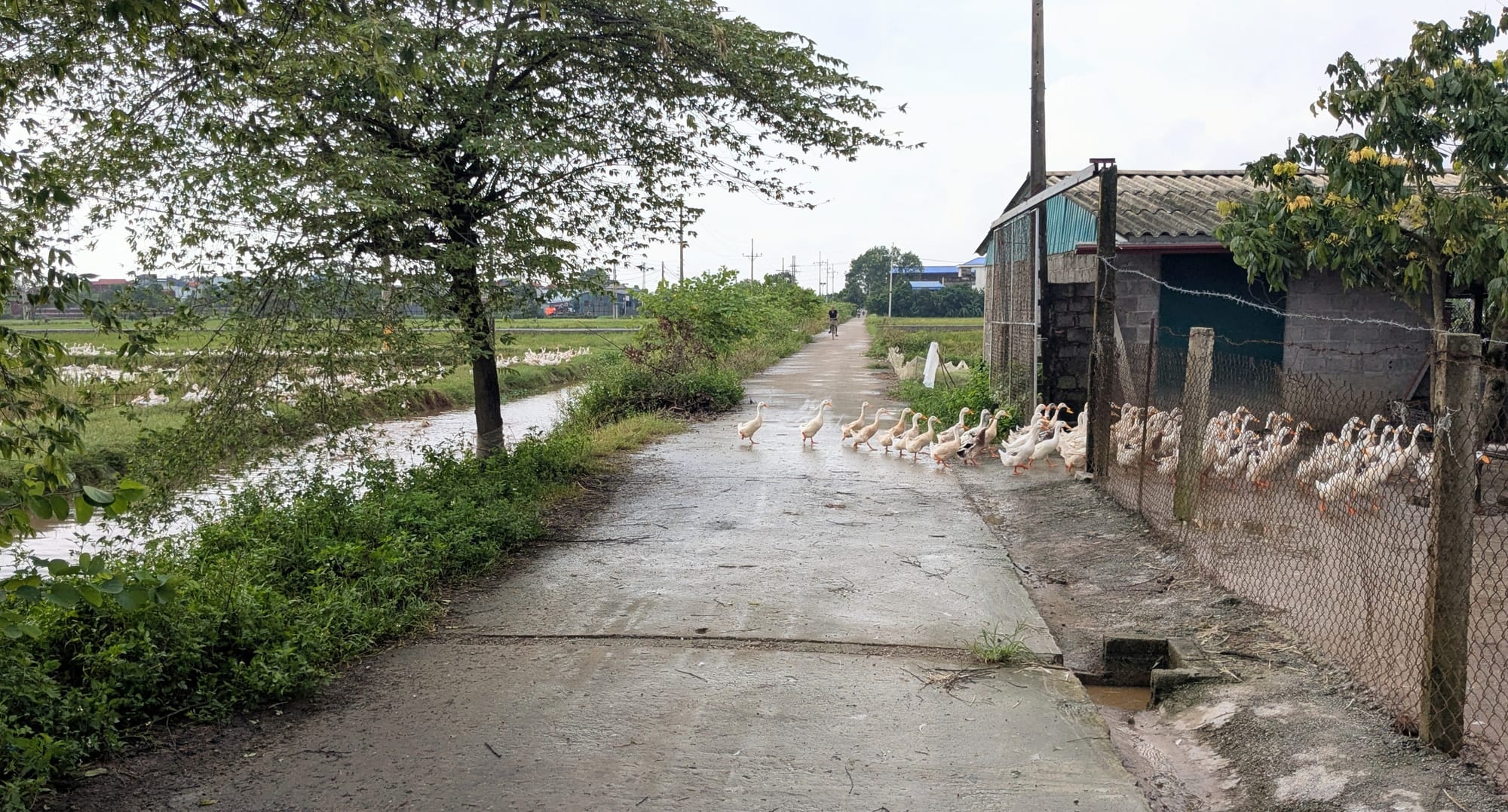
Fences are rare except for the duck farms, when a hundred ducks will scatter away from my passing bicycle. Occasionally I pass a lone brown cow tied to a stake with its calf next to it, an organic lawnmower munching on the weeds alongside a foot path. A man on a bicycle stops every few hundred feet to dip a long pole with a loop on its end into an irrigation ditch. The pole is attached to his backpack with electrical wires. I learn that he is fishing: sending an electrical current into the water to stun fish long enough to yank them out with the loop.
Primary school students roam the villages freely before dinner, and the curious kids often follow me for a little while. I'll turn to see two girls on one pink bicycle with training wheels following me at a distance, or they'll zoom by and the one on the back will shout "Hello!" I wave and say "Hello" back. Invariably, they burst into laughter, ride away and disappear.
Occasionally I'll pass another man bicycling for exercise in the afternoon who will want to talk, or an old man will wave me to come over and join him with his friends. They are sitting on park benches in the shade of a tree on the edge of a village. He asks me the same questions that start every first meeting: "How old are you?" and "Do you have a wife?" I tell him I'm a teacher at the high school, and that I'm here for two years, and that I don't know yet whether I'll marry a Vietnamese woman. He repeats everything I say to his friends with better pronunciation so they can understand me, and they smile and nod. Then I learn that he is 85 (he barely looks 65) and he also rides his bicycle every evening for an hour.
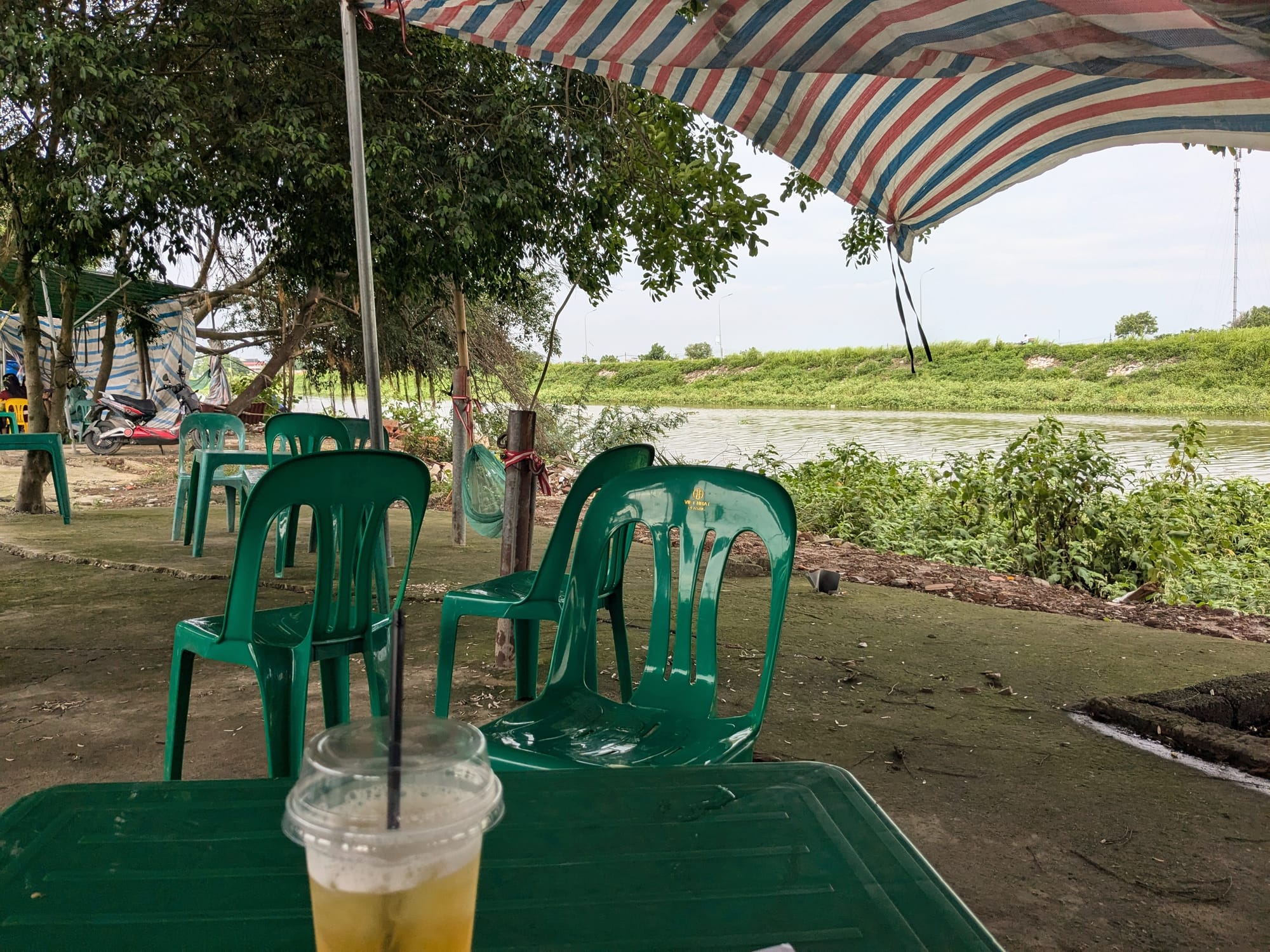
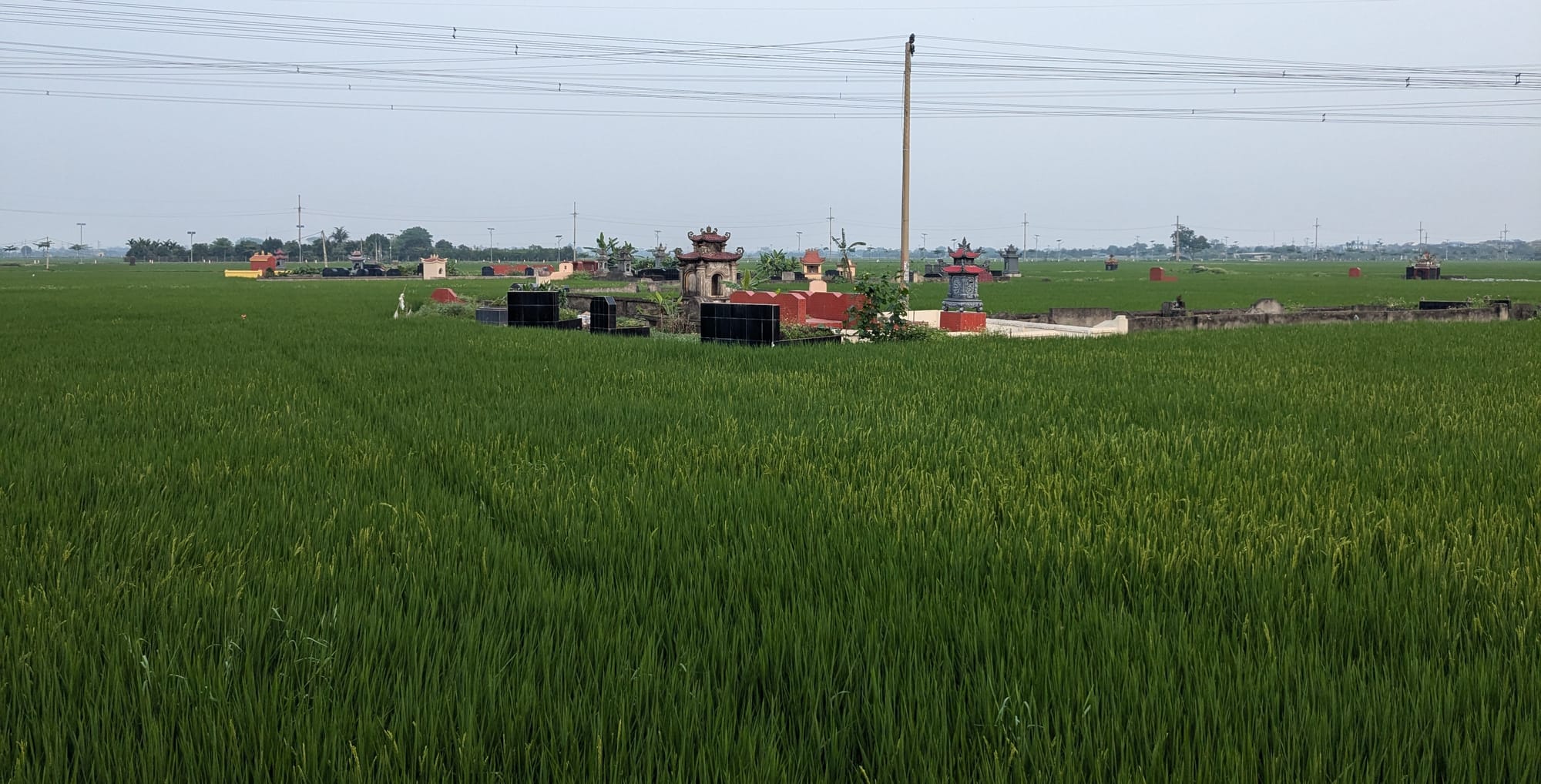
We sit for a few minutes with a beautiful view, as two kids come and climb up into the tree to listen to us. The mountains form a backdrop, along with a rare clump of trees, and this section of rice fields is punctuated by a well-maintained cemetery. Graves here are built above ground due to all the water but also to serve as full shrines where offerings can be left and incense burned. The well-maintained graves are frequently cleaned and sometimes freshly painted bright white or yellow. Not everyone buys plots in the cemeteries and the fields are also dotted with shrines pointing chaotically in different directions.
I tell my new acquaintance how beautiful the view is here from his village. He responds that two years is plenty of time to get married here.
On the way home, I stop by the local market for food. In the evenings, the full market is not open but a number of local women are out selling produce or cooking street food on portable card tables. The market is on the corner of a major intersection and a few families here sell straight from the front of their houses. Others rent stalls or just lay their wares out on a blanket on the street.
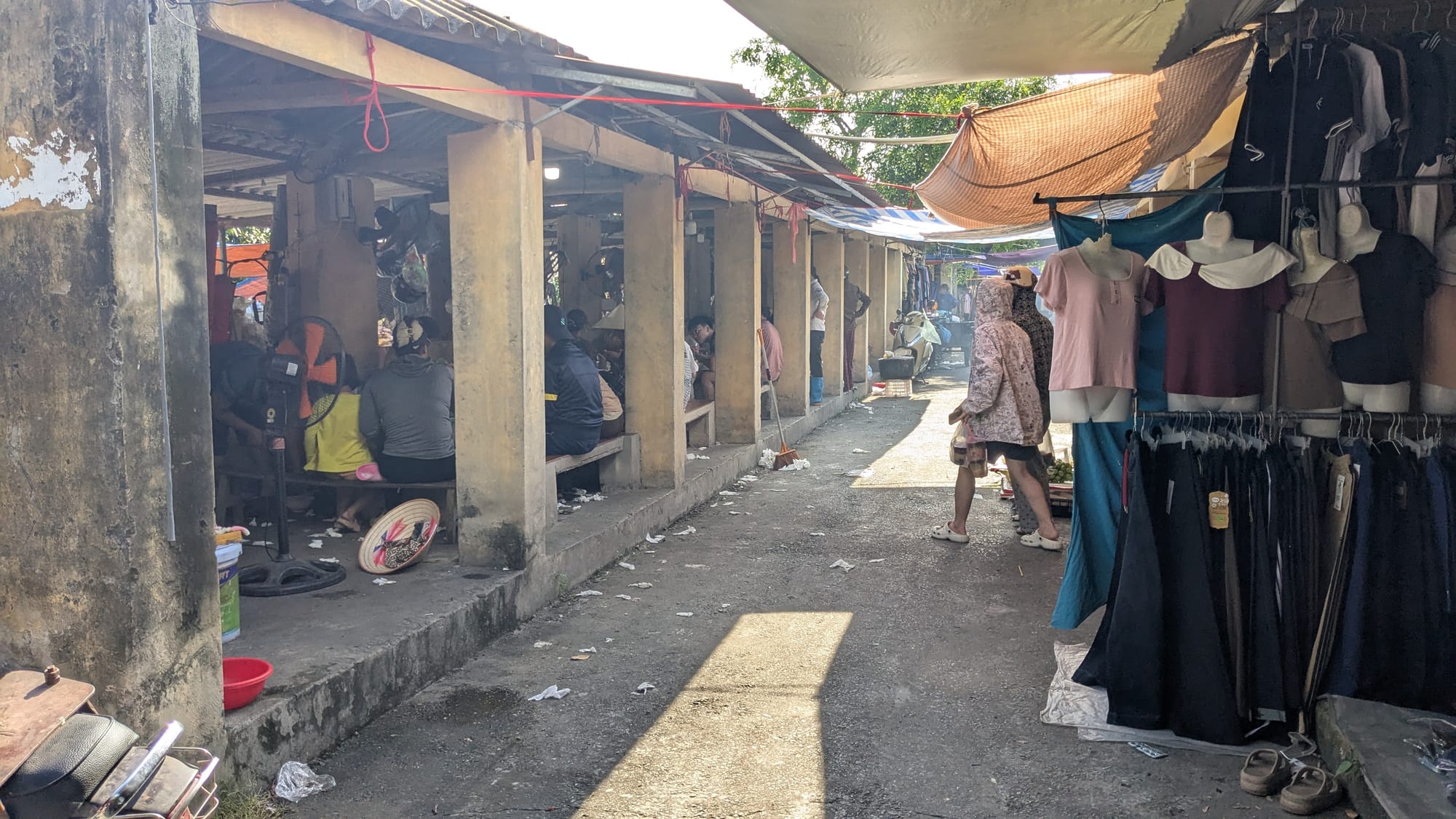
The cornerstone of the market is an auntie who sells non-local vegetables and gạo, or uncooked rice, from her house. When I need rice, I have to walk to the market with my storage bucket; four kilos of rice fill the bucket, for $1 USD per kilo. That lasts me about a month. My colleagues would tell me I should be eating twice that, but the secret truth is I don't eat rice with every meal. I sometimes eat noodles or pasta with my food to change things up; I buy these staples outside my village to prevent nagging comments about what I'm eating.
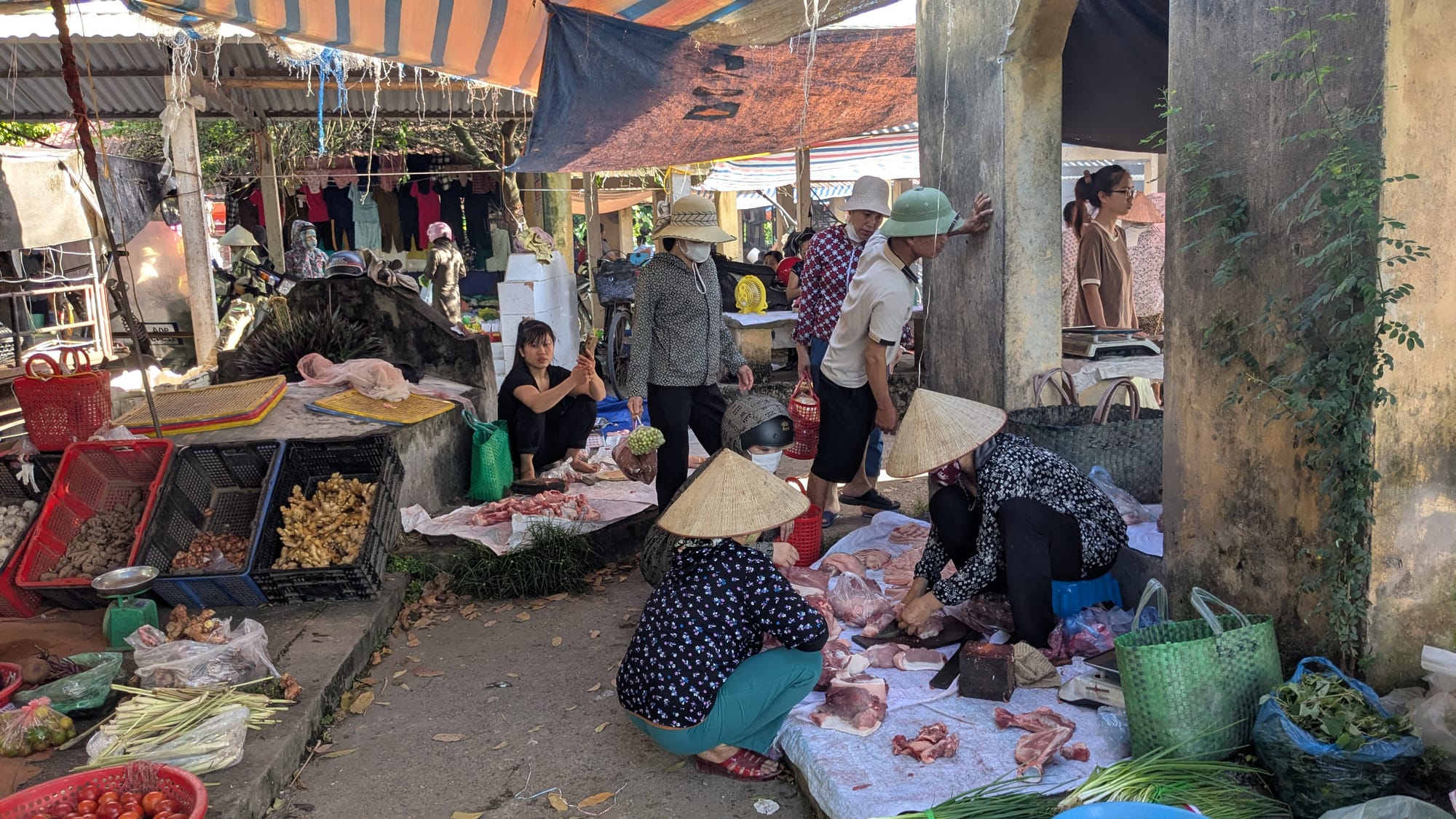
People like to gossip about what I buy because I'm a source of local fascination. They have expressed amusement about how often I buy certain things, like bell peppers. While instant ramen is often added to hot-pot meals, if I were to buy it locally I would soon have teachers coming to tell me I shouldn't eat that. There is a stigma against it being poor quality "fast food", even though I don't use the seasoning packets and I think it's arguably more nutritious than the locally preferred rice noodles.
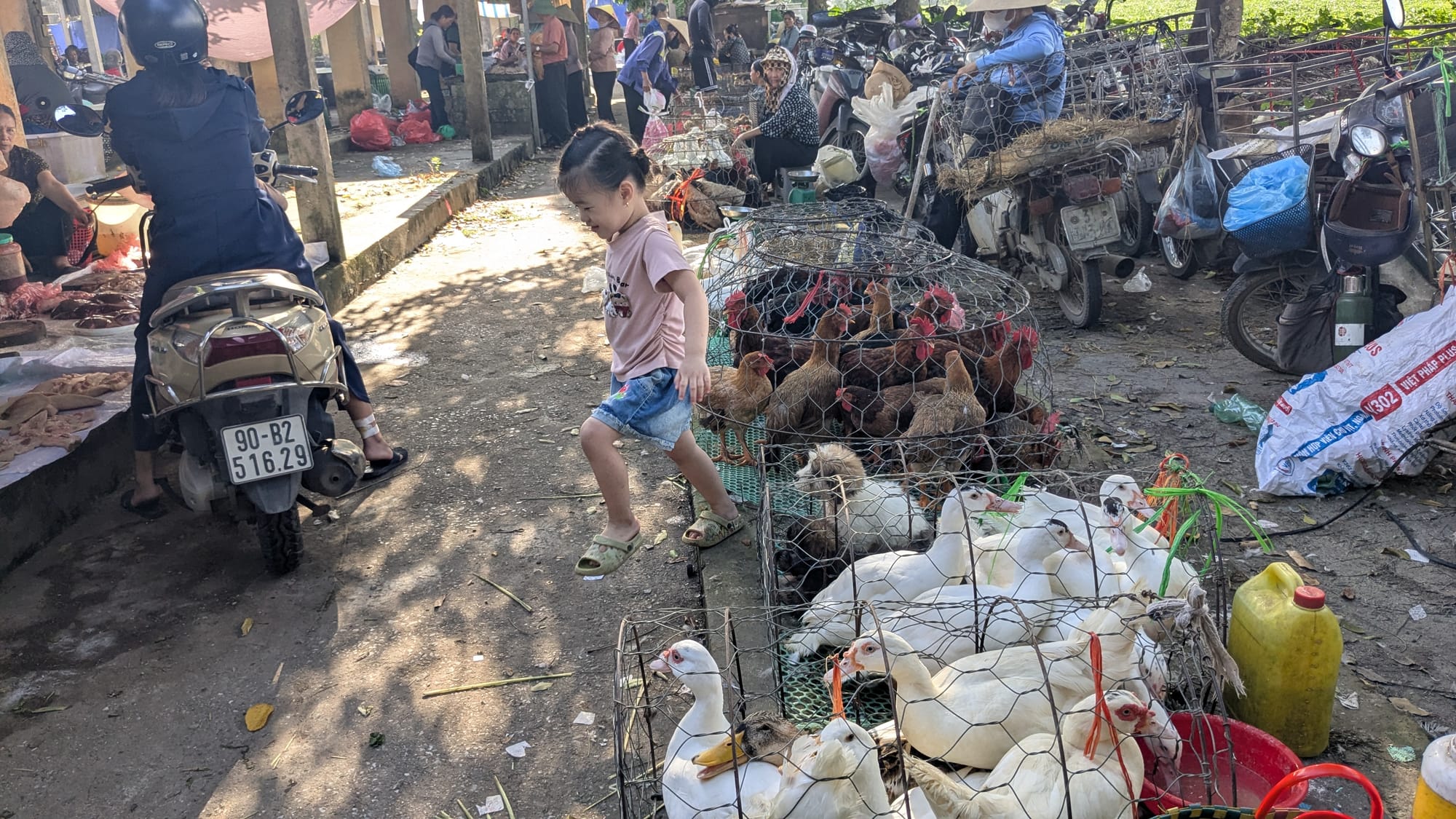
Elsewhere in the market, there are two vendors who exclusively sell fruit - a lot of it imported from south and central Việt Nam in styrofoam crates. There are usually 1 or 2 vendors selling boiled pig intestines (and other parts) out of igloo coolers: an extra protein to add to your spread when you have company for dinner. There's a woman who is always frying nem (spring rolls) on a card table in front of her house. She always shouts and waves me over to buy; I'm a regular now, it's cheap and it's a good appetizer so I can eat something quick before cooking the rest of my dinner.
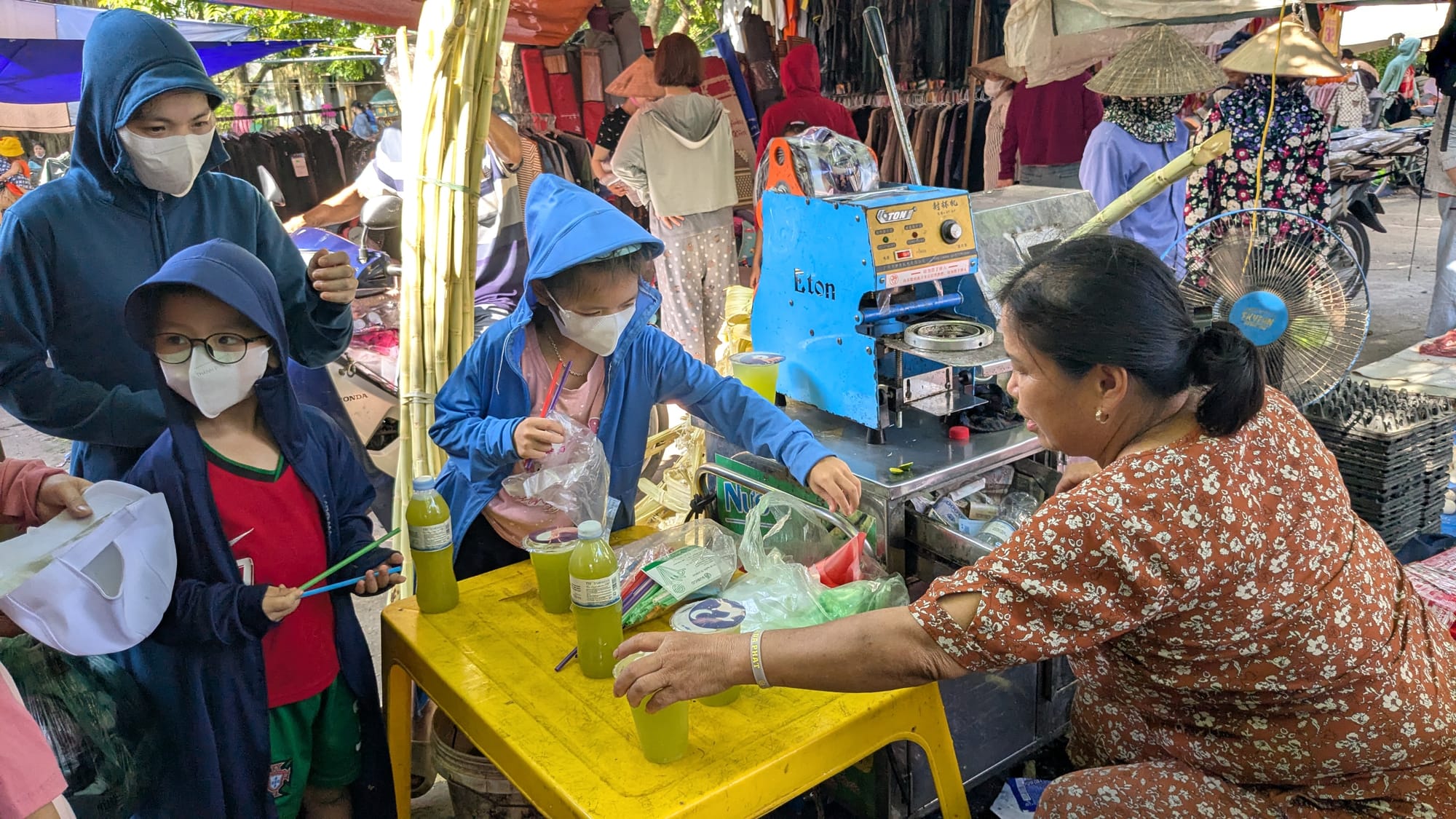
Sometimes she is also selling various soups, or fried white meat: pork or chicken, pounded thin like schnitzel and fried in a store-bought flour mix that is common here. It is super crispy, like panko breadcrumbs, but also has a slight sweetness to it. The staple soup in my area is canh cua, a mild broth made from small black crabs that are all over the rice fields.
On the outskirts of the market are the aunties with blankets on the ground with only a few types of vegetables each. Everything on their blankets is stuff they have grown, and I always try to purchase something from them - splitting my business between them as fairly as possible - because I think my business has a bigger impact for them. They always have big smiles for me when I walk or ride up to the market, waving me over hopefully with a palm-down digging gesture.
Throughout the spring they mostly have greens of all varieties: spinach, lettuce, cabbage, celery greens, sweet potato greens, and others that don't have common English names. There are firm, plum-sized tomatoes, and corn is intermittently available. It is not the same species of corn we usually eat in America, the kernels are pale and stay quite toothsome after cooking. But they are still tasty so I always buy some to add "new world" flavor to my dinners.
I try to buy just three ears of corn, but the auntie keeps putting more in the plastic bag until I say "Thôi! Thôi!" (Enough!) Oh well, I think, I can eat six ears soon enough. She charges me something like 30,000 Đ, which seems fair enough to me; it's barely more than $1 USD. I've been told I can haggle, but I don't feel the need very often. I have tracked the prices on various supermarket receipts to get a handle on what prices are normal, and I usually manage to get stuff cheaper at the market anyway.
Just then, the eldest vendor shuffles over and shouts at the auntie who has just sold me corn. She suddenly hands me some change back, and her body language says please forgive my mistake. I accept it with two hands and shrug and smile like I don't understand.
The older woman stands proudly with her hands behind her back, like a five-star general five feet tall. I was introduced to the regulars at the market by my school's head English teacher as a volunteer teacher; I think they were told to give me a fair price for things. This elder has taken it on herself to enforce that I'm not taken advantage of. I know her only as Bà, grandmother; I tried asking her name a few times and she seemed to ignore the question. I learned later that it's not really polite to ask an elder of rarified age; you're not meant to be on a first name basis with someone a few generations older than you.
"Chào bà!" I say. She barks something back to me, but her accent is so strong I can't pick up a single word. Her eyes are shrewd and piercing. Her teeth are reddish black from betel nut chewing. She wears her hair in a brightly colored Harley Davidson bandanna.
I try to communicate with her, but eventually am reduced to saying "I'm sorry, I don't understand." It's times like this when I feel like my Vietnamese had progressed farther than it has, and I start to feel a little discouraged.
I buy some fruit and as I'm trying to leave, bà approaches with a bag full of tomatoes and two wilting heads of lettuce. She has given me free produce before and I know that's what she is doing now; the day is almost over, and it is probably stuff she is not going to sell before it goes bad.
"Bao nhiêu tiền?" I ask, determined to try to pay her for it.
Her reply is forceful and clear, and I understand each word: "Một. Trăm. Nghìn."
One hundred thousand. An outrageous price. She is joking, so this is my chance to joke back.
My eyes grow wide and I say with mock surprise: "Ohhh... Đắt quá!"
Her head bucks backwards and she is roaring with laughter. She shouts across the street: "He said 'Too expensive!'" Soon all the aunties on the whole block are laughing too.
She presses me to just take the bag, and I do as graciously as possible. She's one tough cookie, and this is the first time I've seen her laugh or smile. I make a mental note to give her my business next time.
I'm called into the principal's office one day to discuss the attendance of the school's English Club. Of the 45 students who originally signed up to be a part of it - mostly hand-picked and forced by their teachers - only about 8 are now coming regularly. The principal produces a poll of the members about why they are not attending. I'm not allowed to look at the survey, but my head English teacher helpfully explains: "Your activities are very boring."
There are a thousand things I could say to this. The polled students have not been attending since I changed my activities substantially, and the teachers have not helped with ideas for activities or attendance... But none of these things are expressible in my limited Vietnamese or in my colleagues' limited English, so I just swallow my pride and ask them what they think we should do...
At the next club meeting nearly fifty students are present, at the insistence of their teachers. It is raucous and impossible for me to talk to most of the students, let alone for anyone to hear very much of anything. The club has been divided into 7 teams of 5-8 students each, and the game is a Powerpoint with graphics and sound effects. Each move involves a simple flash card question.
They all know very well the names of common fruits in English, like banana, but each correct response gets an eruption of applause. I have trouble accepting the sincerity of this excitement, but my head English teacher is there with a massive pile of snack food bags like potato chips and is throwing them haphazardly across the room each time a team answers correctly.
No one is speaking English. Everyone seems to be having fun. Except for me, because I don't really need to be there.
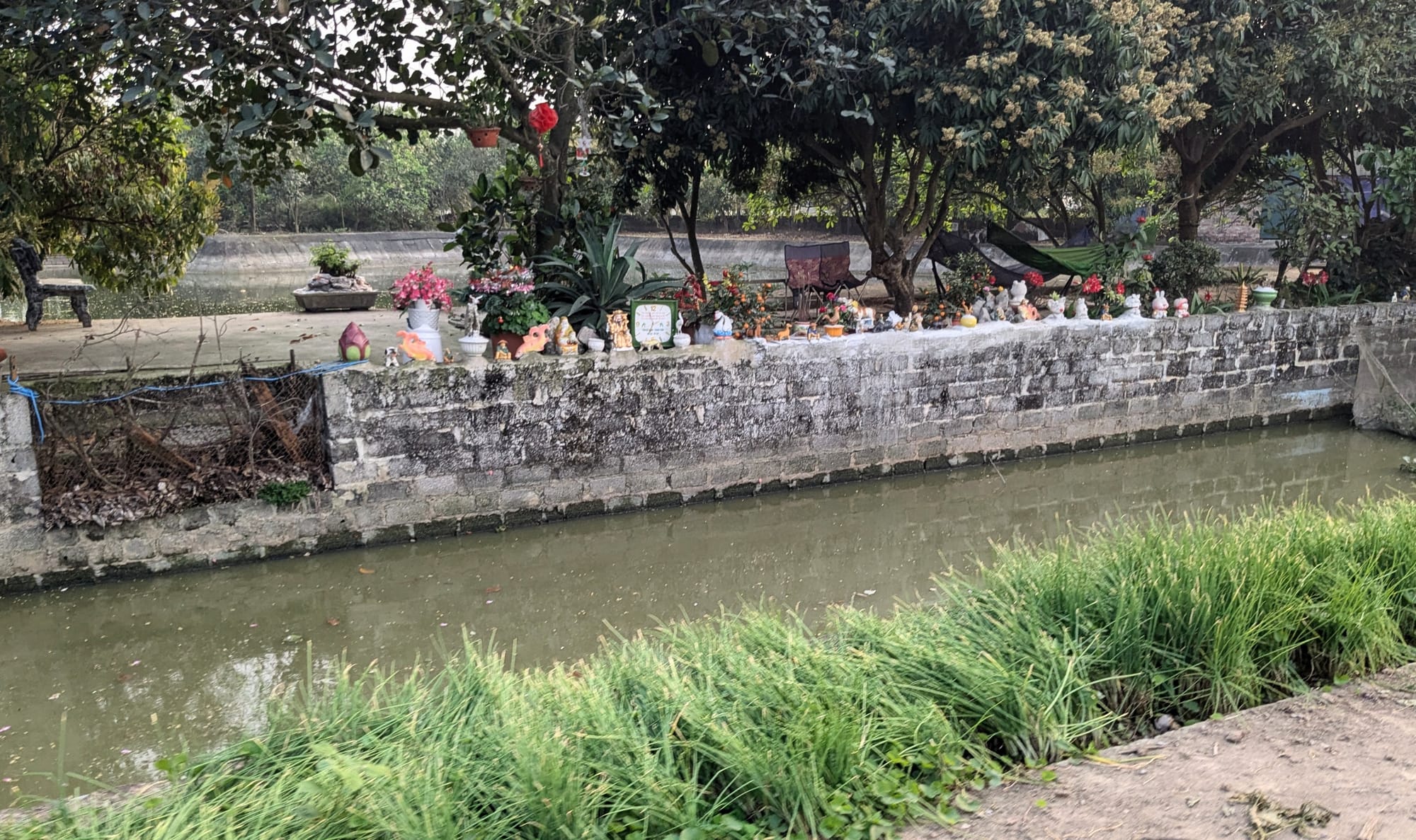
On one of my bicycle routes through the rice fields, I often pass by a home which always fascinates me. The house is merely a small shack of green-painted corrugated metal, but the grounds around it are tended beautifully. There is a duck pond and a couple of shade trees with a hammock between it. And along a rock wall facing the street are several dozen well-polished porcelain figurines.
I've never seen anyone here, but I'm earlier than usual and I'm about to learn why.
Someone starts screaming at me from further up the road.
It's Bà loading her bicycle's basket with a bag of vegetables to go sell in the market. She is motioning to me to stop. I greet her as I usually do, and she runs back through her front gate leaving me confused as to whether I should follow her.
She returns holding a startled chicken upside down by its feet. She tries to give it to me.
For once, I have to be very firm. "No. Thank you very much. No. I can't."
She finally gives up, takes the chicken back in and comes out with a bag of mold covered pomelos. Pomelos can be stored for quite a while after being picked and the fruit will still be tasty under its inch-thick outer flesh. These I can handle, so I can do nothing but accept them.
Of course, I have to cut my bicycle ride a little short, as I have no basket on my bicycle, and it's awkward having a bag of five super-sized grapefruits week hanging off one side of my handles.
The next day is International Women's Day and for once most of the female teachers are present at a teacher's lunch. Most of them have families that they go home to prepare lunch for, leaving only the male teachers to "drink wine" together. We all meet after classes at the village's only full-service restaurant and walk up to one of the private rooms on the second floor, equipped with a small stage for karaoke.
I don't enjoy singing karaoke very much; although I can sing, my baritone voice doesn't fit comfortably in the range of most songs that I actually know. I struggle to find songs that I feel comfortable doing, and I hate getting it wrong.
But I guessed Women's Day would be a karaoke occasion and prepared for it. I couldn't very well say no to the women on Women's Day! The teachers ask who gave me the bag of pomelos, and I'm exasperated that somehow they all know about this.
When it's my turn at karaoke, I sing "The Rainbow Connection". (Yes, I know. Not a baritone song. But it works transposed down an octave!) I don't think anyone recognizes the song, but I can see some of the English teachers following along and mouthing the words. I picked it as much for the simple words and the message (which is - and this is important - not about romance).
Then my head English teacher tries to get me to do another song. Worse she has already cued up a specific song, and it's one that I've never heard of.
Forced to hold the microphone, I say in Vietnamese: "I don't know this one." People laugh, but the other English teachers are now looking expectantly at me, and one says: "Just do your best!"
This is the kind of thing that we say to our students every day, and as I try to sing a song with no clue of the melody, I wonder if it makes them feel this bad.
After lunch is over, a couple of vans come to pick us up and take us to another village, to a coffee shop which is suspiciously next to another karaoke business.
As we walk in I hear one of the teachers ask for a menu in English for me; the local staff are flabbergasted as no one has ever asked for that here. I pick all this up in a dark state of mind. I can almost never understand my colleagues, but a coffee shop menu? How dare they think I can't understand this.
"Không sao," I say - no problem - and order in my most correct Vietnamese: "Cho anh cà phê muối."
As I sit down in the surprisingly open and peaceful courtyard of this coffee shop, I immediately feel remorse for being a little sassy. Everything that is weighing on me starts to come crashing down on me.
Someone asks me if I'm ready to go sing karaoke again next door, and it hurts. I try to enjoy how beautiful this courtyard is, and the fact that my colleagues just bought me a nice coffee drink, and it hurts again thinking that I'm not being grateful. Another teacher suggests that I'm missing my mother because it's Women's Day, and I realize I'm being a downer. I'm hurting everyone else's joy, and it hurts.
Against my will, I start crying in this coffee shop in front of most of my colleagues.
The next day after class, I hear the voice of my gardening chị outside my room.
"Chris! Come to the garden."
I join her there, and as I help her pull the leaves off of some leafy green vegetable, she asks.
"Yesterday, why were you sad?"
It's so hard to explain. Really, it's not one thing. I know very well that I am experiencing culture shock. Things have been so foreign to me for so long, that even though I am having so many experiences that I want to have - that I treasure - the inability to connect and communicate on the level that I'm used to has made me feel inadequate and out-of-place.
I tell her: "I don't know if I did the right things this semester." My English Club did not succeed in advancing English for the school, and also my Vietnamese got worse because I got behind on my studying.
"Chris. Don't be sad. The students like you very much."
"I know. I will be okay. Thank you, chị."
I excuse myself to go for a ride on my bicycle:
D.C. al Fine.
This chapter took a long time to write because I struggled with whether I should write about it now or wait until my service is over. But struggling with culture shock is very common; most Peace Corps volunteers have to face it. After some of my colleagues left their service, I felt compelled to try to share some of my feelings. I hope that it helps others feel better about their own doubts in Peace Corps service. It is normal to feel these things when you are invested and passionate about doing service in a foreign country where it is difficult to integrate and communicate.
Many happier installments coming soon!