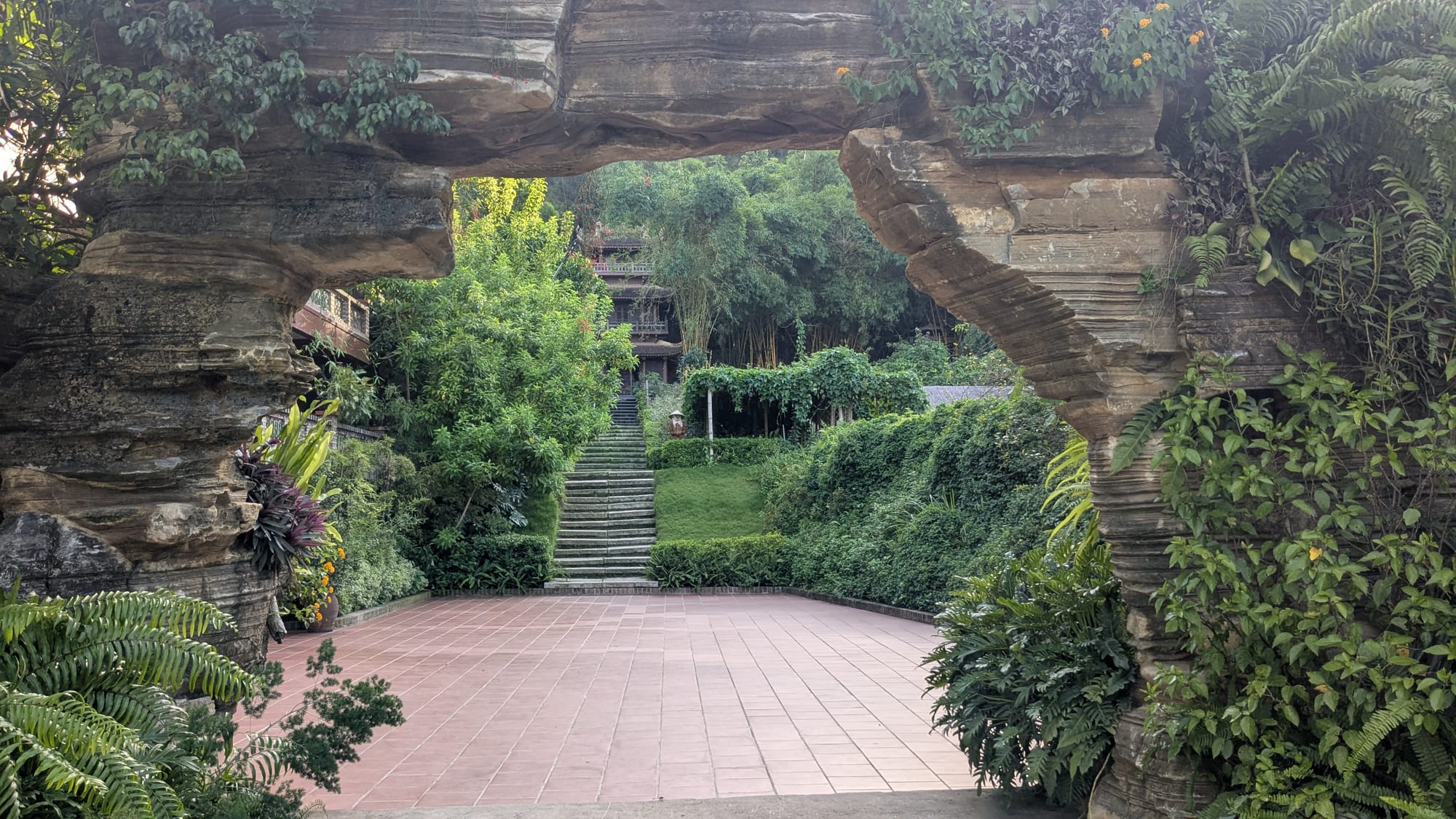
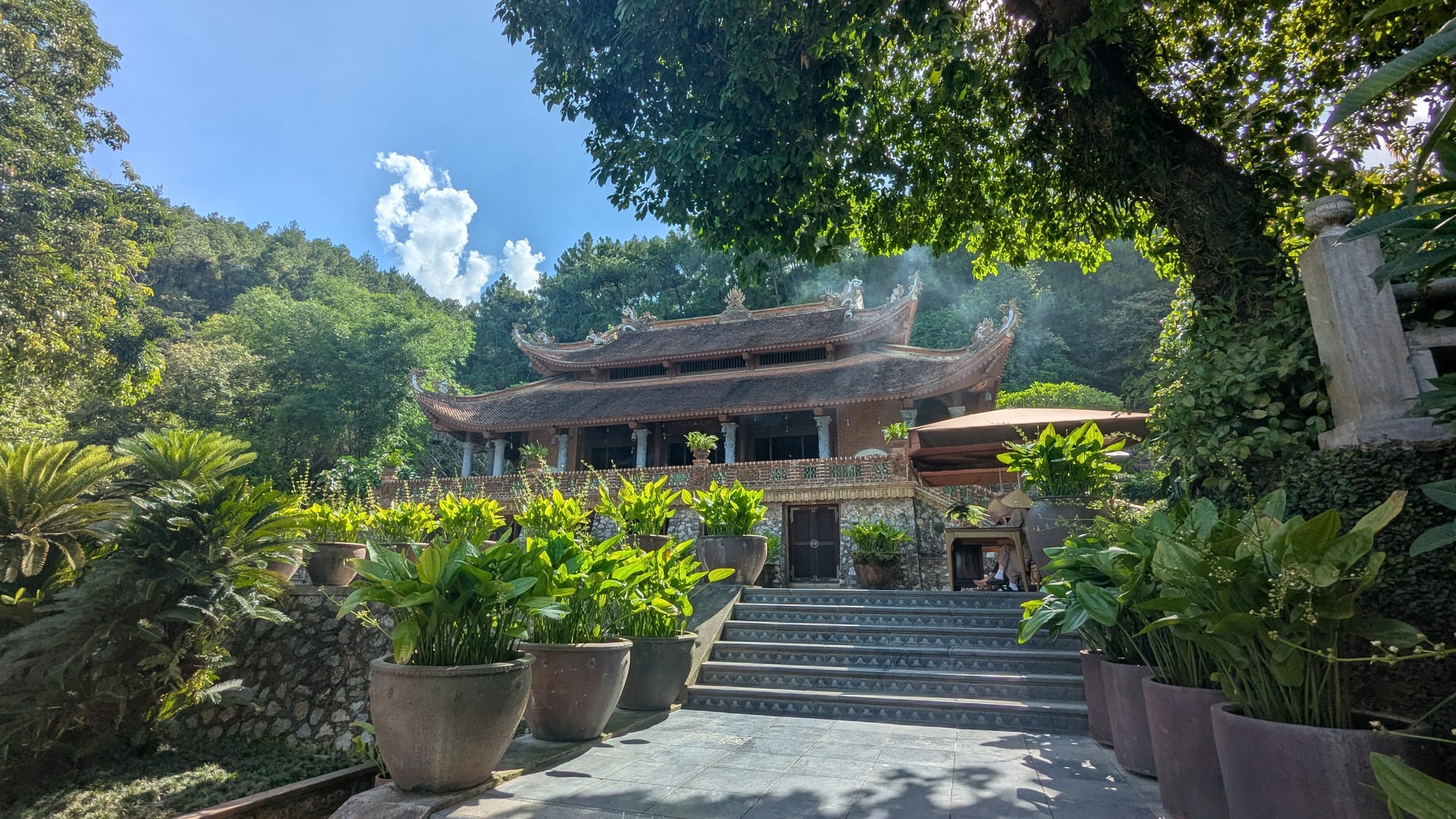
Field Trip: Địa Tạng Phi Lai Pagoda
"Take a rest in your room. We will go in an hour. I will text you."
"I should change into long pants, shouldn't I?" I offer.
Hải is surprised: "Uh, yeah! That would be good."
I smile to myself and leave him to his post-lunch nap. I can't lay down or I'll doze off and wake up groggy, but I'm happy for an hour to rest my brain. I have been trying to use what Vietnamese I can muster and get helpful corrections from my new friend, although I hardly need to as he lives in the city and works for an international company with American colleagues. But he is still working on his English, so I'm sure he feels the same sense of fatigue.
Hải is the son-in-law of one of the teachers at the school and comes back to his "hometown" once a month. This weekend he has volunteered to drive me to a pagoda in a neighboring province. I change into dark slacks to show more respect than the shorts I was wearing.
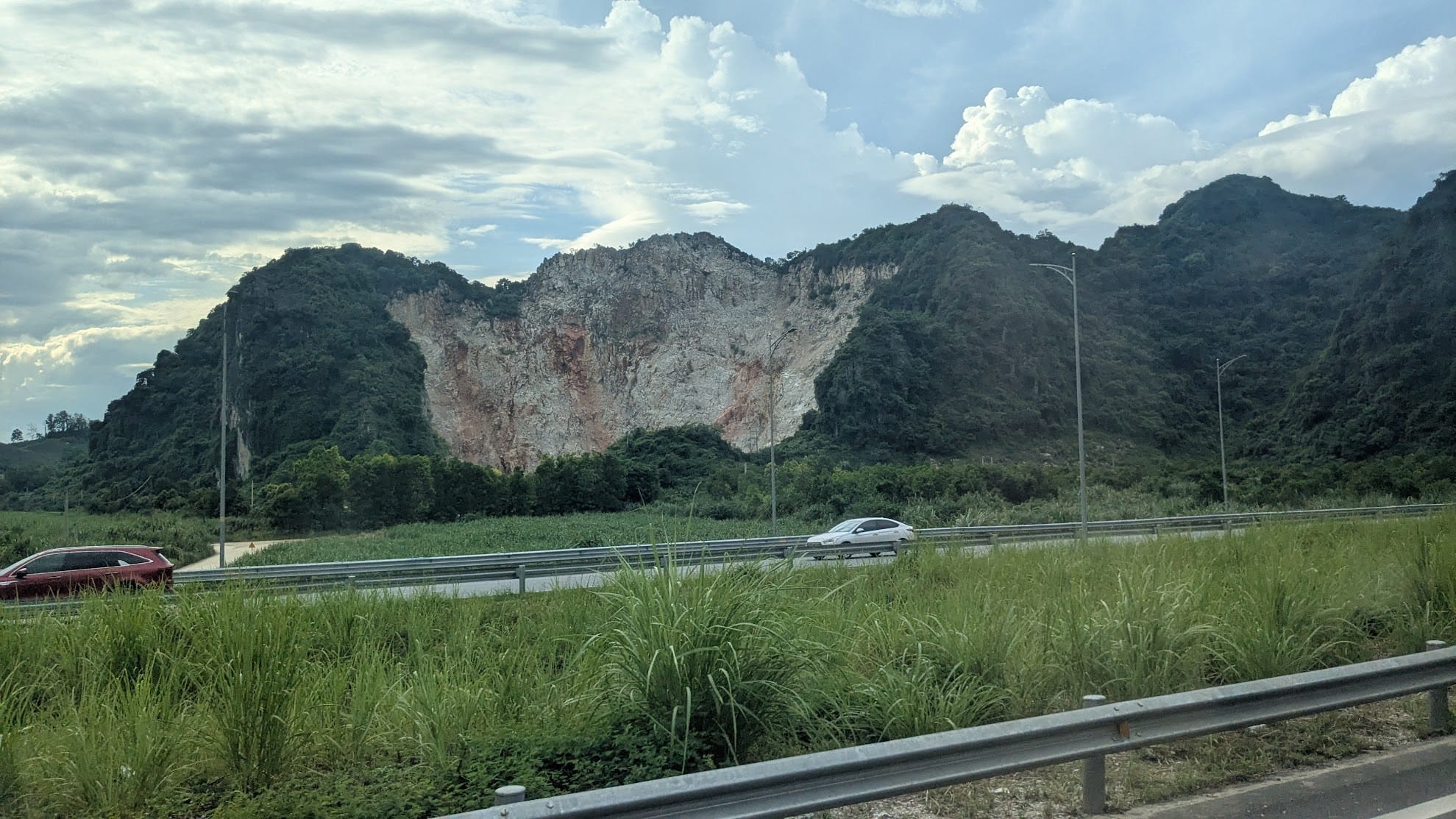
Despite waiting another hour, the sun is still scorching when we leave in the late afternoon. Driving south, the mountains which I sometimes see in the distance from my village grow larger. Some sections of the dark grey mountains are a contrasting white. Quarries for limestone.
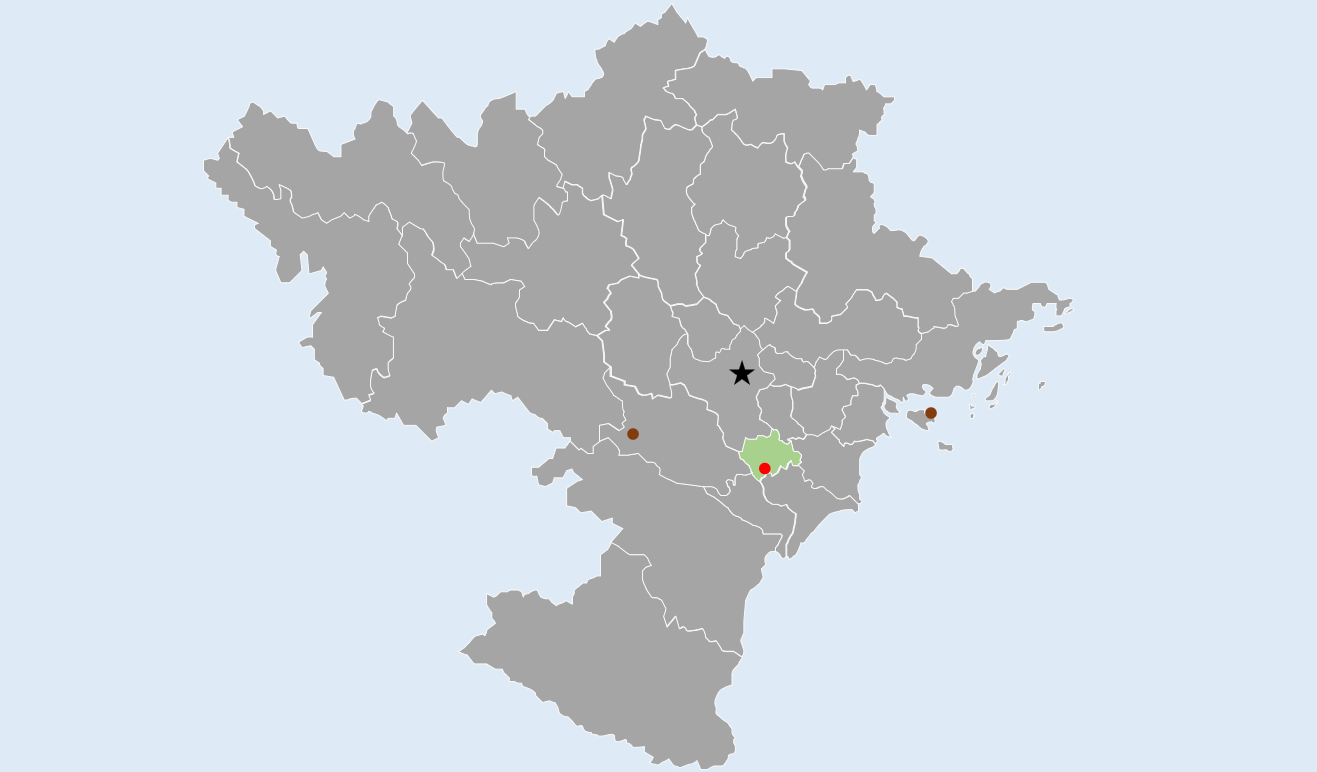
"Now we are in Ninh Bình province," Hải says.
"Oh, really? Hà Nam merged with Ninh Bình?"
"That's right."
"What do you think of the changes? Will the government be more efficient with fewer provinces?"
"I think so. Many old administrative people were retired. They hope it will create more jobs for the next generation."
He notices me staring wistfully at the mountains. "Do you want to visit the mountains?"
I laugh. "Yeah. Sometime."
"Maybe sometime we can go."
"I like to go hiking. Do you?"
He says he does, as he holds his phone in one hand, scrolling through Youtube.
"What kind of music do you like?" Hải asks.
"All kinds of music," I chuckle. "Do you want me to choose something?"
He hands me the phone, and I choose an old song I've recently been obsessed with: Sam Cooke's "A Change is Gonna Come". A comfort for troubled times.
We listen quietly until it ends and Hải says: "I feel like I've heard it before..."
"Yeah?"
"I haven't, but the song gives you that feeling."
"Yeah. It is... elemental."
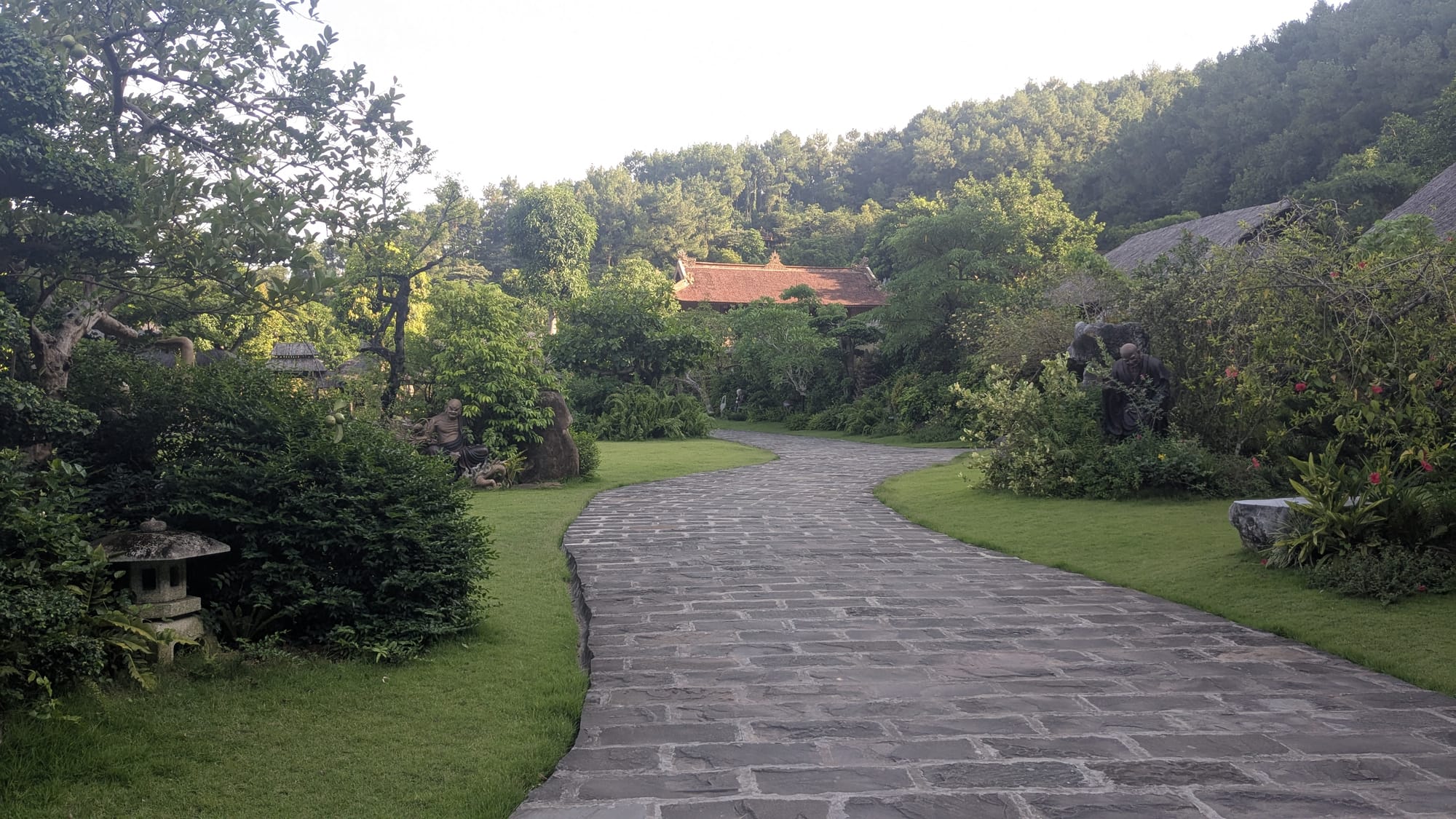
This comforting feeling follows us as the GPS navigation leads us down a deserted, one-lane dirt road through rice and lotus fields towards a low mountain ridge. Not a tall mountain like the ones stretching off in the distance. The hill looks out of place in the middle of a flat plain.
In the shoulder of this hill, the narrow road opens onto a vast, empty parking lot of crushed limestone. Around the edge are bamboo structures providing shade to a few cars. Hải hesitates until he finds one of them that is not leaning so far to one side that it looks like it will collapse on the next car to park there.
We walk first to a modern building which looks to me like the visitors' center. I'm expecting a museum with historical info about the centuries-old complex, but instead I find myself in a spotless and spacious tiled bathroom. Dozens of urinals line the walls stretching away in both directions; in front of me are two rows of sinks followed by aisles of stalls. Some of the stalls are for showering. It's like a Vietnamese Bucee's.
We are the only ones here.
"I guess it's more crowded in the morning when it's cool."
Hải laughs in agreement.
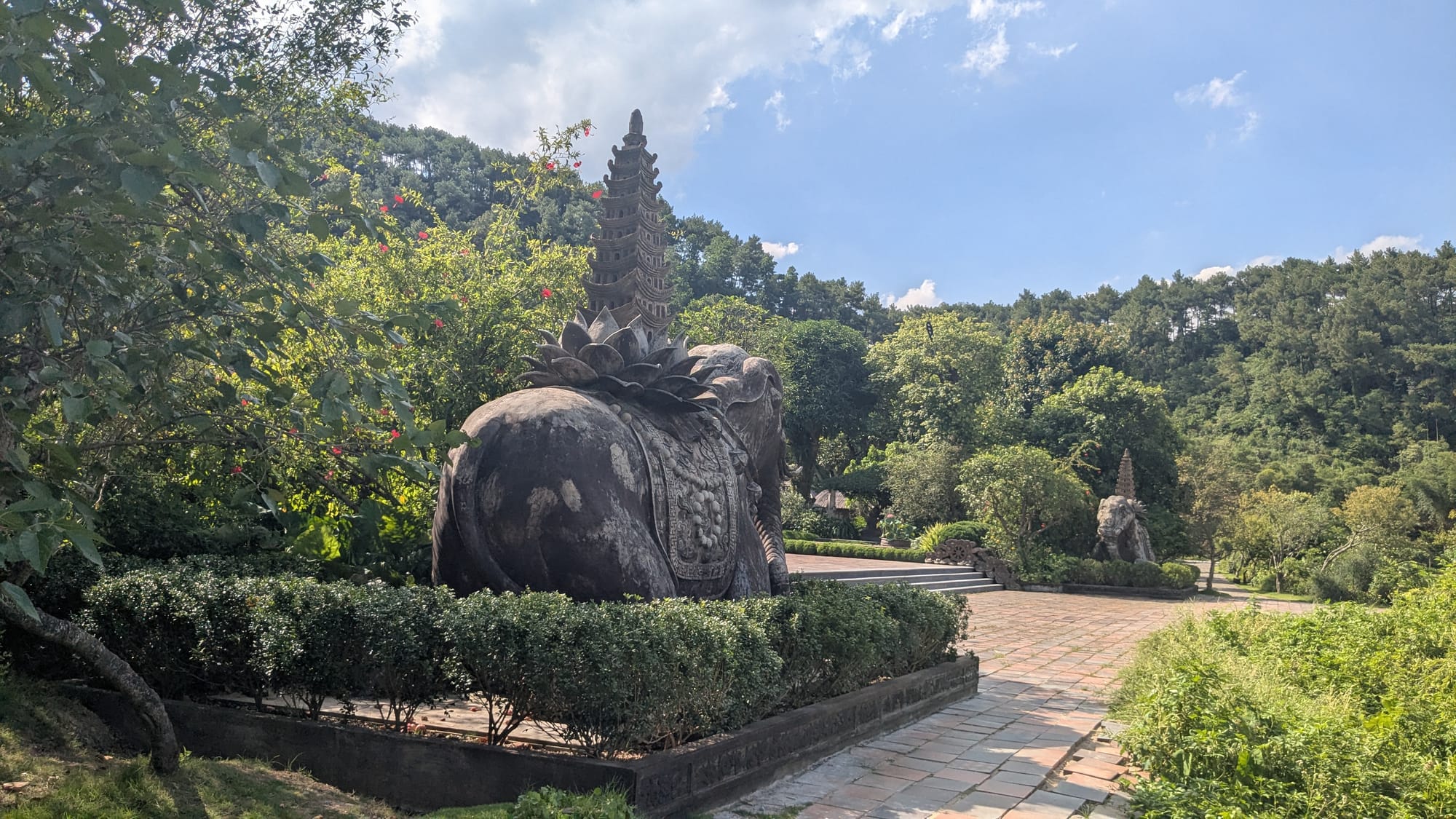
We exit into the searing sunlight and speed over to the nearest shade tree. Following the edge of a carefully-kept garden. Walking up the wide steps of the entrance we are met by two martial-looking sentinel statues.
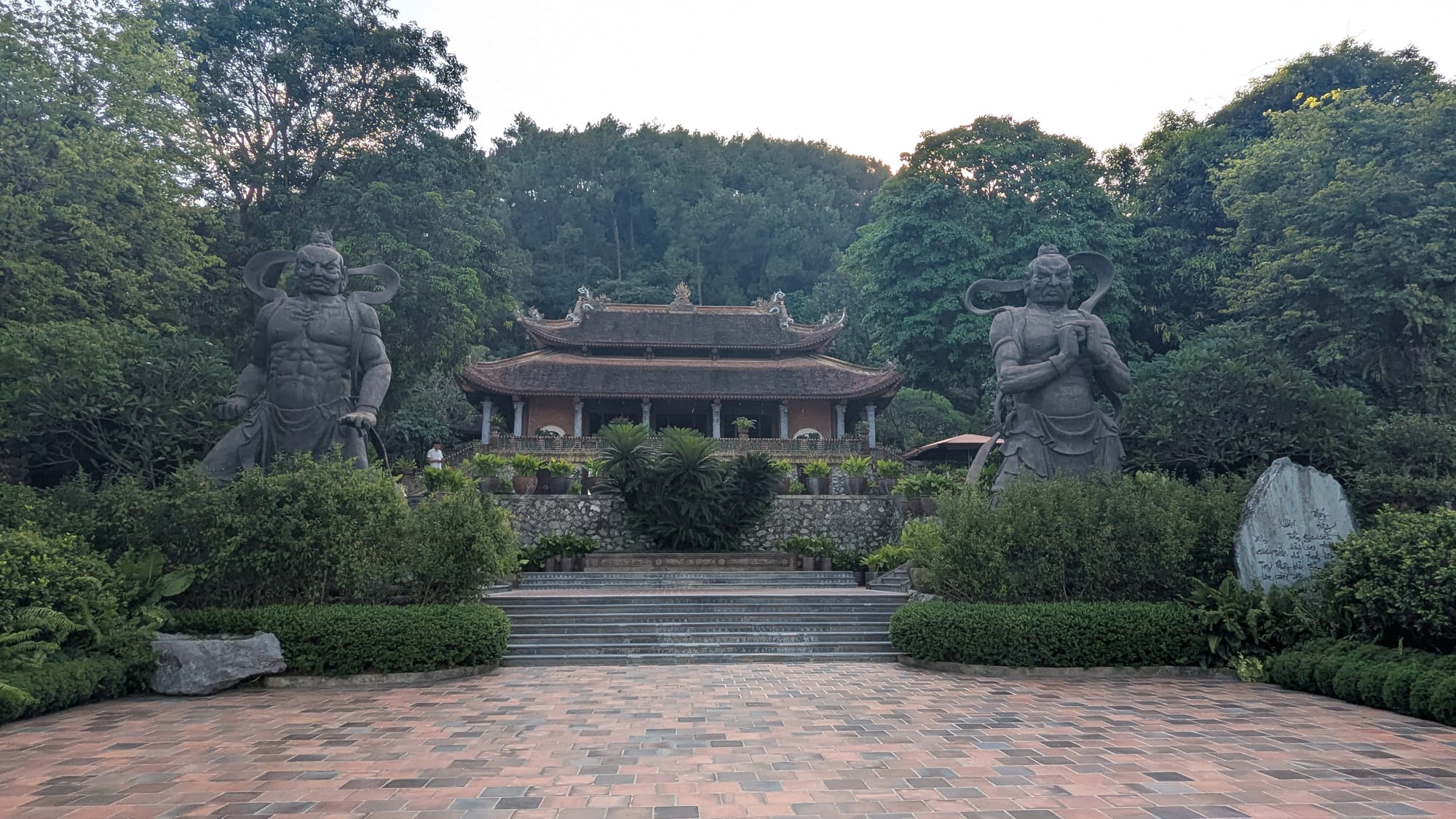
The main pagoda towers above us in the center of the complex, but we start by heading to the smaller buildings to the right. We walk across flat stones over a carefully raked Japanese-style Zen garden. I haven't seen one like this yet in the pagodas I've visited in Việt Nam.
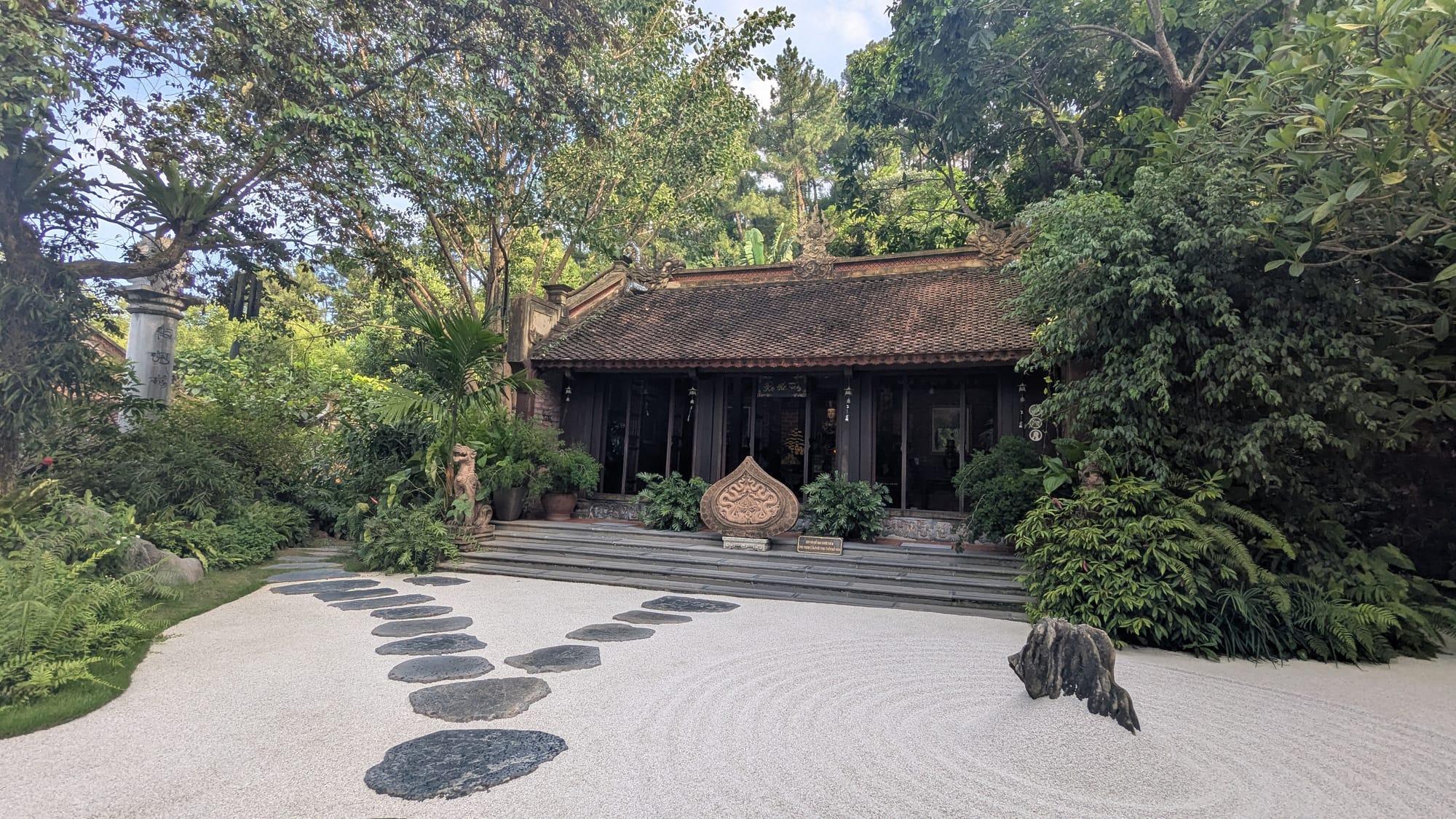
Hải consults a small sign in front of the first building we come to:
"This shrine is where you pray for peace. Would you like to go inside?"
I nod.
"Do you know how to pray?"
"Three times."
Satisfied, he hands me a wad of small denomination bills. The total value of these 1,000-2,000 VND notes is less than a US dollar, but I try to object. But my friend insists, saying we must make an offering for our prayers to be heard. I am grateful and wonder if he knows how difficult it is for me to keep cash on hand, especially small bills. My bank is only in the city, far from my village.
We take off our shoes and enter the building through the door on the right. Devout Buddhists might kneel to pray here, but Hải and I simply stand a respectful distance from the central altar. I put my palms together and bow my head, thinking about my wish for peace and then slowly bow three times. When my friend bows, he makes a wiggling gesture with his hands; rather than mimic his style, I just try to do what comes naturally to me.
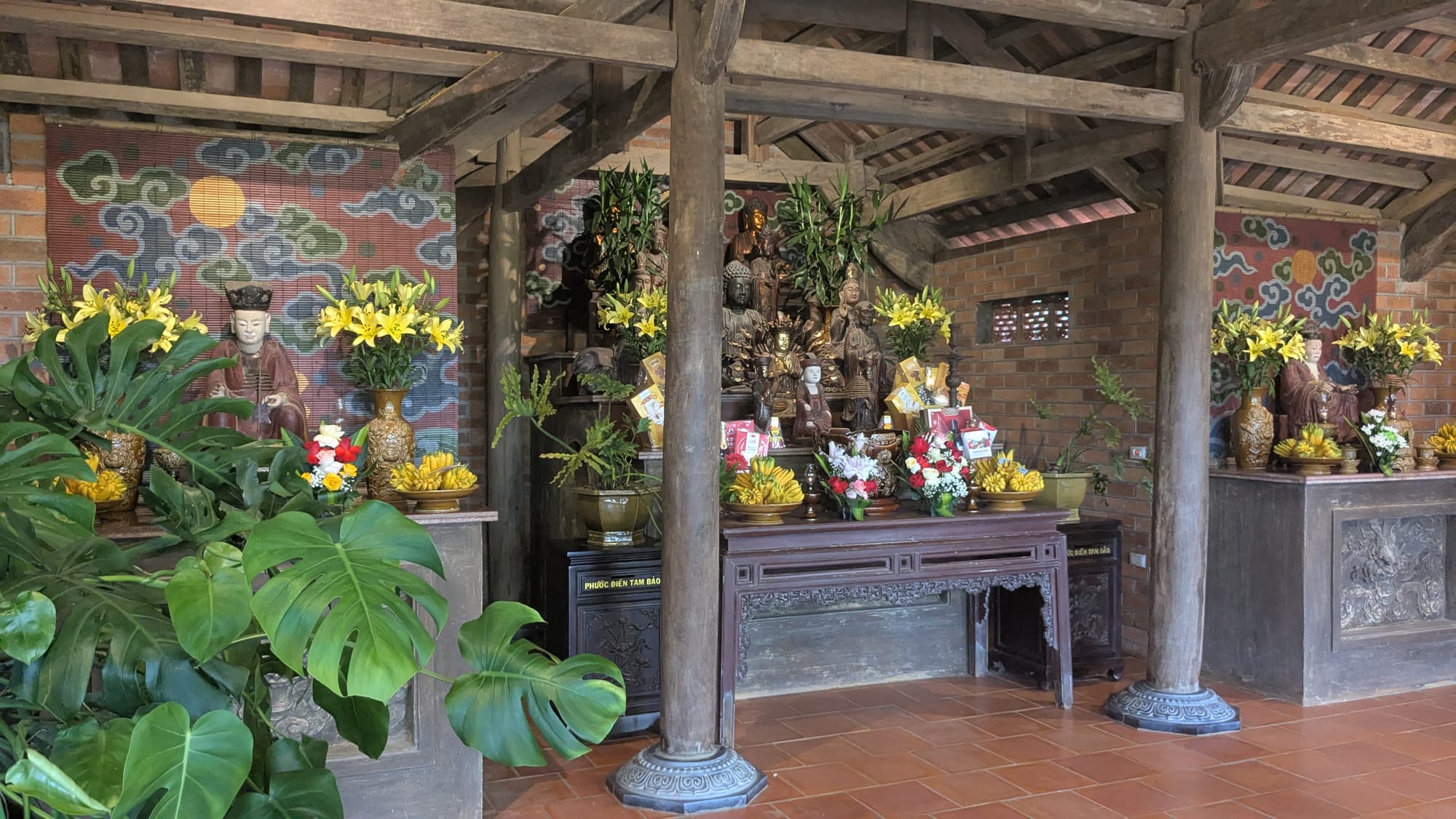
He motions to follow him and he approaches the altar. On the right and left sides are wooden boxes with a slot. We place a small bill in the right side and then another in the left side. We stop one last time before exiting through the other door of the shrine, to admire the beauty of the altar and the decorated wood panels on all sides. To take in the calming scent of incense burning on the altar. A low bell rings out from a neighboring building breaking the silence.
The bell sound is joined by a persistent tapping sound from a wood block, and both sounds are coming from the next building we are heading to. Here we see a single monk sitting in front of this building's altar, chanting a mantra. He is tapping a carved wooden block with a small drumstick in one hand; his other hand is producing the bell sound from a black iron bowl-like bell. The bell seems to reverberate on its own for about a minute before he strikes it again.
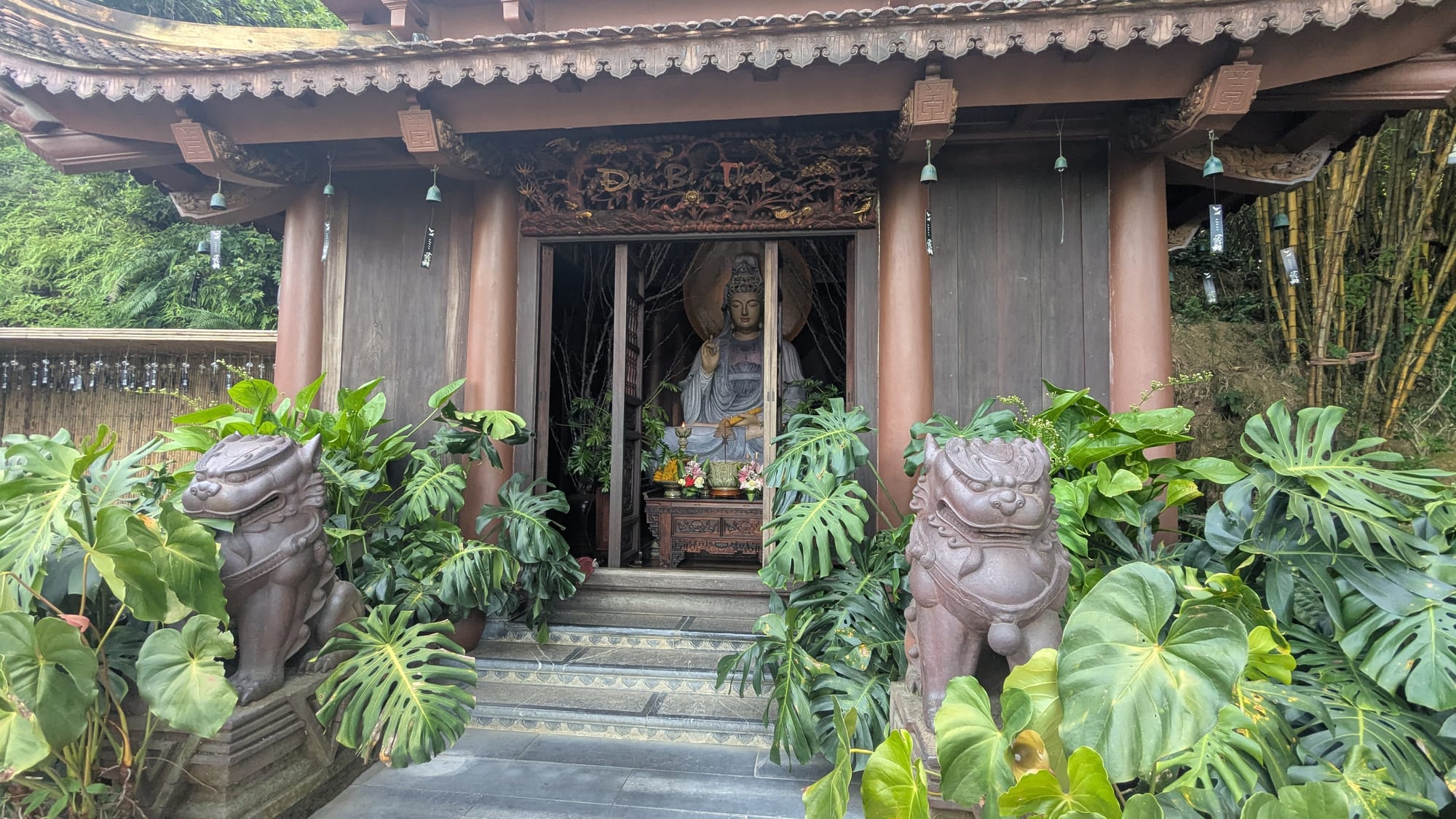
We enter this building and sit behind the brown-robed monk for a few minutes. On either side of the central altar in this building are rows of small wooden tablets with Chữ Nôm writing on them, the old Vietnamese alphabet based on Chinese characters. The tablets stand vertically like steles. When we leave, I ask Hải what the tablets represent.
"I'm not sure, but I think... fallen soldiers who fought for Việt Nam in the past."
"Really? I'm surprised that they would pray for that at a Buddhist temple."
"But it is important to us in Việt Nam."
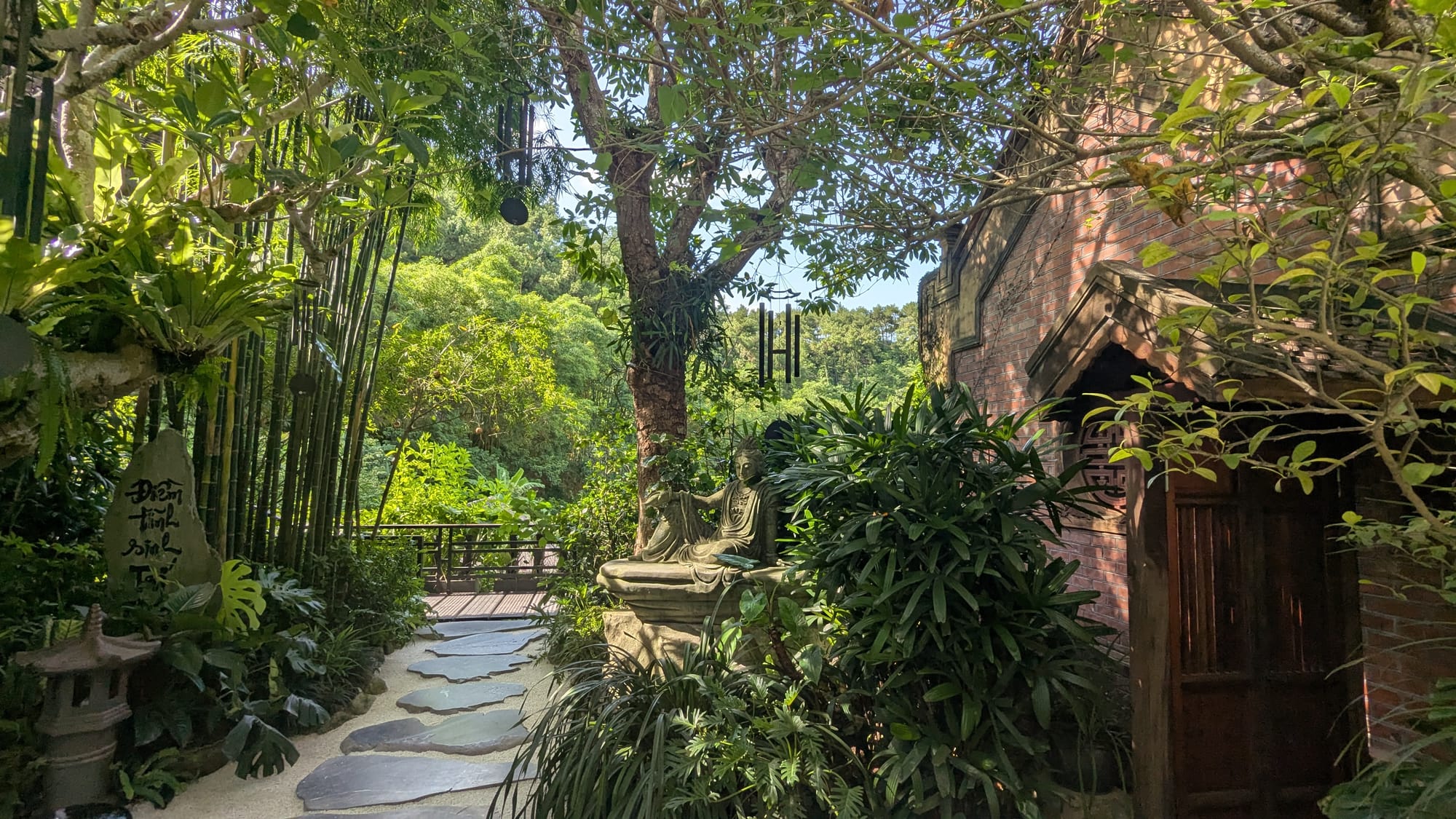
We move on past these first buildings and see a tower-like pagoda on one side and a valley below us on the other side. In the valley is a large vegetable garden for the monks and nuns who live here.
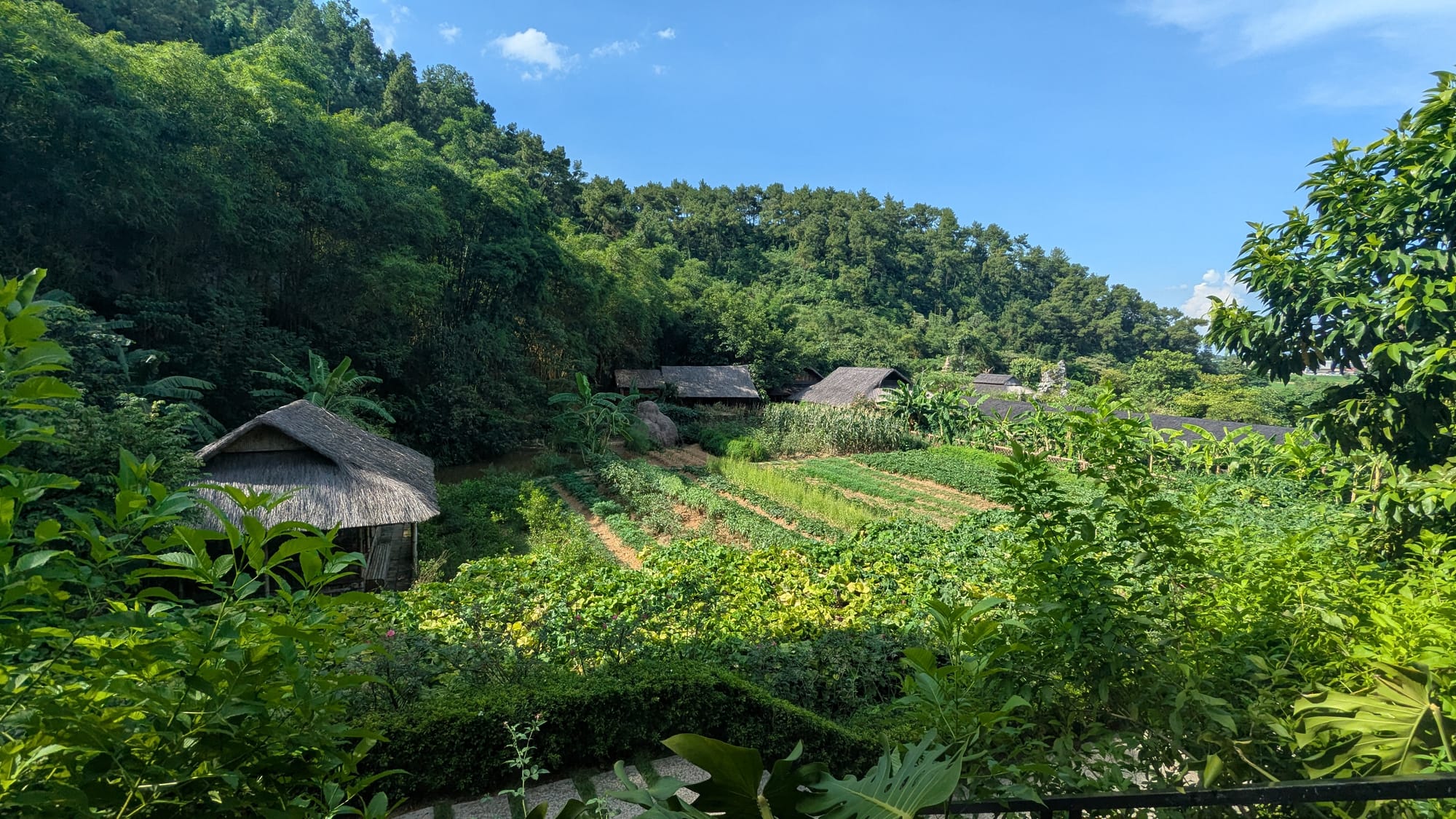
"I think we should go up this way, it says the path is closing soon," Hải says.
"Wait, have you been here before?" I ask.
"No, it's my first time."
We walk up the hill, in the shade of an old forest, and there is suddenly an outdoor courtyard paved with large, hand-carved clay tiles. A bamboo staircase leads up to the side of a humble hut with a thatched roof.
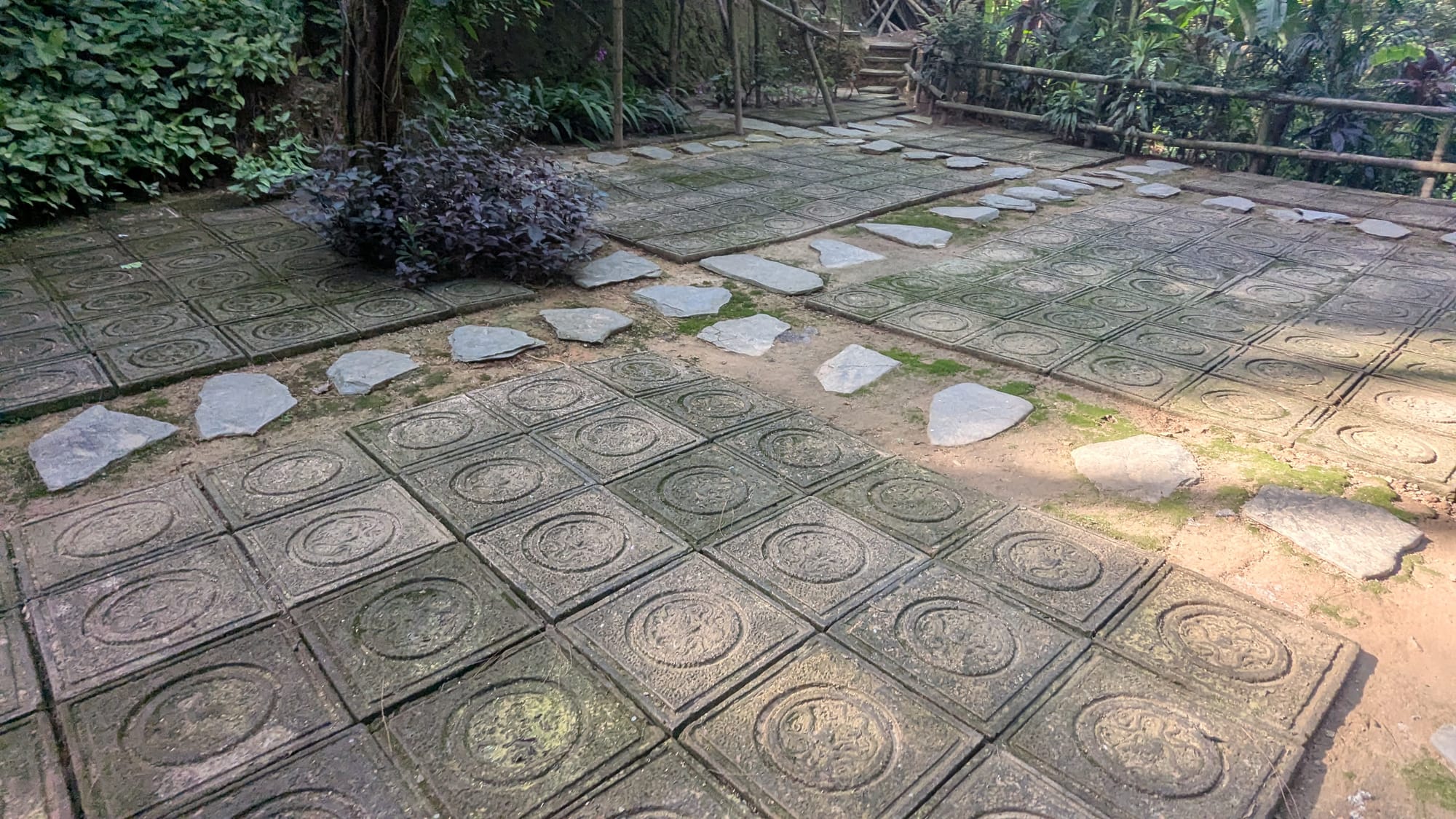
"Should we go and see what is here?" Hải asks.
It doesn't look like a prayer shrine to me, but the courtyard suggests people come to sit here. There are cobs of husked, dried corn hanging from the eaves of the building.
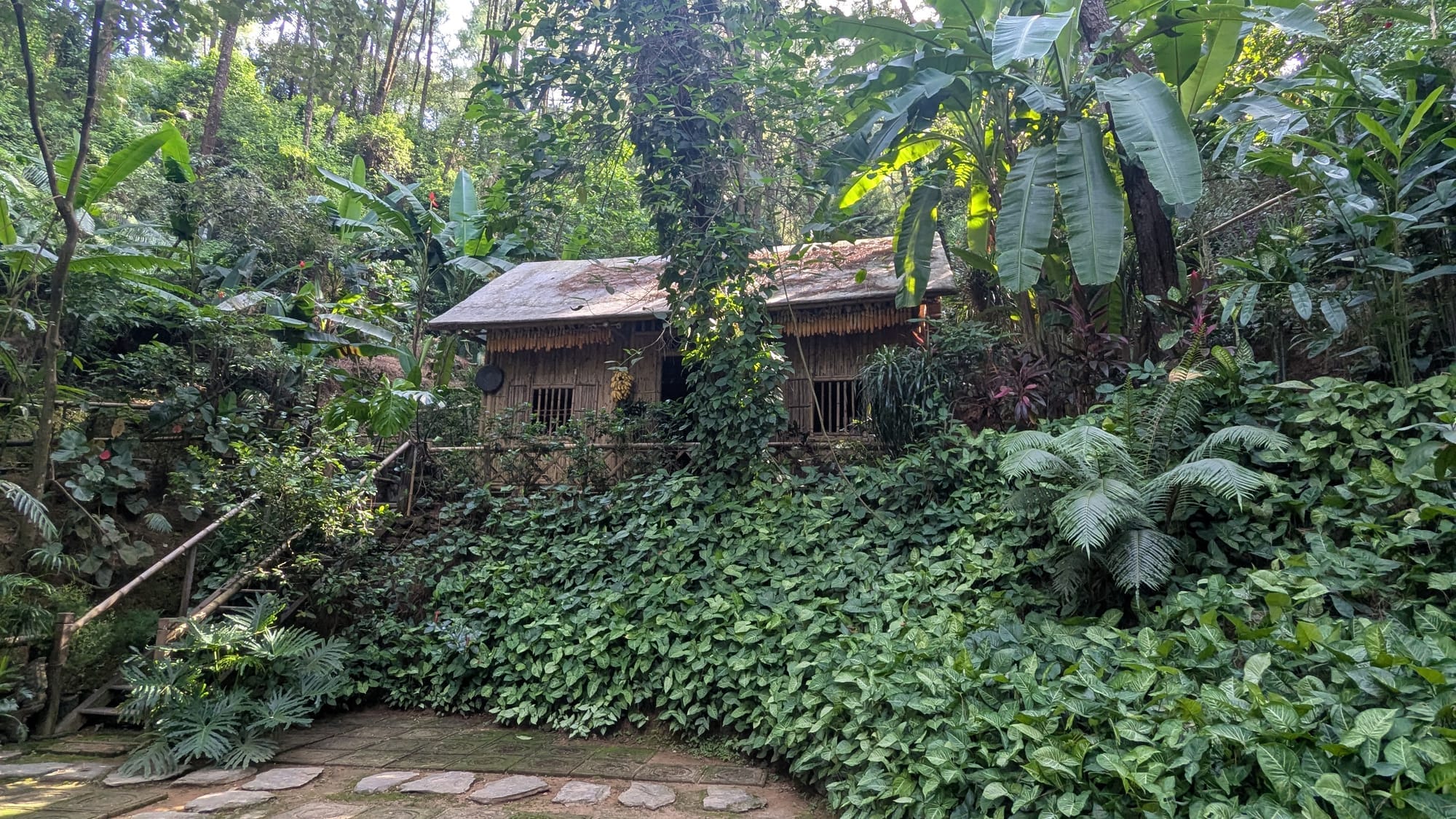
"I think it's a kitchen, or a residence."
Hải walks quietly up the stairs and peers in the window into the darkness and then comes back down.
"I think one of the monks lives here."
We retreat to the path which starts to climb up the mountain.
"Do you want to go up?" Hải asks.
"Definitely."
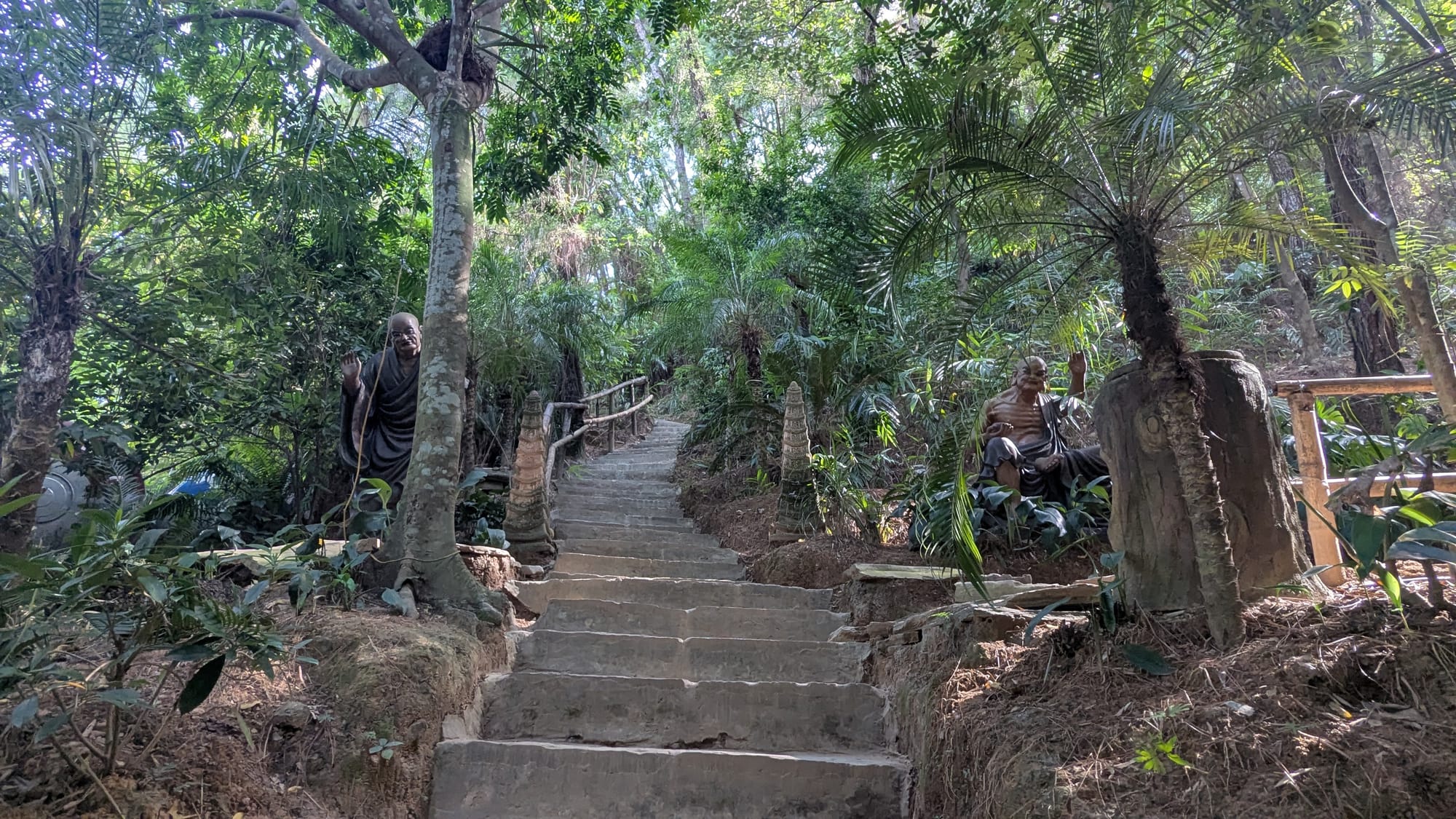
On rainy days, I exercise by running up and down the stairwells of my school, but I still get winded climbing up the steep mountain, past smaller statues and several other monk residences, each with a large iron wok hanging outside.
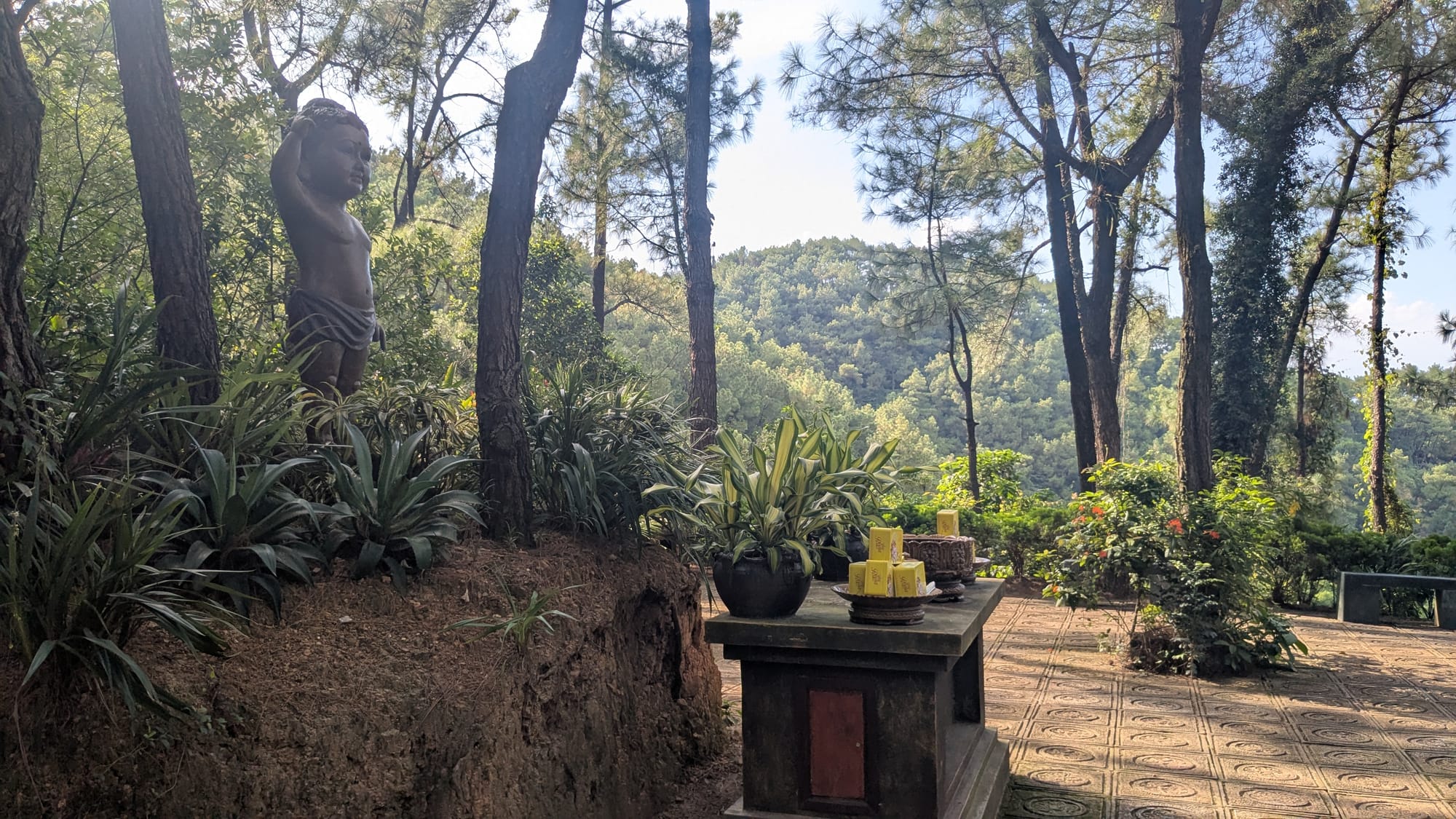
The path up the mountain is steep but broken up by about six stops to rest and pray. The altars here are adorned with statues of the Buddha at different stages of his life. The struggle of climbing up the mountain is a chance to reflect on the spiritual journey of one's life. We are rewarded simply with a grand view of the pagoda complex.
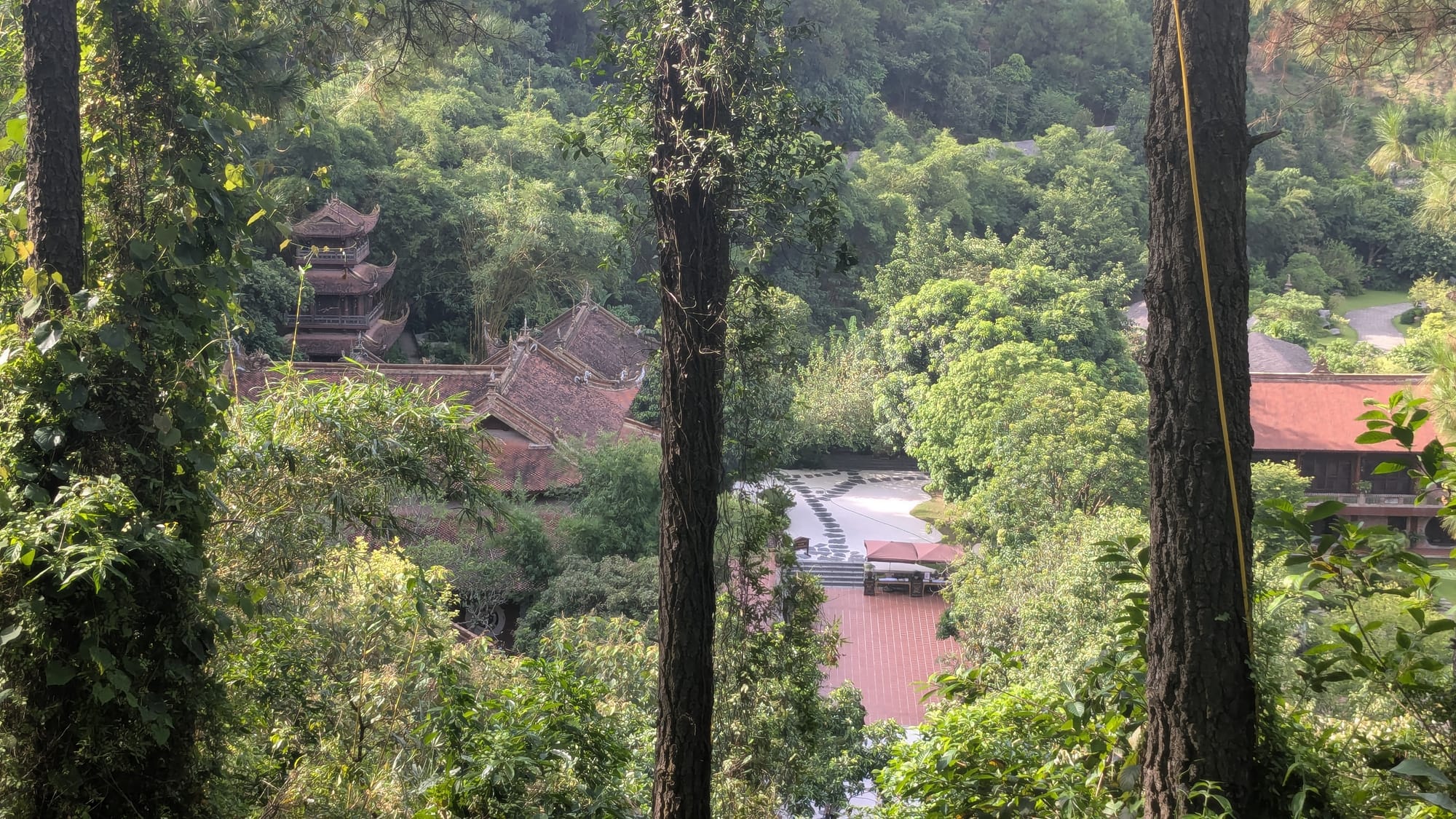
Arriving back down at the bottom, drenched with sweat, a cool breeze is suddenly blowing and everything is now in the shade of the mountain. Tiny chimes hanging from all the trees and buildings are suddenly tinkling, hundreds of them all at once, providing a musical score to our new-found sense of serenity.
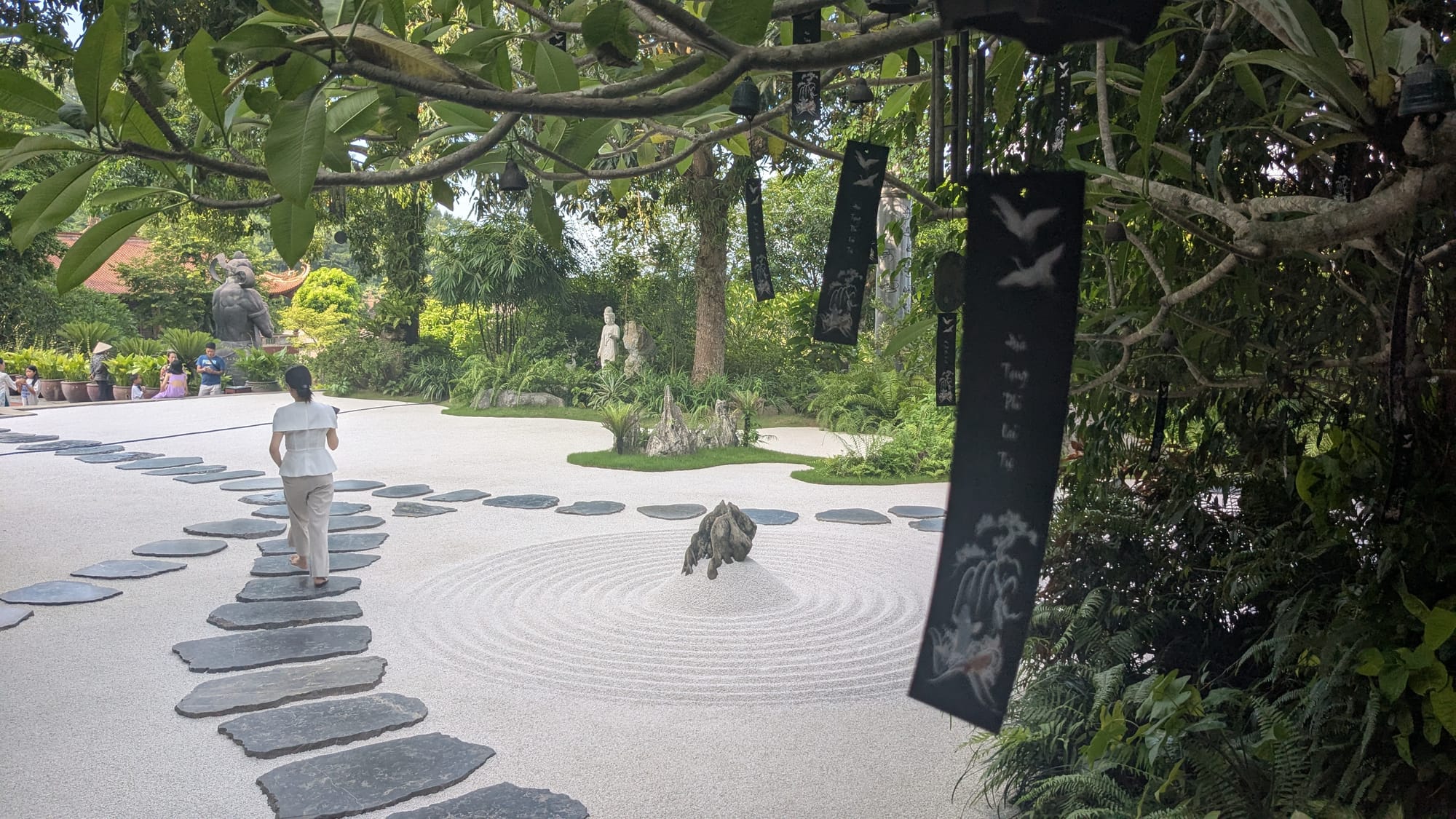
A monk carefully sweeps the path ahead of us. Two female nuns or students in plain brown robes bow their heads to us and smile as they scurry silently past us. Having only been to a few tourist destination pagodas, I have not yet witnessed so much of the daily lives of Buddhist monks going about their day.
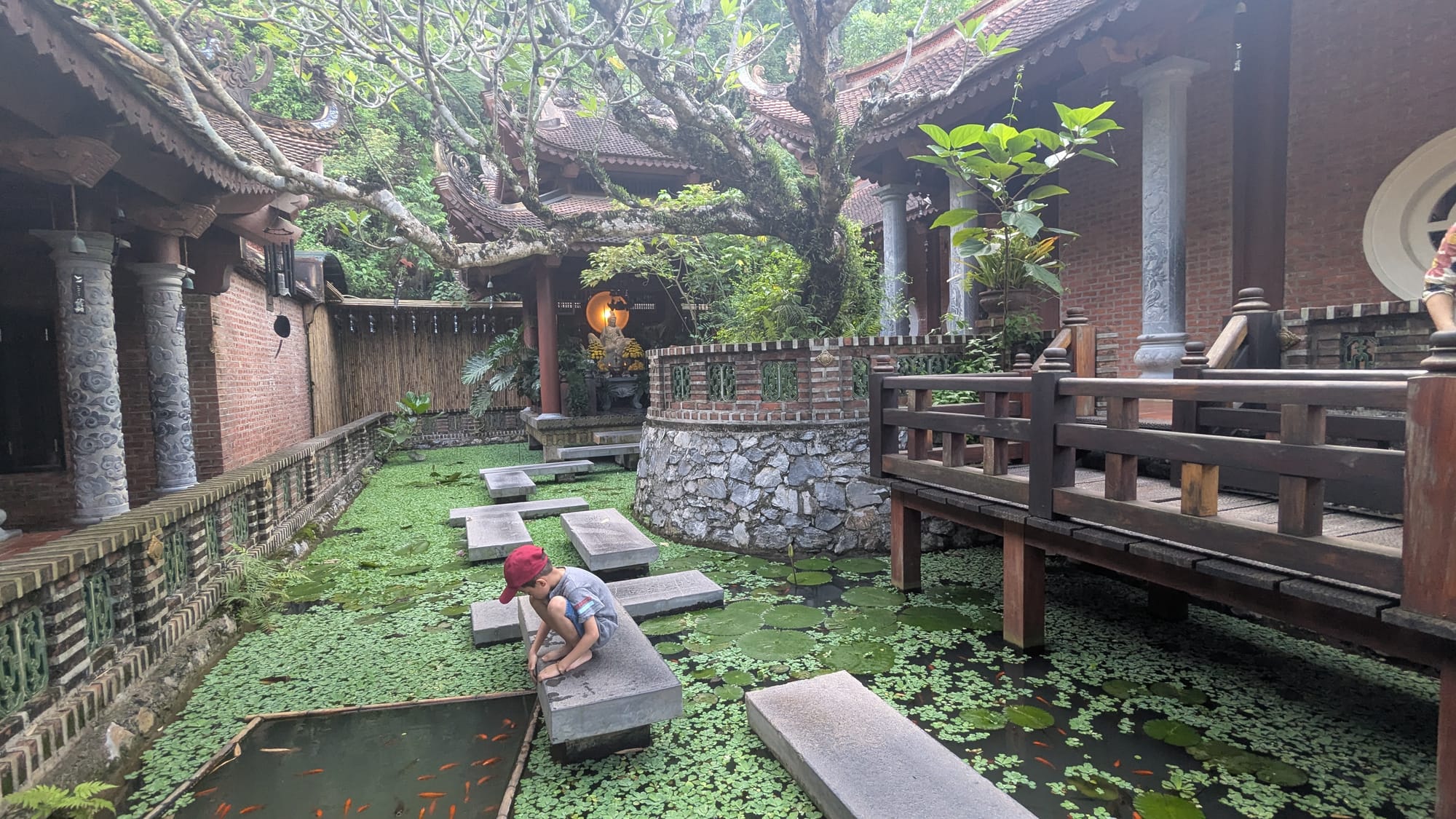
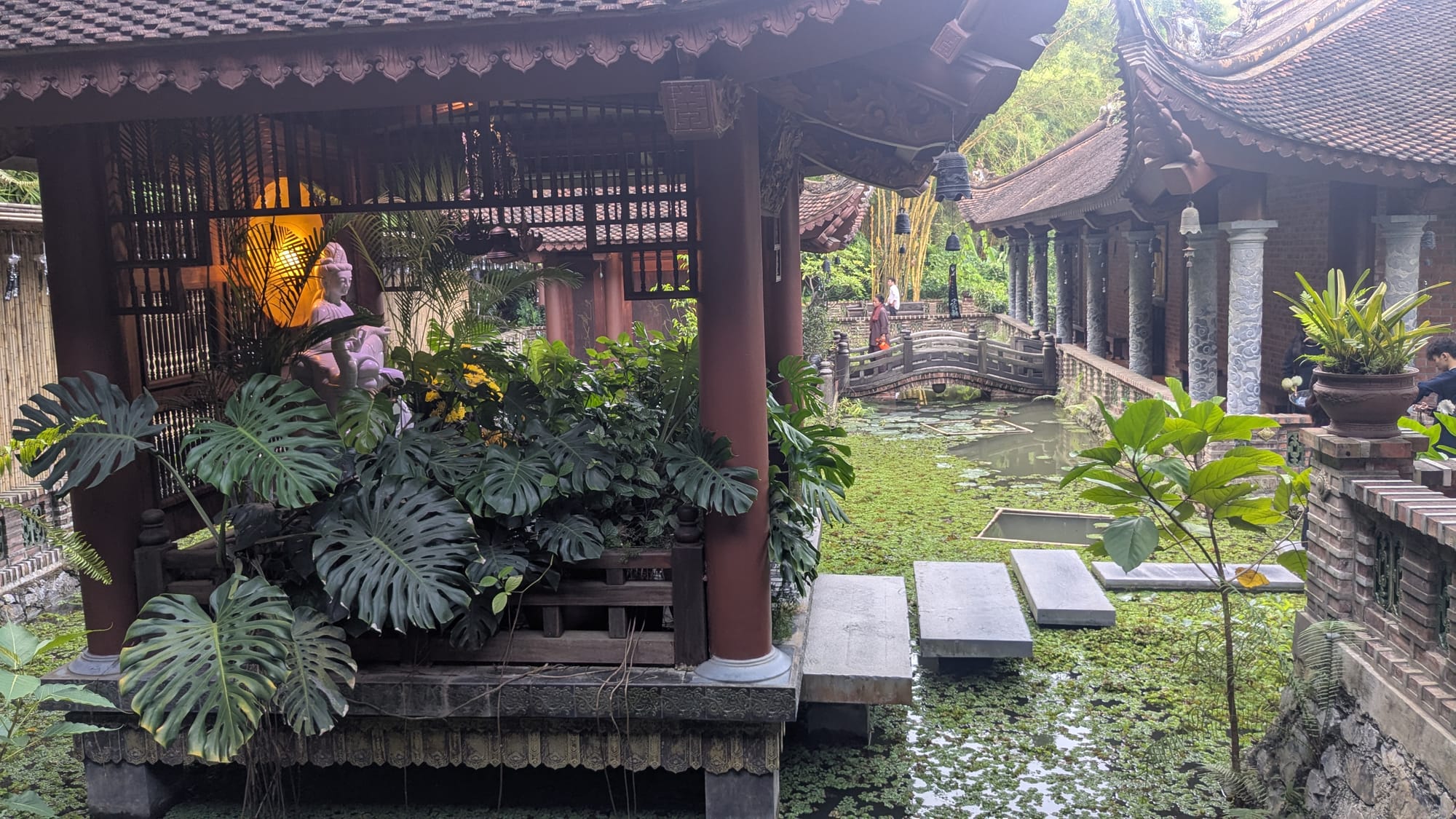
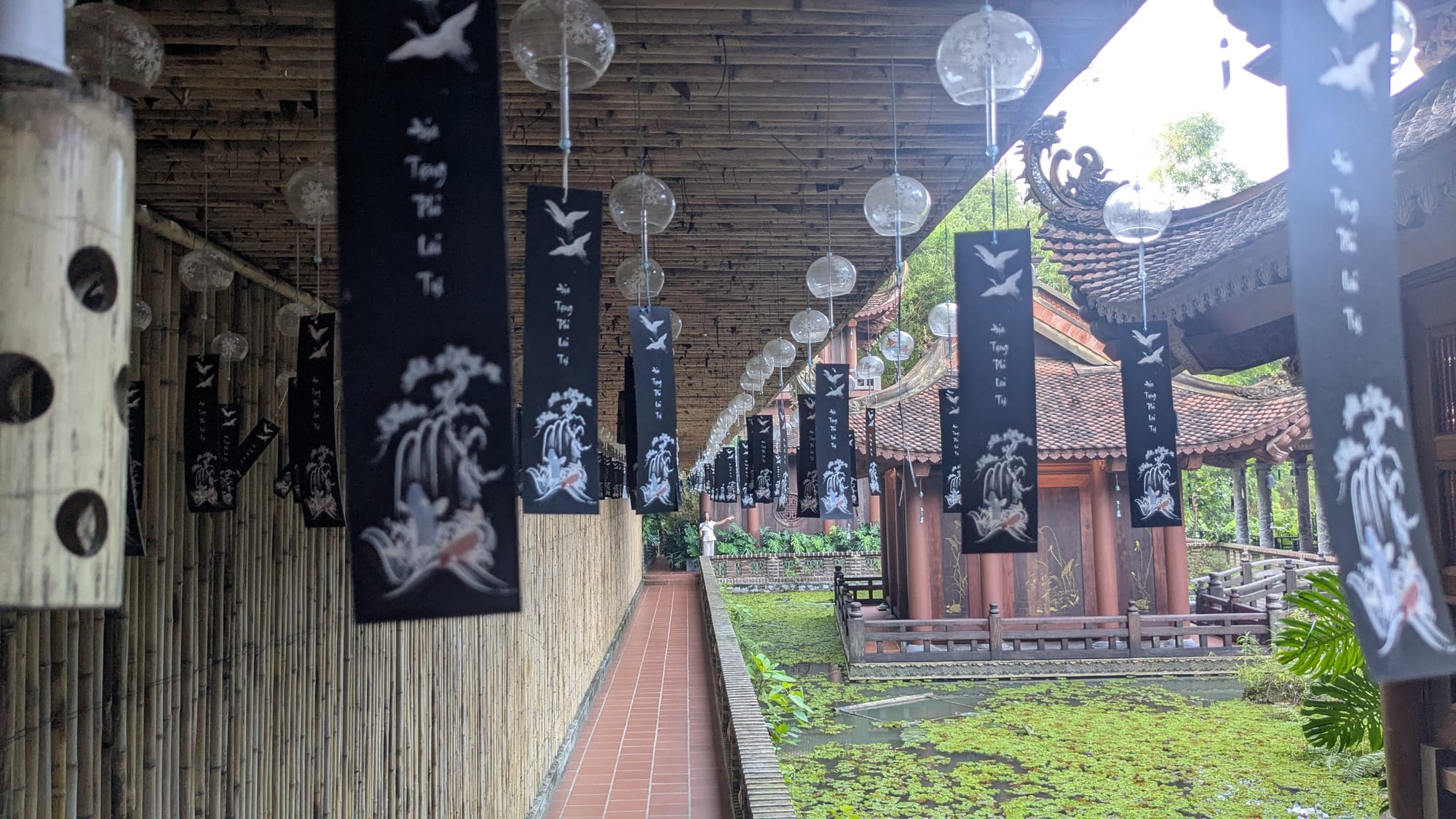
The temple is dedicated to the bodhisattva Kṣitigarbha, a legendary monk whose story probably originates from China, who vowed not to achieve buddhahood until all souls in hell are saved and released.
On the road back, I ask Hải why so many Vietnamese visit Buddhist pagodas even though they are often not Buddhist. He tells me both Buddhist and non-Buddhist pagodas are carefully designed to create a sense of peace and help you stop to reflect on yourself.
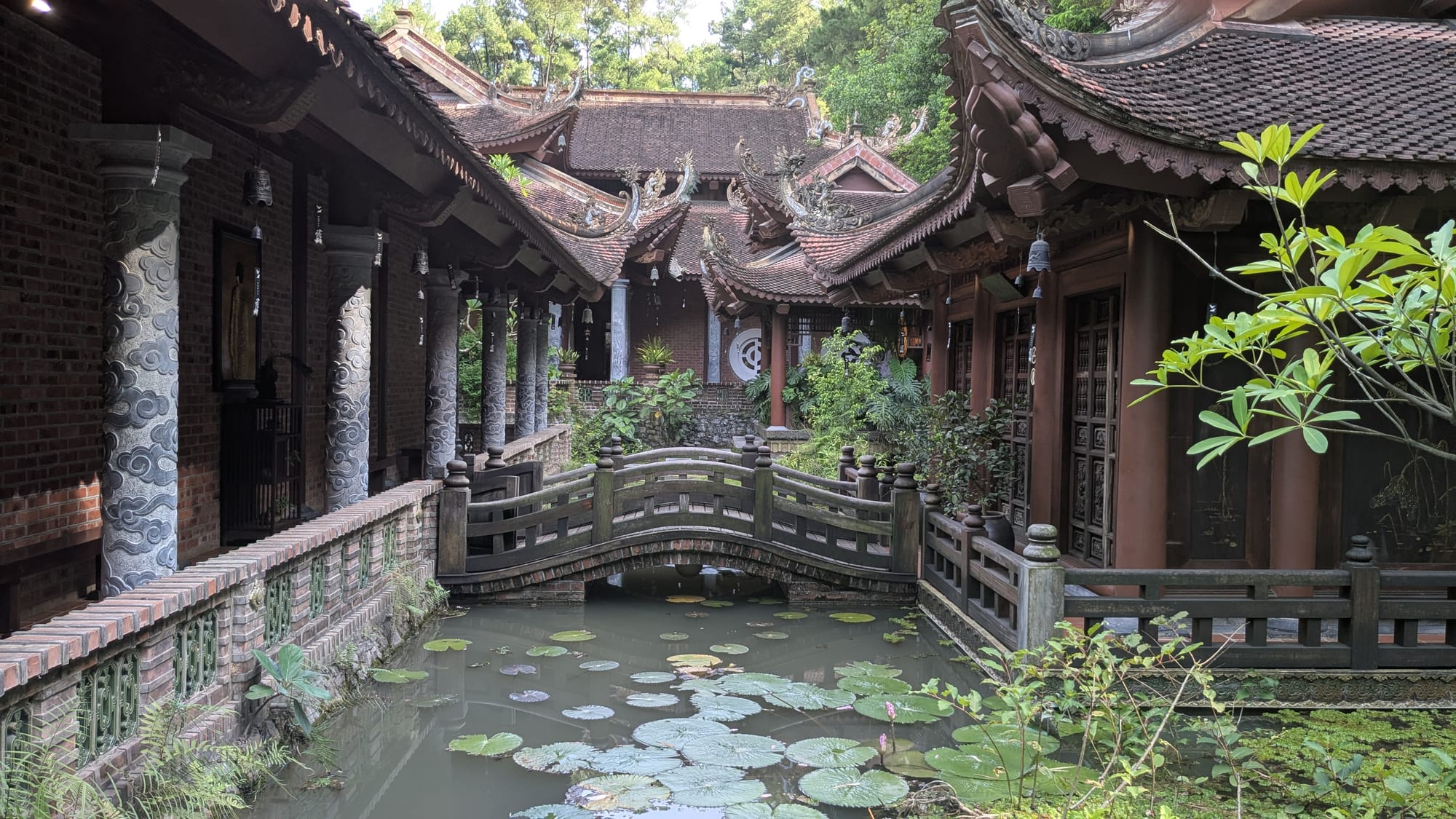
"I felt that here much more than the over-crowded pagodas that tourists go to in Hà Nội," I offer. "I think I understand that better now."
He also reiterates how much Vietnamese care about their heritage and ancestors.
"When you return to the US, will you visit the grave of your grandparents?"
I chuckle. "I guess it sounds a little sad, but no I won't. I never have."
Hải looks very uncomfortable at this admission.
"We don't believe that we need to go there to talk to them. Their spirits left there. Our heaven is above us and all around us. So if I want to talk to them or pray to them, I can do that anywhere."
"Oh, okay." He sounds relieved.
But I really admire the ritual aspect of remembering your ancestors in Vietnamese culture, because when something is easy, you sometimes don't appreciate it like you should. The ritual of going and burning incense on certain days ensures that you remember and show respect for those who have gone before you.